
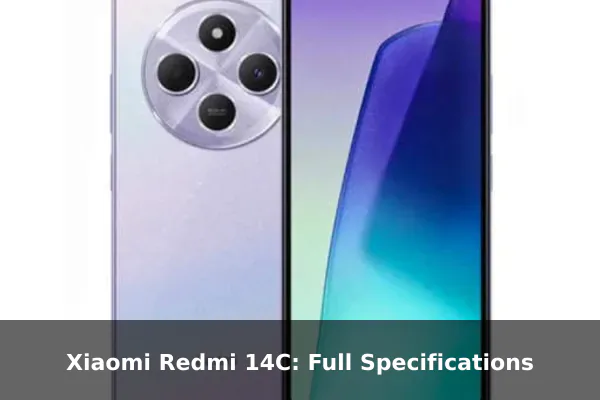
The Xiaomi Redmi 14C lands as one of the most accessible entries in the brand’s 2024 lineup, aimed at shoppers who want a roomy display, dependable battery life, and a recognizable Xiaomi software experience without stretching their budget. Announced on August 30, 2024, it carries an indicative price of around €89.04 / $110.70 / £83.70, placing it firmly in the entry-level tier where every specification choice has to justify itself.
Rather than chasing flagship benchmarks, the Redmi 14C focuses on the fundamentals: a 6.88-inch 120Hz screen, a 5160 mAh battery, a 50 MP main camera, and the MediaTek Helio G81 Ultra chipset running Android 14 with HyperOS. This article looks at how those choices come together and who actually stands to benefit from picking this phone over its many siblings and rivals.
Full Specifications
Network
| Technology: | GSM / HSPA / LTE |
| 2G bands: | GSM 850 / 900 / 1800 / 1900 |
| 3G bands: | HSDPA 850 / 900 / 2100 |
| 4G bands: | 1, 3, 5, 7, 8, 20, 28, 38, 40, 41 |
| Speed: | HSPA, LTE |
Launch
| Announced: | 2024, August 30 |
| Status: | Available. Released 2024, August 30 |
Body
| Dimensions: | 171.9 x 77.8 x 8.2 mm (6.77 x 3.06 x 0.32 in) |
| Weight: | 204 / 207 / 211 g (7.20 oz) |
| Build: | Glass front (Gorilla Glass 3), plastic frame, glass back or silicone polymer (eco leather) back |
| SIM: | Nano-SIM + Nano-SIM |
| Dust and splash resistant |
Display
| Type: | IPS LCD, 120Hz, 450 nits (typ), 600 nits (HBM) |
| Size: | 6.88 inches, 112.4 cm2 (~84.0% screen-to-body ratio) |
| Resolution: | 720 x 1640 pixels (~260 ppi density) |
| Protection: | Corning Gorilla Glass 3 |
Platform
| OS: | Android 14, HyperOS |
| Chipset: | Mediatek Helio G81 Ultra (12 nm) |
| CPU: | Octa-core (2×2.0 GHz Cortex-A75 & 6×1.8 GHz Cortex-A55) |
| GPU: | Mali-G52 MC2 |
Memory
| Card slot: | microSDXC (dedicated slot) |
| Internal: | 64GB 4GB RAM, 128GB 4GB RAM, 128GB 6GB RAM, 128GB 8GB RAM, 256GB 4GB RAM, 256GB 8GB RAM |
| eMMC 5.1 |
Main Camera
| Dual: | 50 MP, f/1.8, 28mm (wide), 1/2.96″, PDAF or 50 MP, f/1.8, 28mm (wide), 1/2.76″, 0.64µm, PDAF QVGA, f/3.0 |
| Features: | LED flash, HDR |
| Video: | 1080p@30fps |
Selfie camera
| Single: | 13 MP, f/2.0, (wide), 1/3.06″ |
| Features: | HDR |
| Video: | 1080p@30fps |
Sound
| Loudspeaker: | Yes |
| 3.5mm jack: | Yes |
Comms
| WLAN: | Wi-Fi 802.11 a/b/g/n/ac, dual-band, Wi-Fi Direct |
| Bluetooth: | 5.4, A2DP, LE |
| Positioning: | GPS, GLONASS, GALILEO, BDS |
| NFC: | Yes (market/region dependent) |
| Radio: | FM radio |
| USB: | USB Type-C 2.0, OTG |
Features
| Sensors: | Fingerprint (side-mounted), accelerometer, compass |
| Virtual proximity sensing |
Battery
| Type: | 5160 mAh |
| Charging: | 18W wired, PD |
Misc
| Colors: | Midnight Black, Sage Green, Dreamy Purple, Starry Blue |
| Models: | 2411DRN47C, 2409BRN2CA, 2409BRN2CG, 2409BRN2CY |
| SAR EU: | 0.99 W/kg (head) 0.90 W/kg (body) |
| Price: | € 89.04 / $ 110.70 / £ 83.70 |
Price and Availability
The Xiaomi Redmi 14C offers a compelling combination of features and performance. While the base price is around €89, the actual cost may vary depending on your location and retailer. Below, you’ll find the approximate price of the Xiaomi Redmi 14C converted into various currencies. Please note that these are estimates based on recent exchange rates as of May 24, 2026 and may not reflect the exact price you’ll find at a retailer.
- United States: $103
- Japan: ¥16,442
- United Kingdom: £77
- Australia: A$145
- Canada: C$143
- Taiwan: NT$3,253
- Denmark: kr664
- Saudi Arabia: ﷼387
- South Korea: ₩156,472
- Germany: €89
- Brazil: R$517
- Vietnam: ₫2.701.352
- Kenya: KSh 13,415
- India: ₹9,898
- Indonesia: Rp 1.828.416
- Nigeria: ₦140,389
- Pakistan: ₨28,822
- Philippines: ₱6,368
- Bangladesh: ৳১২,৭০২
Value Positioning in the Entry-Level Segment
At roughly €89 / $111 / £84 according to the source listing, the Redmi 14C sits in a price band where buyers usually accept compromises in either screen size, battery capacity, or software polish. Xiaomi’s approach here is to keep the headline numbers generous, large display, large battery, multiple storage tiers up to 256 GB, while controlling cost through an IPS LCD panel, a 12 nm chipset, and 18W charging. Pricing and availability can vary by region and retailer, so the figures above should be treated as indicative rather than fixed.
Design and Build Choices
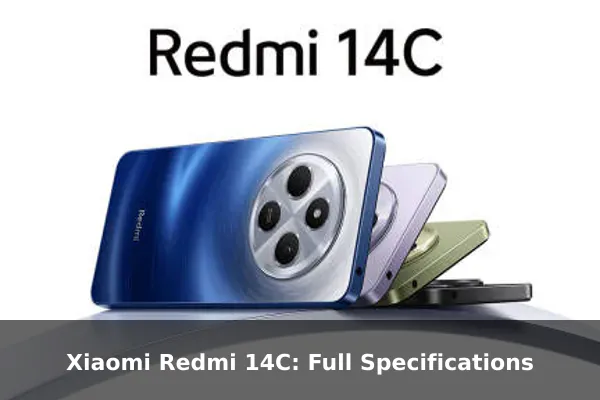
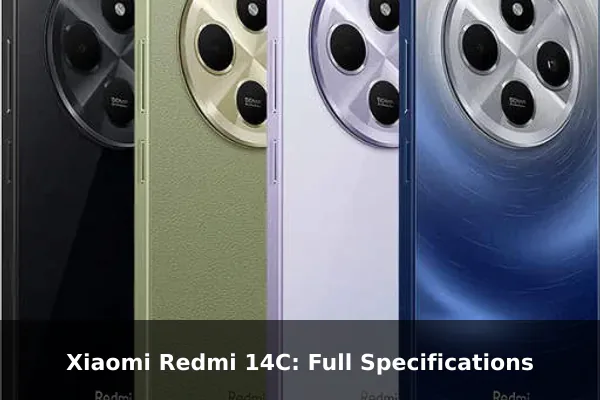
The Redmi 14C measures 171.9 x 77.8 x 8.2 mm and weighs between 204 and 211 g depending on the back finish. Xiaomi pairs a Gorilla Glass 3 front and plastic frame with either a glass back or a silicone polymer eco-leather back, and lists Midnight Black, Sage Green, Dreamy Purple, and Starry Blue as color options. It is described as dust and splash resistant rather than carrying a formal IP rating, so it is best treated as protected against everyday exposure, not submersion.
Display Experience
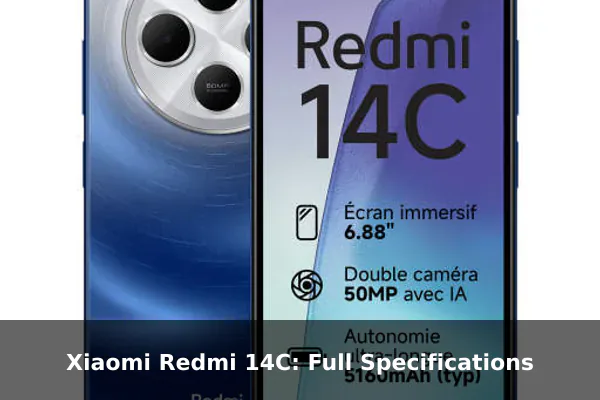
The 6.88-inch IPS LCD runs at 120Hz with a 720 x 1640 resolution, giving an approximate pixel density of 260 ppi and a screen-to-body ratio near 84 percent. Brightness is quoted at 450 nits typical and 600 nits in high brightness mode, which is enough for shaded outdoor use but will struggle under direct sunlight. The combination of a high refresh rate with a HD+ resolution is a deliberate trade-off: smoother scrolling now takes priority over sharpness, which is unusual at this price.
Performance and Software
Inside is the MediaTek Helio G81 Ultra on a 12 nm process, an octa-core CPU with two Cortex-A75 cores at 2.0 GHz and six Cortex-A55 cores at 1.8 GHz, paired with a Mali-G52 MC2 GPU and eMMC 5.1 storage. RAM and storage options range from 4 GB / 64 GB up to 8 GB / 256 GB, and a dedicated microSDXC slot keeps expansion simple. Out of the box it ships with Android 14 and HyperOS; long-term update commitments for this tier are typically shorter than for Xiaomi’s mid-range and flagship lines, so prospective buyers should verify the policy for their specific market.
Cameras for Everyday Use
The rear camera system is built around a 50 MP f/1.8 wide sensor with PDAF, listed in two sensor variants (1/2.96″ and 1/2.76″ with 0.64 µm pixels), accompanied by a low-resolution QVGA auxiliary sensor and an LED flash. Video tops out at 1080p at 30 fps from both the main and 13 MP f/2.0 selfie cameras. In practice, this hardware is geared toward well-lit social shots and document capture rather than night photography or stabilized video work.
Battery and Charging
A 5160 mAh battery is one of the strongest selling points, comfortably supporting all-day use for messaging, browsing, and video at the panel’s modest resolution. Charging is rated at 18W wired with PD support, which is functional but noticeably slower than the 33W and higher solutions found in step-up Redmi Note models, so overnight or longer top-up sessions should be expected.
Connectivity and Practical Extras
Connectivity covers the essentials for this segment: dual nano-SIM, 4G LTE across common European and Asian bands, dual-band Wi-Fi 5 (a/b/g/n/ac), Bluetooth 5.4, GPS with GLONASS, Galileo and BDS, FM radio, and USB Type-C 2.0 with OTG. NFC is listed as market and region dependent, so contactless payment support cannot be assumed without checking the local variant. A side-mounted fingerprint sensor and a retained 3.5 mm headphone jack round out the practical touches.
Who Should Consider the Redmi 14C
This phone is best suited to first-time smartphone buyers, students on a tight budget, and anyone needing a reliable secondary device for calls, messaging, and media. Users who prioritize gaming performance, sharp display content, fast charging, or advanced camera capabilities should look at the Redmi Note 14 series or comparable mid-range alternatives instead.
Conclusion
The Xiaomi Redmi 14C is a sensible entry-level pick that leans on a large 120Hz display, a 5160 mAh battery, and flexible storage tiers to justify its sub-€100 positioning, while accepting an HD+ panel, modest 18W charging, and a basic camera setup as the trade-offs. If your priority is dependable daily use at the lowest reasonable price and you can confirm the specific variant and NFC availability in your region, it is an easy phone to recommend; if you need stronger performance, faster charging, or a sharper screen, a step up to a Redmi Note model will serve you better.
Official references
- Xiaomi Global – Redmi 14C Specs – Primary manufacturer specifications for processor, RAM/storage variants, dimensions, display, cameras, battery, bands, sensors, OS, and package contents.
- Xiaomi Global – Redmi 14C Product Page – Official product overview for headline features, launch positioning, design colors, feature notes, and Xiaomi disclaimers about regional variation.
- Xiaomi Global Compliance – Official Xiaomi compliance/document repository that lists Redmi 14C, useful for checking regulatory documents and product safety/compliance references.
- MediaTek Helio G81 – Primary chipset vendor reference for the Helio G81 platform family used as the basis for Redmi 14C processor claims.
- FCC Equipment Authorization System (fcc.gov) – Primary US regulator database for verifying FCC filings, radio certifications, SAR, and model/FCC ID details for relevant Redmi 14C variants.
