
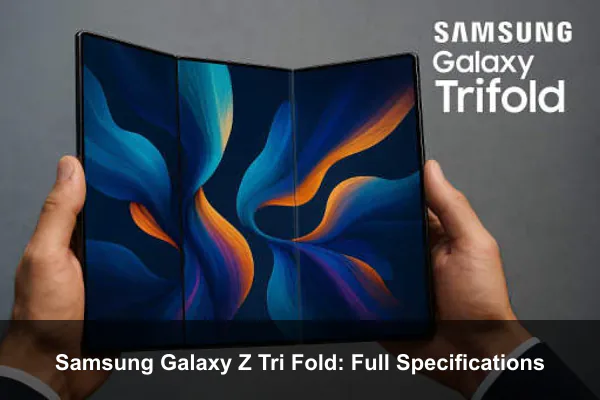
Samsung has pushed foldable design into uncharted territory with the Galaxy Z Tri Fold, a device that unfolds twice to reveal a tablet-sized 10.0-inch canvas. Announced on December 2, 2025 and released ten days later, this triple-folding flagship blends a Snapdragon 8 Elite engine, a 200 MP main camera, and a titanium-reinforced hinge system into a body that still slips into a pocket when folded.
Priced at roughly 2100 EUR in its South Korean debut, the Galaxy Z Tri Fold is unmistakably a halo product. This article looks beyond the spec sheet to explain what the tri-fold form factor actually changes, where Samsung made smart engineering trade-offs, and which type of buyer will get the most out of this ambitious machine.
Full Specifications
Network
| Technology: | GSM / CDMA / HSPA / EVDO / LTE / 5G |
| 2G bands: | GSM 850 / 900 / 1800 / 1900 |
| CDMA 800 / 1900 | |
| 3G bands: | HSDPA 850 / 900 / 1700(AWS) / 1900 / 2100 |
| CDMA2000 1xEV-DO | |
| 4G bands: | LTE |
| 5G bands: | SA/NSA/Sub6 |
| Speed: | HSPA, LTE, 5G |
Launch
| Announced: | 2025, December 02 |
| Status: | Available. Released 2025, December 12 |
Body
| Dimensions: | Unfolded: 159.2 x 214.1 x 3.9-4.2 mmFolded: 159.2 x 75 x 12.9 mm |
| Weight: | 309 g (10.90 oz) |
| Build: | Glass front (Gorilla Glass Victus Ceramic 2) (folded), plastic front (unfolded), ceramic-glass fiber-reinforced polymer back, aluminum frame, titanium hinge housing |
| SIM: | · Nano-SIM + Nano-SIM + eSIM + eSIM (max 2 at a time)· Nano-SIM + Nano-SIM + multiple eSIM (max 2 at a time)· Nano-SIM + Nano-SIM |
| IP48 dust and water resistant (dust > 1mm; immersible up to 1.5m for 30 min) Advanced Armor aluminum frame |
Display
| Type: | Tri-foldable Dynamic LTPO AMOLED 2X, 120Hz, HDR, 1600 nits (peak) |
| Size: | 10.0 inches, 305.4 cm2 (~89.6% screen-to-body ratio) |
| Resolution: | 1584 x 2160 pixels, 4:3 ratio (~269 ppi density) |
| Dynamic LTPO AMOLED 2X, 120Hz, HDR, 2600 nits (peak), Corning Gorilla Glass Ceramic 2 6.5 inches, 1080 x 2520 pixels, 422 ppi |
Platform
| OS: | Android 16, One UI 8 |
| Chipset: | Qualcomm SM8750-AC Snapdragon 8 Elite (3 nm) |
| CPU: | Octa-core (2×4.47 GHz Oryon V2 Phoenix L + 6×3.53 GHz Oryon V2 Phoenix M) |
| GPU: | Adreno 830 (1200 MHz) |
Memory
| Card slot: | No |
| Internal: | 512GB 16GB RAM, 1TB 16GB RAM |
| UFS |
Main Camera
| Triple: | 200 MP, f/1.7, 24mm (wide), 1/1.3″, 0.6µm, multi-directional PDAF, OIS 10 MP, f/2.4, 67mm (telephoto), 1/3.94″, 1.0µm, PDAF, OIS, 3x optical zoom 12 MP, f/2.2, 13mm, 120˚ (ultrawide), 1/2.55″, 1.4µm, dual pixel PDAF |
| Features: | LED flash, HDR, panorama |
| Video: | 8K@30fps, 4K@60fps, 1080p@60/120/240fps (gyro-EIS), 10-bit HDR, HDR10+ |
Selfie camera
| Single: | 10 MP, f/2.2, 18mm (ultrawide), 1/3.0″, 1.12µm Cover camera: 10 MP, f/2.2, 24mm (wide), 1/3.0″, 1.12µm |
| Features: | HDR |
| Video: | 4K@30/60fps, 1080p@30/60fps, gyro-EIS |
Sound
| Loudspeaker: | Yes, with stereo speakers |
| 3.5mm jack: | No |
Comms
| WLAN: | Wi-Fi 802.11 a/b/g/n/ac/6e/7, tri-band, Wi-Fi Direct |
| Bluetooth: | 5.4, A2DP, LE, aptX HD |
| Positioning: | GPS, GALILEO, GLONASS, BDS, QZSS |
| NFC: | Yes |
| Radio: | No |
| USB: | USB Type-C |
Features
| Sensors: | Fingerprint (side-mounted), accelerometer, gyro, proximity, compass, barometer |
| Samsung DeX wireless (desktop experience support) |
Battery
| Type: | Li-Ion 5600 mAh |
| Charging: | 45W wired, QC2.0, 50% in 30 min 15W wireless 4.5W reverse wireless |
Misc
| Colors: | Crafted Black |
| Models: | SM-D639B, SM-D639B/DS, SM-D639U, SM-D639U1, SM-D639N, SM-D6390 |
| Price: | About 2100 EUR (price in S. Korea) |
Price and Availability
The Samsung Galaxy Z Tri Fold offers a compelling combination of features and performance. While the base price is around €2.100, the actual cost may vary depending on your location and retailer. Below, you’ll find the approximate price of the Samsung Galaxy Z Tri Fold converted into various currencies. Please note that these are estimates based on recent exchange rates as of June 15, 2026 and may not reflect the exact price you’ll find at a retailer.
- United States: $2,433
- Japan: ¥389,639
- United Kingdom: £1,813
- Australia: A$3,447
- Canada: C$3,402
- Taiwan: NT$77,022
- Denmark: kr15.668
- Saudi Arabia: ﷼9,123
- South Korea: ₩3,692,689
- Germany: €2.100
- Brazil: R$12.361
- Vietnam: ₫63.774.639
- Kenya: KSh 314,934
- India: ₹2,31,476
- Indonesia: Rp 43.449.733
- Nigeria: ₦3,299,266
- Pakistan: ₨677,642
- Philippines: ₱147,563
- Bangladesh: ৳২,৯৯,০২৬
Why the Tri-Fold Form Factor Matters
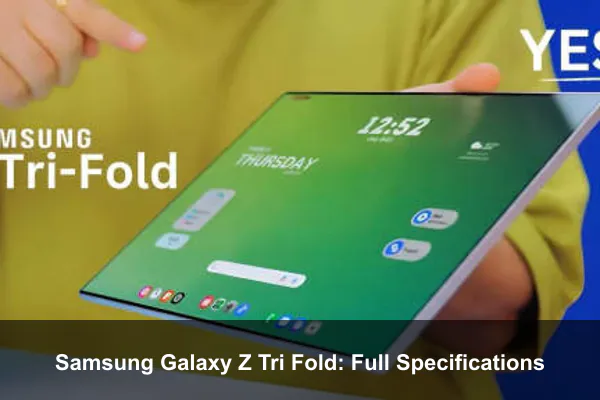
The defining feature here is the dual-hinge design. Where a typical book-style foldable opens once, the Galaxy Z Tri Fold folds twice, so a phone-sized 6.5-inch cover panel expands into a near-square 10.0-inch interior display. That 4:3 ratio is closer to a true tablet than the tall, narrow panels found on most foldables, making it far more comfortable for reading documents, splitting three apps side by side, or watching films without heavy letterboxing. It is a genuinely different category of device rather than an incremental update.
Design and Build Quality
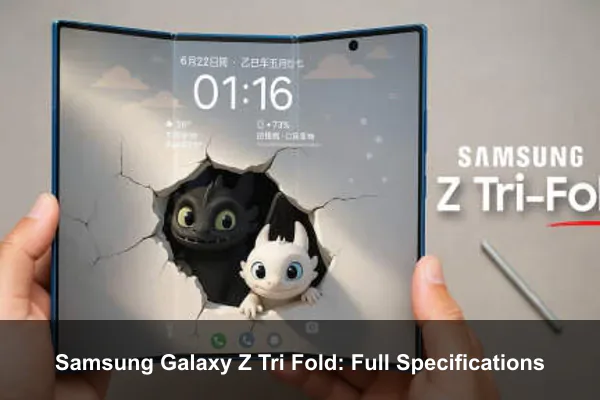
Folded, the phone measures 159.2 x 75 x 12.9 mm and weighs 309 g, so it is noticeably thicker and heavier than a slab phone but still manageable in one hand. Unfolded, it thins out to between 3.9 and 4.2 mm. Samsung leans on premium materials throughout: Gorilla Glass Victus Ceramic 2 on the cover, a ceramic glass-fiber-reinforced polymer back, an aluminum Advanced Armor frame, and a titanium hinge housing to absorb the stress of two folding axes. IP48 dust and water resistance is reassuring for a mechanism this complex, with immersion protection up to 1.5 m for 30 minutes.
Display Experience
Both screens are Dynamic LTPO AMOLED 2X panels with 120Hz refresh and HDR. The 10.0-inch main display runs at 1584 x 2160 pixels and peaks at 1600 nits, while the 6.5-inch cover screen is sharper at 422 ppi and brighter still at 2600 nits peak, so outdoor visibility on the everyday cover panel is excellent. The LTPO technology lets the refresh rate scale dynamically to conserve power, and the large interior surface is where this device justifies itself for multitasking and media.
Performance and Storage
The Galaxy Z Tri Fold is built on the Qualcomm Snapdragon 8 Elite (SM8750-AC), a 3 nm chip pairing two high-clocked 4.47 GHz Oryon V2 Phoenix L cores with six 3.53 GHz Phoenix M cores, backed by the Adreno 830 GPU. With a fixed 16GB of RAM and a choice of 512GB or 1TB of UFS storage, it is engineered to keep multiple demanding apps live across that expansive display. There is no microSD slot, so picking the right storage tier at purchase is important.
Camera System
Imaging is led by a 200 MP f/1.7 wide sensor with OIS and multi-directional PDAF, supported by a 10 MP 3x optical telephoto and a 12 MP 120-degree ultrawide. Video tops out at 8K@30fps with 10-bit HDR10+ capture. For selfies and calls there are two 10 MP cameras, one inside and one on the cover, so you can frame yourself on whichever screen suits the moment. The flexible form factor also doubles as its own tripod, opening creative angles that fixed-body phones cannot match.
Battery and Charging
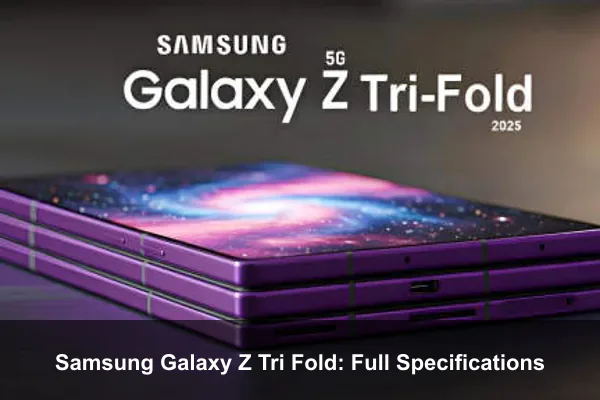
A 5600 mAh Li-Ion battery powers the trio of folding panels. Charging reaches 45W wired with QC2.0, hitting 50% in around 30 minutes, alongside 15W wireless and 4.5W reverse wireless to top up earbuds or a watch. Given the larger interior display, the capacity is sensible rather than class-leading, and the LTPO panels help stretch endurance during lighter use.
Software and Productivity
It ships with Android 16 under One UI 8, and Samsung DeX wireless turns the device into a desktop-style workspace on an external display. The combination of a tablet-class screen, abundant RAM, and DeX makes this one of the most capable mobile productivity tools Samsung has ever shipped, leaning into the tri-fold’s strengths for on-the-go work.
Connectivity
Connectivity is comprehensive: Wi-Fi 7 with tri-band support, Bluetooth 5.4 with aptX HD, NFC, USB Type-C, and full 5G with SA/NSA/Sub6 bands. Positioning covers GPS, Galileo, GLONASS, BDS, and QZSS. The flexible SIM setup supports dual Nano-SIM plus eSIM combinations, suiting frequent travelers who manage multiple lines.
Who Should Buy It
The Galaxy Z Tri Fold is aimed at early adopters, mobile professionals, and tech enthusiasts who want the largest pocketable screen available and can absorb a flagship-plus price. If you value multitasking, media, and a genuine tablet experience that collapses into a phone, this delivers something nothing else on the market does.
Conclusion
The Samsung Galaxy Z Tri Fold is a statement device that turns the foldable concept up a level, pairing a 10.0-inch tri-folding display with top-tier silicon, a versatile 200 MP camera, and serious build engineering. Its weight, thickness, and roughly 2100 EUR price keep it firmly in enthusiast territory, and the modest 45W charging is its clearest compromise. If you want the most ambitious productivity-focused foldable money can buy and the cost is not a barrier, it earns a strong recommendation; mainstream buyers will be better served by a conventional book-style foldable or a flagship slab.
