
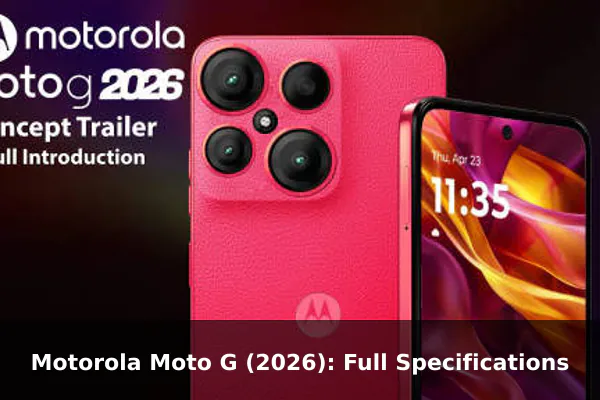
The Motorola Moto G (2026) is a budget 5G Android phone built around practical everyday hardware rather than headline-chasing extras. Its key pitch is simple: a large 120Hz display, Android 16, a Dimensity 6300 chipset, a 5200mAh battery, stereo speakers, expandable storage, NFC, and a headphone jack at a price class aimed at value-first buyers.
This article looks beyond the raw specification sheet to explain what those numbers mean in daily use. The full specifications table will handle the line-by-line details separately, while this analysis focuses on value, compromises, and the type of user who should consider the Moto G (2026).
Full Specifications
Network
| Technology: | GSM / HSPA / LTE / 5G |
| 2G bands: | GSM 850 / 900 / 1800 / 1900 |
| 3G bands: | HSDPA 850 / 900 / 1700(AWS) / 1900 / 2100 |
| 4G bands: | 1, 2, 3, 4, 5, 7, 8, 12, 13, 14, 17, 18, 20, 25, 26, 28, 29, 30, 38, 39, 40, 41, 48, 66, 71 |
| 5G bands: | 2, 5, 7, 12, 14, 25, 26, 29, 30, 41, 48, 66, 70, 71, 77, 78 SA/NSA/Sub6 |
| Speed: | HSPA, LTE, 5G |
Launch
| Announced: | 2025, November 05 |
| Status: | Available. Released 2025, December 11 |
Body
| Dimensions: | 167.2 x 76.4 x 8.5 mm (6.58 x 3.01 x 0.33 in) |
| Weight: | 202 g (7.13 oz) |
| Build: | Glass front (Gorilla Glass 3), silicone polymer (eco leather) back, plastic frame |
| SIM: | Nano-SIM + eSIM |
| Water-repellent design |
Display
| Type: | IPS LCD, 120Hz, 1000 nits (peak) |
| Size: | 6.7 inches, 108.2 cm2 (~84.7% screen-to-body ratio) |
| Resolution: | 720 x 1604 pixels, 20:9 ratio (~262 ppi density) |
| Protection: | Corning Gorilla Glass 3 |
Platform
| OS: | Android 16 |
| Chipset: | Mediatek Dimensity 6300 (6 nm) |
| CPU: | Octa-core (2×2.4 GHz Cortex-A76 & 6×2.0 GHz Cortex-A55) |
| GPU: | Mali-G57 MC2 |
Memory
| Card slot: | microSDXC (dedicated slot) |
| Internal: | 128GB 4GB RAM |
Main Camera
| Dual: | 50 MP, f/1.8, (wide), 0.61µm, PDAF 2 MP (macro) |
| Features: | LED flash, HDR, panorama |
| Video: | 1080p@30fps |
Selfie camera
| Single: | 32 MP, f/2.2, (wide), 0.64µm |
| Video: | 1080p@30fps |
Sound
| Loudspeaker: | Yes, with stereo speakers (with Dolby Atmos) |
| 3.5mm jack: | Yes |
| 24-bit/192kHz Hi-Res audio |
Comms
| WLAN: | Wi-Fi 802.11 a/b/g/n/ac, dual-band |
| Bluetooth: | Yes |
| Positioning: | GPS, GALILEO, GLONASS |
| NFC: | Yes |
| Radio: | No |
| USB: | USB Type-C 2.0 |
Features
| Sensors: | Fingerprint (side-mounted), accelerometer, gyro, proximity, compass, barometer |
Battery
| Type: | 5200 mAh |
| Charging: | 30W wired |
Misc
| Colors: | Pantone: Slipstream, Cattleya Orchid |
| Price: | About 170 EUR |
Price and Availability
The Motorola Moto G (2026) offers a compelling combination of features and performance. While the base price is around €170, the actual cost may vary depending on your location and retailer. Below, you’ll find the approximate price of the Motorola Moto G (2026) converted into various currencies. Please note that these are estimates based on recent exchange rates as of September 26, 2026 and may not reflect the exact price you’ll find at a retailer.
- United States: $194
- Japan: ¥30,522
- United Kingdom: £146
- Australia: A$276
- Canada: C$274
- Taiwan: NT$6,153
- Denmark: kr1.271
- Saudi Arabia: ﷼727
- South Korea: ₩263,344
- Germany: €170
- Brazil: R$1.005
- Vietnam: ₫5.031.066
- Kenya: KSh 25,174
- India: ₹18,555
- Indonesia: Rp 3.462.341
- Nigeria: ₦264,521
- Pakistan: ₨53,636
- Philippines: ₱12,121
- Bangladesh: ৳২৩,৮৩৯
Value Position
The Moto G (2026) sits in the part of the market where small choices matter. Motorola has not tried to turn it into a miniature flagship, and that is probably the right call. Instead, the phone focuses on the features that usually affect daily satisfaction most: battery capacity, network support, display smoothness, storage space, speakers, and charging speed. The source price data lists it at about 170 EUR, while Motorola’s US launch material positioned the model as an affordable unlocked and carrier-ready option. Actual pricing will vary by market, retailer, and carrier plan, so the best way to judge the phone is by its hardware balance rather than one fixed number.
The value angle is strongest if you want a modern 5G phone without paying for premium camera sensors, wireless charging, metal construction, or a high-resolution OLED panel. Compared with ultra-cheap phones, the Moto G (2026) brings better storage, a more capable front camera, NFC, and faster 30W wired charging. Compared with pricier mid-range phones, its main compromises are the HD+ screen resolution, modest 4GB RAM, basic secondary rear camera, and USB 2.0 port.
Design And Build
Motorola gives the Moto G (2026) a practical build with a glass front protected by Gorilla Glass 3, a plastic frame, and a silicone polymer back described as eco leather. That combination is not luxurious in a flagship sense, but it can be a smart fit for a budget phone: the textured rear panel should be easier to grip than glossy plastic, while the 202g weight makes the phone feel substantial without becoming unusually heavy for a 6.7-inch device.
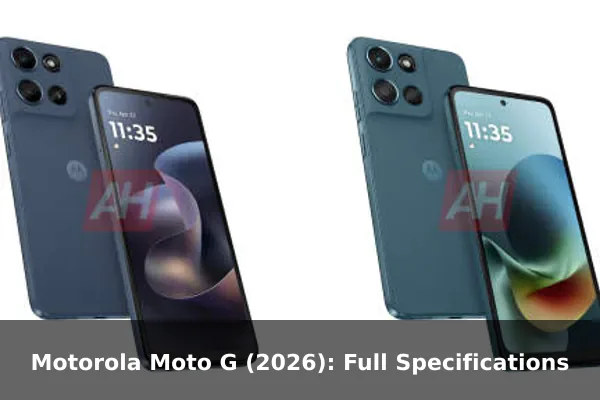
The water-repellent design is useful for light everyday accidents, but it should not be read as a license to submerge the phone or treat it like a rugged handset. Motorola’s own materials describe protection against common mishaps and splashes, which is reassuring for commute, kitchen, or rainy-day use. The Pantone Slipstream and Cattleya Orchid color choices also help the phone avoid the anonymous look that many budget models fall into.
Display Experience
The 6.7-inch IPS LCD is one of the most important parts of the Moto G (2026) experience. Its 120Hz refresh rate should make scrolling, menus, and compatible app animations feel smoother than a standard 60Hz budget display. Peak brightness is listed at 1000 nits, which is a helpful figure for outdoor readability, although real-world visibility will still depend on auto-brightness behavior, reflections, and content.
The tradeoff is resolution. At 720 x 1604 pixels and roughly 262ppi, this is an HD+ panel rather than a sharper Full HD+ display. Text, icons, and fine image detail will not look as crisp as they do on more expensive phones with higher pixel density. For streaming, messaging, maps, social feeds, and casual gaming, the size and refresh rate may matter more to many buyers than the resolution. For readers who are sensitive to text sharpness, this is the first spec to consider carefully.
Performance And Storage
The MediaTek Dimensity 6300 is a sensible chip for this category. Its octa-core CPU pairs two Cortex-A76 performance cores with six Cortex-A55 efficiency cores, and the 6nm process should help with power management. This is not a gaming-first platform, but it is well matched to messaging, browsing, video calls, streaming, navigation, banking apps, and lighter games. The Mali-G57 MC2 GPU can handle casual graphics workloads, but demanding 3D titles will require lowered expectations.
The 128GB internal storage is a meaningful advantage because budget phones can feel cramped quickly once apps, photos, videos, and system files accumulate. The dedicated microSDXC slot is also welcome because it expands media storage without forcing a choice between a second SIM and a memory card. The main limitation is 4GB of RAM. Android 16 can run on it, but heavy multitasking will be less comfortable than on phones with 6GB or 8GB RAM. Motorola’s RAM Boost-style virtual memory can help in some moments, but it is not a full substitute for physical RAM.
Camera Expectations
The Moto G (2026) uses a 50MP main rear camera with PDAF, backed by a 2MP macro camera. The main sensor is the one that matters. In good light, it should be suitable for everyday snapshots, documents, social posts, and family photos. HDR and panorama support add basic flexibility, while 1080p video at 30fps keeps recording expectations modest and straightforward.
The 2MP macro camera is more of a budget-category extra than a reason to buy the phone. It may be fun for close-up experiments, but it is unlikely to match the usefulness of an ultrawide or telephoto camera. The 32MP front camera is more interesting, especially for buyers who make frequent video calls or take selfies. Like the rear camera, selfie video is capped at 1080p at 30fps. The safest expectation is dependable casual imaging, not advanced low-light photography or creator-grade video.
Battery And Charging
Battery life should be one of the Moto G (2026)’s strongest selling points. A 5200mAh battery paired with an efficient 6nm chipset and an HD+ display gives the phone a good technical foundation for long endurance. Motorola promotes two-day battery life for the model family, but real results will depend heavily on brightness, 5G signal strength, gaming, hotspot use, navigation, and camera recording.
The 30W wired charging support is also notable in this price segment. It is not among the fastest charging systems on the market, but it is quick enough to make short top-ups useful. There is no wireless charging listed, which is expected at this level. The practical takeaway is that the Moto G (2026) is better suited to users who want predictable battery stamina than users chasing ultra-fast refill times or premium charging extras.
Software And Everyday Features
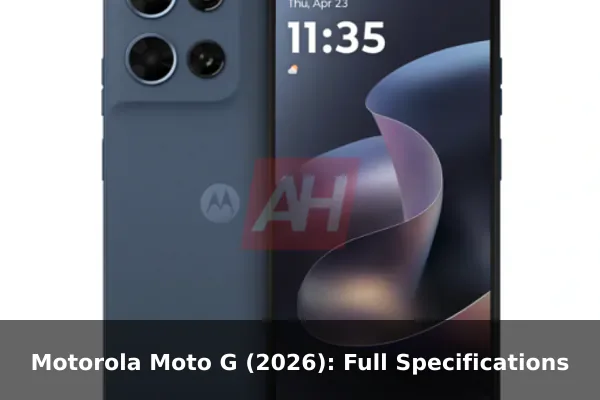
Android 16 out of the box gives the Moto G (2026) a fresh software baseline. Motorola’s software style is usually close to familiar Android while adding Moto features such as gestures, security tools, and convenience settings. The side-mounted fingerprint reader is a practical choice on a budget phone because it can be fast, reliable, and easy to reach without needing an in-display sensor.
The sensor list is stronger than some entry-level rivals, including accelerometer, gyro, proximity, compass, and barometer. Stereo speakers with Dolby Atmos support, Hi-Res audio, and the 3.5mm headphone jack make the phone more media-friendly than its price might suggest. For many buyers, that combination matters more than a flashy spec that only helps once in a while.
Connectivity
Connectivity is a major reason the Moto G (2026) feels current. It supports GSM, HSPA, LTE, and sub-6GHz 5G, with a wide range of 4G and 5G bands listed in the source data. That does not guarantee perfect compatibility with every carrier in every country, but it gives the phone a broad technical base for North American-style and international network coverage.
Wi-Fi 802.11 a/b/g/n/ac dual-band, Bluetooth, GPS with GALILEO and GLONASS, NFC, Nano-SIM plus eSIM support, and USB Type-C 2.0 round out the package. NFC is especially important because some low-cost phones still omit it in certain regions. The lack of FM radio may disappoint a small group of users, but the overall connectivity set is strong for a budget 5G handset.
Who Should Buy It
The Moto G (2026) makes the most sense for buyers who want a large-screen Android phone for messaging, browsing, maps, streaming, social apps, school, work communication, and long battery life. It is also a good candidate for users upgrading from an older LTE-only phone and wanting 5G, eSIM support, NFC, and Android 16 without moving into mid-range pricing.
It is less ideal for buyers who care most about display sharpness, high-end gaming, ultrawide photography, 4K video, premium materials, or long-term performance headroom. In those cases, spending more on a stronger mid-range phone may be wiser. But if the goal is a dependable, modern, value-focused phone with few missing everyday essentials, the Moto G (2026) is positioned well.
References
Sources checked for this article include the official Motorola Moto G (2026) product page, Motorola’s official Moto G and Moto G Play launch news post, Motorola Support specifications for Moto G (2026), Android Central’s Moto G (2026) versus Moto G Play (2026) comparison, and the supplied source catalog at tampungspekhp.berkasdrive.com.
Conclusion
The Motorola Moto G (2026) is a practical budget 5G phone with a large 120Hz display, Android 16, solid battery capacity, expandable storage, stereo speakers, NFC, and a headphone jack. Its HD+ screen, 4GB RAM, and basic secondary camera keep it clearly in the affordable class, but the core package is sensible. Recommended for buyers who want a dependable low-cost Android phone with strong everyday essentials.
