
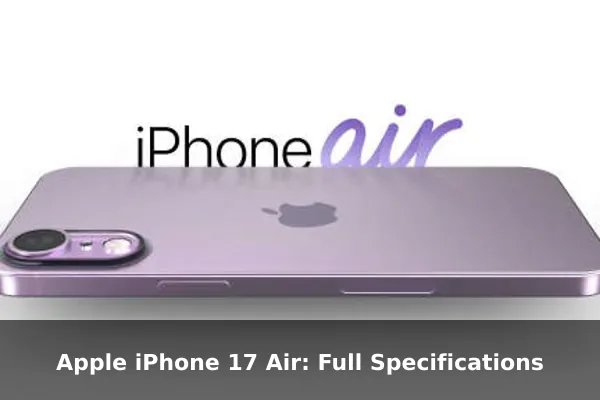
The Apple iPhone 17 Air arrives as one of the most talked-about entries in Apple’s lineup, built around a single bold idea: an iPhone that is thinner and lighter than almost anything Apple has shipped before. At a rumored 5.5 mm thickness and roughly 146 g, it pairs a large 6.9-inch LTPO Super Retina XDR OLED with the new Apple A19 Pro chip, positioning itself between the standard iPhone and the heavier Pro models for buyers who prize a featherweight feel in the hand.
Because this device is still listed as rumored and has not been officially announced, every figure here should be read as provisional and subject to change when Apple confirms the final specifications. This article looks at what the leaked spec sheet suggests, how the trade-offs of an ultra-thin design might play out in daily use, and which kind of user is most likely to be tempted by the iPhone 17 Air.
Full Specifications
Network
| Technology: | GSM / CDMA / HSPA / EVDO / LTE / 5G |
| 2G bands: | GSM 850 / 900 / 1800 / 1900 |
| CDMA 800 / 1900 | |
| 3G bands: | HSDPA 850 / 900 / 1700(AWS) / 1900 / 2100 |
| CDMA2000 1xEV-DO | |
| 4G bands: | LTE |
| 5G bands: | SA/NSA/Sub6 |
| Speed: | HSPA, LTE, 5G, EV-DO Rev.A 3.1 Mbps |
Launch
| Announced: | Not announced yet |
| Status: | Rumored |
Body
| Dimensions: | 163 x 77.6 x 5.5 mm (6.42 x 3.06 x 0.22 in) |
| Weight: | 146 g (5.15 oz) |
| Build: | Glass front, aluminum frame (7000 series), glass back |
| SIM: | eSIM |
| IP68 dust tight and water resistant Apple Pay (Visa, MasterCard, AMEX certified) |
Display
| Type: | LTPO Super Retina XDR OLED, 120Hz, HDR10, Dolby Vision, 1000 nits (typ), 2000 nits (HBM) |
| Size: | 6.9 inches, 116.7 cm2 (~92.2% screen-to-body ratio) |
| Resolution: | 1320 x 2868 pixels, 19.5:9 ratio (~458 ppi density) |
| Protection: | Scratch-resistant glass |
Platform
| OS: | iOS 26 |
| Chipset: | Apple A19 Pro (3 nm) |
| CPU: | Penta-core |
| GPU: | Apple GPU |
Memory
| Card slot: | No |
| Internal: | 128GB 8GB RAM, 256GB 8GB RAM, 512GB 8GB RAM |
| NVMe |
Main Camera
| Single: | 48 MP, f/1.6, 26mm (wide), 1/1.56″, 1.0µm, dual pixel PDAF, sensor-shift OIS* * speculative camera details |
| Features: | Dual-LED dual-tone flash, HDR (photo/panorama) |
| Video: | 4K@24/25/30/60fps, 1080p@25/30/60/120/240fps, HDR, Dolby Vision HDR (up to 60fps), stereo sound rec. |
Selfie camera
| Single: | 12 MP, f/1.9, 23mm (wide), 1/3.6″, PDAF SL 3D, (depth/biometrics sensor)* * speculative camera details |
| Features: | HDR, Dolby Vision HDR, 3D (spatial) audio, stereo sound rec. |
| Video: | 4K@24/25/30/60fps, 1080p@25/30/60/120fps, gyro-EIS |
Sound
| Loudspeaker: | Yes |
| 3.5mm jack: | No |
Comms
| WLAN: | Wi-Fi 802.11 a/b/g/n/ac/6, dual-band, hotspot |
| Bluetooth: | 5.3, A2DP, LE |
| Positioning: | GPS, GLONASS, GALILEO, BDS, QZSS |
| NFC: | Yes |
| Radio: | No |
| USB: | USB Type-C 2.0, DisplayPort |
Features
| Sensors: | Face ID, accelerometer, gyro, proximity, compass, barometer |
| Ultra Wideband (UWB) support (gen2 chip) Emergency SOS, Messages and Find My via satellite |
Battery
| Type: | Si/C Li-Ion 3000 mAh |
Misc
| Colors: | Black; other colors |
Who Should Consider the iPhone 17 Air
The iPhone 17 Air seems aimed at people who want a big-screen iPhone without big-phone bulk. If you have ever found the Pro Max too heavy for one-handed use or uncomfortable in a pocket, a 5.5 mm, 146 g body with a 6.9-inch display is an unusual combination that directly targets that complaint. It is less about chasing the absolute best camera system and more about everyday comfort, premium materials, and a thin, modern silhouette.
Buyers focused purely on maximum battery endurance or multi-lens photography may still gravitate toward the Pro tier, but for many users the Air’s balance of size and weight could be the deciding factor.
Design and Build: The Thin Story
The headline is clearly the chassis. A glass front, 7000-series aluminum frame, and glass back keep the build premium, while the rumored 163 x 77.6 x 5.5 mm dimensions make it remarkably slim. The reported IP68 rating suggests Apple is not sacrificing dust and water resistance for thinness, which would be reassuring given how delicate ultra-thin phones can feel.
An eSIM-only approach and Apple Pay support fit Apple’s recent direction. The obvious question with any thin phone is structural rigidity and heat management, so it is worth waiting for hands-on durability testing before drawing firm conclusions.
Display Quality
The 6.9-inch LTPO Super Retina XDR OLED panel is a genuine strong point on paper. With a 120Hz adaptive refresh rate, HDR10, Dolby Vision, a typical 1000 nits and up to 2000 nits in high-brightness mode, plus a sharp 1320 x 2868 resolution at around 458 ppi, it should deliver fluid scrolling, vivid color, and excellent outdoor visibility. The roughly 92.2% screen-to-body ratio points to slim bezels that maximize the viewing area on such a thin frame.
Performance and Software
Power reportedly comes from the Apple A19 Pro built on a 3 nm process, paired with a penta-core CPU, Apple GPU, and 8GB of RAM across the 128GB, 256GB, and 512GB storage tiers. On Apple’s recent track record, that silicon should comfortably handle demanding games, multitasking, and on-device intelligence features. Shipping with iOS 26 means a long runway of software updates, which has long been one of the iPhone’s most durable advantages over rivals.
Camera Capabilities
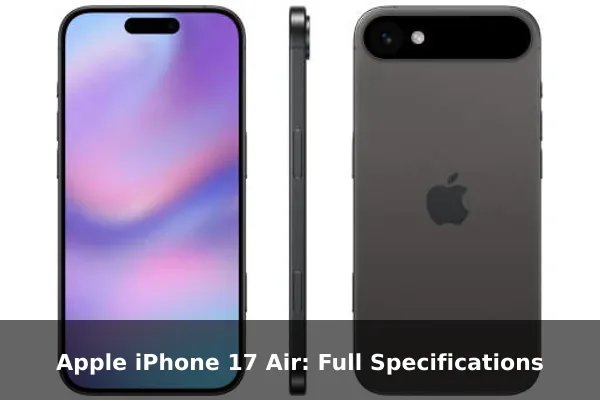
The rumored camera setup is a single 48 MP f/1.6 wide sensor with dual-pixel PDAF and sensor-shift OIS, supported by a 12 MP front camera. Several of these camera details are flagged as speculative in the source data, so treat them cautiously. A strong single rear lens can still produce excellent stills and 4K Dolby Vision video, but a one-camera system is a clear trade-off against the multi-lens Pro models for users who rely on telephoto or ultrawide framing.
Battery and Endurance
The reported 3000 mAh Si/C Li-Ion battery is modest by large-screen standards, and that is the most important caveat for the Air. Thinness almost always costs battery volume, so real-world endurance will depend heavily on the efficiency of the A19 Pro and iOS 26 power management. Anyone who routinely drains their phone by evening should watch independent battery tests closely before committing.
Connectivity Features
Connectivity looks modern: 5G with SA/NSA/Sub6 support, Wi-Fi 6, Bluetooth 5.3, NFC, and broad satellite positioning. The USB Type-C port is listed at USB 2.0 speeds with DisplayPort output, plus second-generation Ultra Wideband and satellite features for Emergency SOS, Messages, and Find My. The USB 2.0 data rate is the one limitation worth noting for users who move large video files over cable.
Conclusion
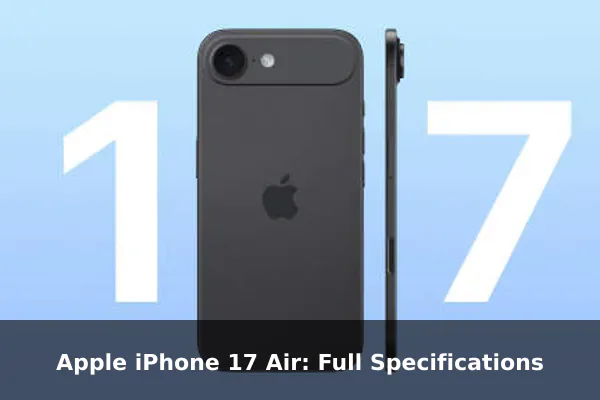
The Apple iPhone 17 Air shapes up as a focused device with a clear personality: a large, high-quality display wrapped in an exceptionally thin and light body powered by capable A19 Pro silicon. The main compromises are a single rear camera and a relatively small 3000 mAh battery, both natural consequences of the slim design. Since the phone is still rumored, treat all figures as unconfirmed and cross-check them against Apple’s official specifications once they are published. If portability and screen size matter more to you than maximum camera versatility or all-day-plus battery life, the iPhone 17 Air is well worth shortlisting; if endurance and a full lens suite are your priorities, the Pro models remain the safer pick.
References
- Apple iPhone Air Technical Specifications – Primary source for official iPhone Air specifications, including display, dimensions, weight, chipset, cameras, battery-life claims, cellular bands, eSIM support, charging, and iOS version.
- Apple Newsroom: Introducing iPhone Air – Official launch announcement for the product sometimes searched as iPhone 17 Air; useful for release date, positioning, availability, colors, pricing, and feature claims.
- Apple Store: Buy iPhone Air – Current official retail source for available storage variants, colors, US pricing, carrier/eSIM notes, and availability details.
- Apple iPhone Air Product Environmental Report – Official Apple PDF confirming introduction date, configuration-specific environmental data, materials, energy efficiency, and product lifecycle details.
- GSMArena Apple iPhone Air specifications (gsmarena.com) – Recognized smartphone specifications database useful as a secondary cross-check for fields Apple may not disclose directly, such as RAM and battery capacity; verify against Apple sources where possible.
