
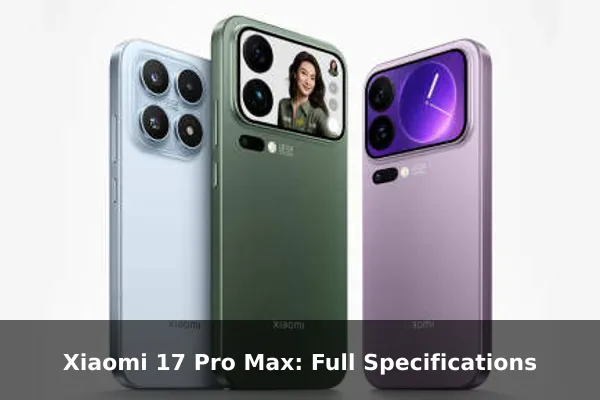
The Xiaomi 17 Pro Max is a large-format Android flagship built around three headline ideas: a Snapdragon 8 Elite Gen 5 platform, a 7500 mAh silicon-carbon battery, and a rear secondary AMOLED display that gives the phone a more experimental identity than a standard slab flagship.
Rather than focusing only on raw speed, this model tries to combine endurance, Leica-branded triple 50 MP cameras, premium display hardware, and broad modern connectivity. It is best viewed as Xiaomi’s power-user flagship for buyers who want a big screen and unusually strong battery capacity in one device.
Full Specifications
Network
| Technology: | GSM / HSPA / LTE / 5G |
| 2G bands: | GSM 850 / 900 / 1800 / 1900 |
| 3G bands: | HSDPA 800 / 850 / 900 / 1700(AWS) / 1900 / 2100 |
| 4G bands: | 1, 2, 3, 4, 5, 7, 8, 12, 13, 17, 18, 19, 20, 25, 26, 28, 34, 38, 39, 40, 41, 42, 48, 66, 71 |
| 5G bands: | 1, 2, 3, 5, 7, 8, 12, 13, 18, 20, 25, 26, 28, 38, 40, 41, 48, 66, 70, 71, 77, 78, 79, 80, 81, 83, 84, 89 SA/NSA |
| Speed: | HSPA, LTE, 5G |
Launch
| Announced: | 2025, September 25 |
| Status: | Available. Released 2025, September 25 |
Body
| Dimensions: | 162.9 x 77.6 x 8 mm (6.41 x 3.06 x 0.31 in) |
| Weight: | 219 g (7.72 oz) |
| Build: | Glass front (Dragon Crystal Glass 3), aluminum frame |
| SIM: | Nano-SIM + Nano-SIM |
| IP68 dust tight and water resistant (immersible up to 6m for 30 min) |
Display
| Type: | LTPO AMOLED, 68B colors, 2160Hz PWM, 120Hz, Dolby Vision, HDR Vivid, HDR10+, 3500 nits (peak) |
| Size: | 6.9 inches, 116.6 cm2 (~92.3% screen-to-body ratio) |
| Resolution: | 1200 x 2608 pixels, 19.5:9 ratio (~416 ppi density) |
| Protection: | Xiaomi Dragon Crystal Glass 3 |
| Secondary display (on the back): LTPO AMOLED, 120Hz, Dolby Vision, HDR Vivid, HDR10+, 3500 nits (peak) 2.9 inches, 596 x 976 pixels |
Platform
| OS: | Android 16, HyperOS 3 |
| Chipset: | Qualcomm SM8850-AC Snapdragon 8 Elite Gen 5 (3 nm) |
| CPU: | Octa-core (2×4.6 GHz Oryon V3 Phoenix L + 6×3.62 GHz Oryon V3 Phoenix M) |
| GPU: | Adreno 840 |
Memory
| Card slot: | No |
| Internal: | 512GB 12GB RAM, 512GB 16GB RAM, 1TB 16GB RAM |
| UFS 4.1 |
Main Camera
| Triple: | 50 MP, f/1.7, 23mm (wide), 1/1.28″, 1.22µm, dual pixel PDAF, OIS 50 MP, f/2.6, 115mm (periscope telephoto), 1/1.95″, 0.8µm, PDAF (30cm – ∞), OIS, 5x optical zoom 50 MP, f/2.4, 17mm, 102˚ (ultrawide), 1/2.88″, 0.61µm, PDAF |
| Features: | Laser AF, color spectrum sensor, Leica lens, Dual-LED dual-tone flash, HDR, panorama |
| Video: | 8K@30fps (HDR), 4K@30/60/120fps (HDR10+, 10-bit Dolby Vision HDR, 10-bit LOG), 1080p@30/60/120/240/960fps, 720p@1920fps, gyro-EIS |
Selfie camera
| Single: | 50 MP, f/2.2, 21mm (wide), 1/2.88″, 0.61µm, PDAF |
| Features: | HDR, panorama |
| Video: | 4K@30/60fps, 1080p@30/60fps, HDR10+, gyro-EIS |
Sound
| Loudspeaker: | Yes, with stereo speakers (with Dolby Atmos) |
| 3.5mm jack: | No |
| 24-bit/192kHz Hi-Res & Hi-Res wireless audio Snapdragon sound |
Comms
| WLAN: | Wi-Fi 802.11 a/b/g/n/ac/6e/7, dual-band, Wi-Fi Direct |
| Bluetooth: | 5.4, A2DP, LE, aptX HD, aptX Adaptive, LHDC 5 |
| Positioning: | GPS (L1+L5), BDS (B1I+B1c+B2a), GALILEO (E1+E5a), QZSS (L1+L5), NavIC (L5), GLONASS |
| NFC: | Yes |
| Infrared port: | Yes |
| Radio: | No |
| USB: | USB Type-C 3.2, Display Port, OTG |
Features
| Sensors: | Fingerprint (under display, ultrasonic), accelerometer, proximity, gyro, compass, barometer |
| Ultra Wideband (UWB) support |
Battery
| Type: | Si/C Li-Ion 7500 mAh |
| Charging: | 100W wired, PD3.0, QC3+, 100W PPS 50W wireless 22.5W reverse wireless |
Misc
| Colors: | Black, White, Purple, Green |
| Models: | 2509FPN0BC |
| Price: | About 720 EUR |
Our Tests
| Performance: | AnTuTu: 2456317 (v10), 3543388 (v11) GeekBench: 10600 (v6) 3DMark: 6761 (Wild Life Extreme) |
| Display: | 1026 nits max brightness (measured) |
| Loudspeaker: | -26.1 LUFS (Good) |
| Battery: | Active use score 20:50h |
Price and Availability
The Xiaomi 17 Pro Max offers a compelling combination of features and performance. While the base price is around €720, the actual cost may vary depending on your location and retailer. Below, you’ll find the approximate price of the Xiaomi 17 Pro Max converted into various currencies. Please note that these are estimates based on recent exchange rates as of August 30, 2026 and may not reflect the exact price you’ll find at a retailer.
- United States: $836
- Japan: ¥133,596
- United Kingdom: £616
- Australia: A$1,166
- Canada: C$1,160
- Taiwan: NT$26,463
- Denmark: kr5.382
- Saudi Arabia: ﷼3,134
- South Korea: ₩1,152,956
- Germany: €720
- Brazil: R$4.326
- Vietnam: ₫21.632.539
- Kenya: KSh 108,537
- India: ₹79,898
- Indonesia: Rp 14.781.883
- Nigeria: ₦1,140,225
- Pakistan: ₨231,997
- Philippines: ₱52,064
- Bangladesh: ৳১,০২,৯৭১
Why Should You Buy the Xiaomi 17 Pro Max?
The strongest reason to consider the Xiaomi 17 Pro Max is its unusually complete flagship balance. Many premium phones focus on camera hardware, gaming performance, or fast charging, but this model puts all three into the same package while adding a rear display that can change how you frame selfies, check status information, or use the camera module area. The listed battery capacity is especially notable: 7500 mAh is far above what most slim flagship phones offer, so the device targets people who want flagship speed without treating battery anxiety as normal.
It is also a phone for buyers who compare spec sheets closely. The Snapdragon 8 Elite Gen 5 chip, UFS 4.1 storage, up to 1TB internal capacity, Wi-Fi 7, USB-C 3.2 with DisplayPort, UWB, IP68 protection, and 5x periscope telephoto camera all point to a genuinely high-end configuration. The tradeoff is size and weight: at 219 g, this is not designed for users who prefer compact or featherlight phones.
Design and Durability
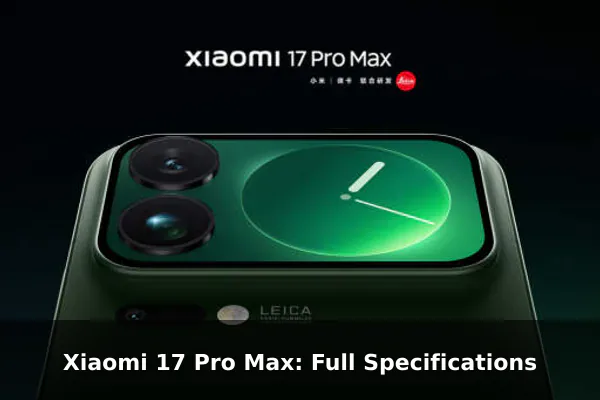
The Xiaomi 17 Pro Max uses a glass front with Xiaomi Dragon Crystal Glass 3 and an aluminum frame, giving it the materials expected from a premium flagship. Its 162.9 x 77.6 x 8 mm body makes it a large phone, but the 8 mm thickness is restrained considering the battery size. The 219 g weight is noticeable in one-handed use, especially for long reading sessions or gaming, though it is reasonable for a device with this screen size and battery capacity.
Durability is another important part of the design story. The IP68 rating covers dust tightness and water resistance, with the source specification noting immersion up to 6 meters for 30 minutes. That does not make the phone indestructible, but it does place it among stronger mainstream flagship designs for accidental exposure to water and dust.
Main Display and Rear Screen
The front display is a 6.9-inch LTPO AMOLED panel with a 120Hz refresh rate, Dolby Vision, HDR Vivid, HDR10+, 2160Hz PWM dimming, and a listed 3500-nit peak brightness. The 1200 x 2608 resolution works out to about 416 ppi, which is sharp enough for dense text, video, maps, and gaming. The measured display brightness figure in the supplied test data is 1026 nits maximum, which is the more practical number to consider for sustained real-world use.
The secondary rear display is what separates this phone from more conventional large flagships. It is a 2.9-inch LTPO AMOLED panel with 120Hz support, HDR formats, and 596 x 976 resolution. Its most obvious benefit is camera use: the main camera system can double as a higher-quality selfie setup when the rear screen is used as a viewfinder. It also gives Xiaomi room for glanceable information without waking the main display.
Performance and Storage
Performance is led by the Qualcomm Snapdragon 8 Elite Gen 5, a 3 nm chipset paired with an octa-core Oryon CPU layout and Adreno 840 graphics. The supplied benchmark data places the phone at 2,456,317 in AnTuTu v10, 3,543,388 in AnTuTu v11, 10,600 in GeekBench v6, and 6,761 in 3DMark Wild Life Extreme. Benchmarks should not be treated as the whole experience, but these numbers indicate a top-tier performance class for gaming, video editing, multitasking, and heavy camera processing.
Storage options are also flagship-grade: 512GB with 12GB RAM, 512GB with 16GB RAM, and 1TB with 16GB RAM. There is no microSD card slot, so buyers should choose carefully at purchase. The use of UFS 4.1 storage is important because fast internal storage affects app loading, large file transfers, burst photography, and long-term responsiveness.
Camera System
The rear camera system uses three 50 MP sensors: a 23 mm wide camera with OIS, a 115 mm periscope telephoto camera with OIS and 5x optical zoom, and a 17 mm ultrawide camera with PDAF. That layout is more versatile than a simple wide-ultrawide setup because it gives the phone a real long-range optical option for portraits, travel details, stage shots, and compressed perspective scenes.
Camera features include Laser AF, a color spectrum sensor, Leica lens branding, Dual-LED dual-tone flash, HDR, and panorama. Video support is extensive, with 8K at 30fps, 4K at up to 120fps, HDR10+, 10-bit Dolby Vision HDR, 10-bit LOG, gyro-EIS, and high-frame-rate slow motion options. The front camera is also a 50 MP unit with PDAF, 4K recording at 30 or 60fps, HDR10+, and gyro-EIS, but the rear screen means serious selfie shooters may often prefer using the main cameras instead.
Battery and Charging
The 7500 mAh silicon-carbon battery is one of the Xiaomi 17 Pro Max’s defining specifications. In the supplied test data, the phone records an active use score of 20 hours and 50 minutes, which supports the idea that this is not just a large battery on paper. For users who travel, stream video, use navigation, shoot photos, or play games away from a charger, this is a major practical advantage.
Charging is equally aggressive. The phone supports 100W wired charging with PD3.0, QC3+, and 100W PPS, plus 50W wireless charging and 22.5W reverse wireless charging. That combination makes the battery setup flexible: wired charging is the fastest option, wireless is useful for desks and nightstands, and reverse wireless can top up earbuds or another accessory when needed.
Software and Everyday Features
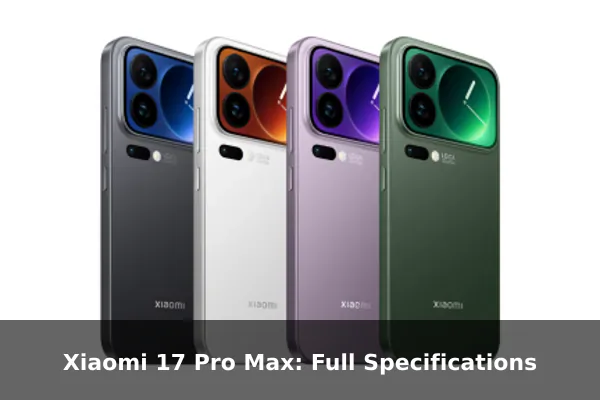
The phone ships with Android 16 and HyperOS 3, giving it Xiaomi’s current software direction over Google’s core Android platform. Buyers who already use Xiaomi phones will find this familiar, while users switching from Pixel, Samsung, or iPhone should consider whether they like Xiaomi’s interface style, app behavior, and ecosystem integrations.
Useful hardware features include an ultrasonic under-display fingerprint sensor, accelerometer, proximity sensor, gyroscope, compass, and barometer. Stereo speakers with Dolby Atmos are included, and the supplied loudspeaker result of -26.1 LUFS is rated as good. There is no 3.5 mm headphone jack, so wired audio users will need USB-C audio or a wireless setup.
Connectivity
The Xiaomi 17 Pro Max has broad network coverage across GSM, HSPA, LTE, and 5G, including extensive listed 4G and 5G bands with SA and NSA support. As always, band support should be checked against the buyer’s carrier and region before import purchase, especially if the device is sold primarily for one market.
Wireless connectivity is comprehensive: Wi-Fi 7, Bluetooth 5.4 with aptX HD, aptX Adaptive and LHDC 5, NFC, infrared, UWB, and multi-system satellite positioning are all present. USB Type-C 3.2 with DisplayPort and OTG support is another meaningful premium feature because it can help with wired display output, storage accessories, and productivity workflows.
Who Should Buy It?
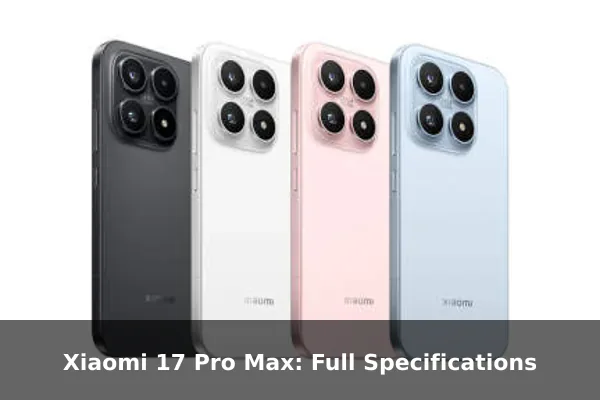
The Xiaomi 17 Pro Max makes the most sense for buyers who want a large Android flagship with exceptional battery capacity, high-end gaming performance, serious camera flexibility, and a display setup that feels different from ordinary premium phones. It is especially appealing for users who shoot a lot of photos and video, travel frequently, or want a device that can handle long days without conservative battery management.
It is less ideal for users who want a small phone, a lighter body, expandable storage, or a built-in headphone jack. It may also require extra research for buyers outside Xiaomi’s primary sales regions, because pricing, warranty support, software builds, and carrier compatibility can vary by market.
Conclusion
The Xiaomi 17 Pro Max is a spec-heavy flagship with a rare mix of a 7500 mAh battery, Snapdragon 8 Elite Gen 5 performance, dual AMOLED displays, advanced Leica-branded cameras, and premium connectivity. Choose it if you want maximum hardware value in a large Android phone and can accept the size, weight, and lack of expandable storage.
References
- Xiaomi official Xiaomi 17 Pro Max specifications – Primary manufacturer source for the phone's official specifications, variants, features, and China-market product details.
- Xiaomi official Xiaomi 17 Pro Max product page – Official overview page for confirming product positioning, design/features, availability, and manufacturer-provided claims.
- Qualcomm Snapdragon 8 Elite Gen 5 Mobile Platform – Official chipset reference for verifying the Snapdragon 8 Elite Gen 5 platform details used in the device.
- GSMArena Xiaomi 17 Pro Max 5G specifications – Well-known independent phone-spec database useful for cross-checking display, dimensions, cameras, battery, connectivity, and launch information.
- PhoneArena Xiaomi 17 Pro Max specifications – Established mobile reference site for secondary verification of specification tables, release details, dimensions, display, cameras, and battery data.
