
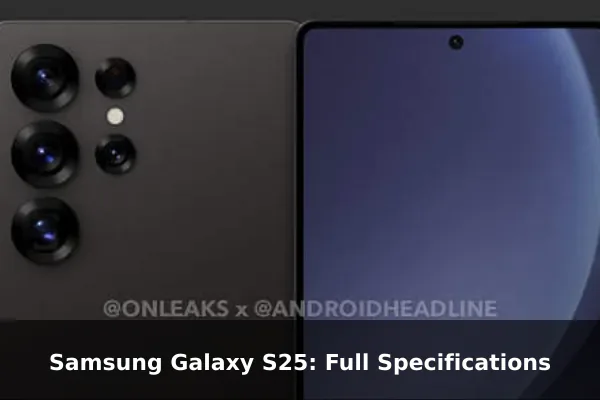
The Samsung Galaxy S25 is the compact flagship anchor of Samsung’s 2025 Galaxy S lineup, announced on January 22, 2025 and released on February 3, 2025. It pairs a pocketable 6.2-inch Dynamic LTPO AMOLED 2X panel with Qualcomm’s Snapdragon 8 Elite (3 nm) and a refined One UI 7 experience on Android 15, with Samsung committing to seven years of major Android upgrades.
While the S25 Ultra grabs most headlines and the new S25 Edge chases thinness, the standard Galaxy S25 quietly delivers the essentials small-phone buyers care about: triple rear cameras with 3x optical telephoto, a 4000 mAh battery, IP68 durability with the Armor Aluminum 2 frame, and Samsung’s growing Galaxy AI toolkit. This article focuses on what makes the base S25 a distinct choice within Samsung’s 2025 flagship range.
Full Specifications
Network
| Technology: | GSM / CDMA / HSPA / EVDO / LTE / 5G |
| 2G bands: | GSM 850 / 900 / 1800 / 1900 |
| CDMA 800 / 1900 & TD-SCDMA | |
| 3G bands: | HSDPA 850 / 900 / 1700(AWS) / 1900 / 2100 |
| CDMA2000 1xEV-DO | |
| 4G bands: | 1, 2, 3, 4, 5, 7, 8, 12, 13, 17, 18, 19, 20, 25, 26, 28, 32, 38, 39, 40, 41, 66 – International |
| 1, 2, 3, 4, 5, 7, 8, 12, 13, 14, 18, 19, 20, 25, 26, 28, 29, 30, 38, 39, 40, 41, 48, 66, 71 – USA unlocked | |
| 5G bands: | 1, 2, 3, 5, 7, 8, 12, 20, 25, 26, 28, 38, 40, 41, 66, 75, 77, 78 SA/NSA/Sub6 – International |
| 1, 2, 5, 7, 25, 28, 41, 66, 71, 77, 78, 257, 258, 260, 261 SA/NSA/Sub6/mmWave – USA unlocked | |
| Speed: | HSPA, LTE (up to 7CA), 5G |
Launch
| Announced: | 2025, January 22 |
| Status: | Available. Released 2025, February 03 |
Body
| Dimensions: | 146.9 x 70.5 x 7.2 mm (5.78 x 2.78 x 0.28 in) |
| Weight: | 162 g (5.71 oz) |
| Build: | Glass front (Gorilla Glass Victus 2), glass back (Gorilla Glass Victus 2), aluminum frame |
| SIM: | Nano-SIM + Nano-SIM + eSIM + eSIM (max 2 at a time) – INT Nano-SIM + eSIM + eSIM (max 2 at a time) – USA Nano-SIM + Nano-SIM – CN |
| IP68 dust tight and water resistant (immersible up to 1.5m for 30 min) Armor aluminum 2 frame |
Display
| Type: | Dynamic LTPO AMOLED 2X, 120Hz, 480Hz PWM, HDR10+, 2600 nits (peak) |
| Size: | 6.2 inches, 94.4 cm2 (~91.1% screen-to-body ratio) |
| Resolution: | 1080 x 2340 pixels, 19.5:9 ratio (~416 ppi density) |
| Protection: | Corning Gorilla Glass Victus 2, Mohs level 5 |
Platform
| OS: | Android 15, up to 7 major Android upgrades, One UI 7 |
| Chipset: | Qualcomm SM8750-AC Snapdragon 8 Elite (3 nm) |
| CPU: | Octa-core (2×4.47 GHz Oryon V2 Phoenix L + 6×3.53 GHz Oryon V2 Phoenix M) |
| GPU: | Adreno 830 (1200 MHz) |
Memory
| Card slot: | No |
| Internal: | 128GB 12GB RAM, 256GB 12GB RAM, 512GB 12GB RAM |
| UFS 4.0 |
Main Camera
| Triple: | 50 MP, f/1.8, 24mm (wide), 1/1.56″, 1.0µm, dual pixel PDAF, OIS 10 MP, f/2.4, 67mm (telephoto), 1/3.94″, 1.0µm, PDAF, OIS, 3x optical zoom 12 MP, f/2.2, 13mm, 120˚ (ultrawide), 1/2.55″ 1.4µm, Super Steady video |
| Features: | Best Face, LED flash, auto-HDR, panorama |
| Video: | 8K@24/30fps, 4K@30/60fps, 1080p@30/60/120/240fps, 10-bit HDR, HDR10+, stereo sound rec., gyro-EIS |
Selfie camera
| Single: | 12 MP, f/2.2, 26mm (wide), 1/3.2″, 1.12µm, dual pixel PDAF |
| Features: | HDR, HDR10+ |
| Video: | 4K@30/60fps, 1080p@30fps |
Sound
| Loudspeaker: | Yes, with stereo speakers |
| 3.5mm jack: | No |
| 32-bit/384kHz audio Tuned by AKG |
Comms
| WLAN: | Wi-Fi 802.11 a/b/g/n/ac/6e/7, tri-band, Wi-Fi Direct |
| Bluetooth: | 5.4, A2DP, LE |
| Positioning: | GPS, GLONASS, BDS, GALILEO, QZSS |
| NFC: | Yes |
| Radio: | No |
| USB: | USB Type-C 3.2, DisplayPort 1.2, OTG |
Features
| Sensors: | Fingerprint (under display, ultrasonic), accelerometer, gyro, proximity, compass, barometer |
| Samsung DeX, Samsung Wireless DeX (desktop experience support) Circle to Search |
Battery
| Type: | Li-Ion 4000 mAh |
| Charging: | 25W wired, PD3.0, 50% in 30 min 15W wireless (Qi2 Ready) 4.5W reverse wireless |
Misc
| Colors: | Icy Blue, Mint, Navy, Silver Shadow, Pink Gold, Coral Red, Blue Black |
| Models: | SM-S931B, SM-S931B/DS, SM-S931U, SM-S931U1, SM-S931W, SM-S931N, SM-S9310, SM-S931E, SM-S931E/DS |
| SAR: | 1.13 W/kg (head) 0.92 W/kg (body) |
| SAR EU: | 1.29 W/kg (head) 1.36 W/kg (body) |
| Price: | € 550.00 / $ 474.45 / £ 517.00 / ₹ 63,999 |
Our Tests
| Performance: | AnTuTu: 2193701 (v10) GeekBench: 10050 (v6) 3DMark: 6755 (Wild Life Extreme) |
| Display: | 1395 nits max brightness (measured) |
| Loudspeaker: | -26.1 LUFS (Good) |
| Battery: | Active use score 13:09h |
EU LABEL
| Energy: | Class B |
| Battery: | 37:16h endurance, 2000 cycles |
| Free fall: | Class A (270 falls) |
| Repairability: | Class C |
Price and Availability
The Samsung Galaxy S25 offers a compelling combination of features and performance. While the base price is around €550, the actual cost may vary depending on your location and retailer. Below, you’ll find the approximate price of the Samsung Galaxy S25 converted into various currencies. Please note that these are estimates based on recent exchange rates as of June 4, 2026 and may not reflect the exact price you’ll find at a retailer.
- United States: $638
- Japan: ¥102,116
- United Kingdom: £475
- Australia: A$894
- Canada: C$886
- Taiwan: NT$20,087
- Denmark: kr4.105
- Saudi Arabia: ﷼2,394
- South Korea: ₩976,470
- Germany: €550
- Brazil: R$3.212
- Vietnam: ₫16.697.117
- Kenya: KSh 82,677
- India: ₹61,092
- Indonesia: Rp 11.475.106
- Nigeria: ₦868,137
- Pakistan: ₨177,990
- Philippines: ₱39,435
- Bangladesh: ৳৭৮,৩৬৭
Value Within Samsung’s 2025 Flagship Range
With a reference launch price around € 550 / $ 474.45 / £ 517 / ₹ 63,999, the base Galaxy S25 sits as the most accessible member of the S25 family. Compared with the larger S25+ and Ultra, it trades a bigger panel and the Ultra’s 200 MP main sensor for a smaller footprint and a lower entry point, while still using the same Snapdragon 8 Elite for Galaxy chipset. According to Samsung’s official Galaxy S25 product page, all three models share the same generation of Galaxy AI features and a seven-year update commitment, so buyers choosing the standard S25 are not paying less to get a watered-down software experience — they are choosing a smaller chassis and a more modest camera island.
Design and Build for One-Handed Use
The Galaxy S25 measures 146.9 x 70.5 x 7.2 mm and weighs only 162 g, which keeps it firmly in the rare category of true one-handed Android flagships. The body uses Gorilla Glass Victus 2 on both the front and back with an aluminum frame branded Armor Aluminum 2, and the phone carries an IP68 rating for dust resistance and immersion up to 1.5 m for 30 minutes. Color options reported for the lineup include Icy Blue, Mint, Navy, Silver Shadow, Pink Gold, Coral Red, and Blue Black, giving the base S25 a wider palette than the Ultra. SIM configurations vary by region: international units take Nano-SIM plus eSIM combinations, the US variant favors eSIM, and the China model uses dual physical Nano-SIMs.
Display: Compact but Uncompromised
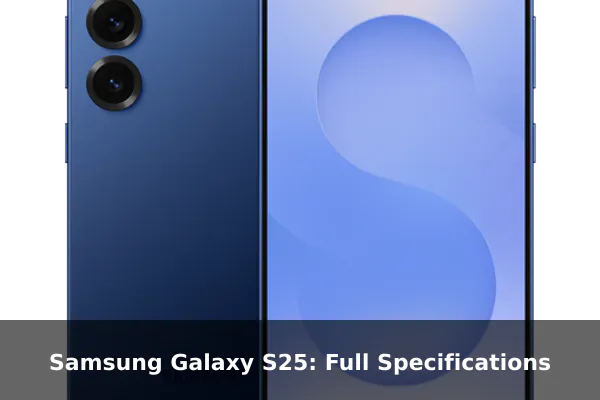
Despite the small body, the 6.2-inch Dynamic LTPO AMOLED 2X panel runs at a 120 Hz refresh rate with 480 Hz PWM dimming and supports HDR10+. Samsung quotes a 2600-nit peak brightness, and independent measurements cited in our test data reach about 1395 nits in real-world use, which is more than enough for outdoor visibility. Resolution comes in at 1080 x 2340 pixels in a 19.5:9 aspect ratio for roughly 416 ppi, and Corning Gorilla Glass Victus 2 with Mohs level 5 hardness handles front protection. This is one of the smallest premium displays on the 2025 market that still delivers a flagship-tier brightness curve.
Performance and Thermals
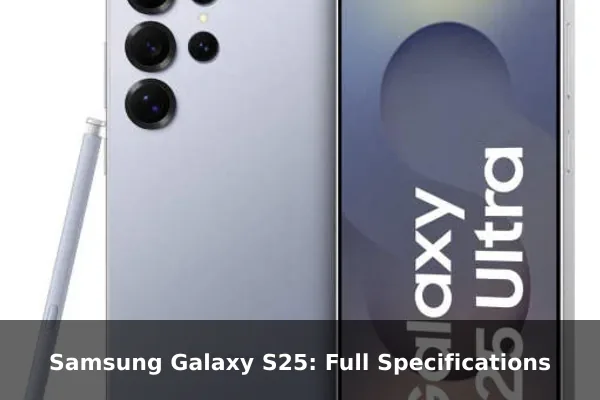
The Snapdragon 8 Elite (Qualcomm SM8750-AC, 3 nm) uses a custom octa-core CPU with two Oryon V2 Phoenix L cores at 4.47 GHz and six Phoenix M cores at 3.53 GHz, paired with an Adreno 830 GPU running at 1200 MHz. In a chassis this compact, sustained performance always matters more than peak scores, but the headline numbers are still strong: AnTuTu v10 around 2,193,701, Geekbench v6 around 10,050, and 3DMark Wild Life Extreme around 6,755. Memory is fixed at 12 GB RAM with UFS 4.0 storage in 128 GB, 256 GB, or 512 GB tiers, and there is no microSD slot, so buyers should size storage carefully at purchase.
Camera System: Steady, Familiar, Capable
Samsung keeps the proven triple rear setup: a 50 MP f/1.8 main sensor with dual-pixel PDAF and OIS, a 10 MP f/2.4 telephoto with 3x optical zoom and OIS, and a 12 MP f/2.2 ultrawide with a 120-degree field of view. Video tops out at 8K at 24/30 fps and 4K at 30/60 fps with 10-bit HDR and HDR10+ capture, plus 1080p slow motion up to 240 fps. The 12 MP f/2.2 selfie camera supports 4K at 30/60 fps. The hardware is broadly similar to the Galaxy S24, but the Galaxy AI suite, ProVisual Engine processing, and the Snapdragon 8 Elite’s ISP carry the upgrade story for stills.
Battery, Charging, and EU Energy Label
The 4000 mAh Li-Ion battery is small by 2025 flagship standards, but the LTPO panel and the 3 nm Snapdragon help stretch it; our active-use score reaches about 13 hours 9 minutes, and the EU energy label rates the S25 with a 37-hour 16-minute endurance figure and a 2000-cycle battery lifespan, alongside a Class B energy grade and a Class C repairability score. Wired charging is rated at 25 W with PD 3.0 for roughly 50 percent in 30 minutes, with 15 W Qi2 Ready wireless charging and 4.5 W reverse wireless for accessories. Buyers expecting 80 W or 100 W charging from rival brands should set expectations accordingly.
Software, AI, and Long-Term Support
Samsung ships the S25 with Android 15 and One UI 7 and, per the official Samsung Global Newsroom announcement, promises up to seven major Android upgrades. Galaxy AI features include Circle to Search with Google, plus Samsung DeX and Samsung Wireless DeX for a desktop-style experience over a monitor or wirelessly. The combination of long support, DeX, and a refined One UI 7 means this small phone is built to stay relevant for several upgrade cycles.
Connectivity and Audio
Connectivity is current-generation: Wi-Fi 7 with tri-band support, Bluetooth 5.4 with LE Audio, NFC, and USB Type-C 3.2 with DisplayPort 1.2 and OTG. Positioning covers GPS, GLONASS, BDS, GALILEO, and QZSS. Stereo speakers tuned with AKG handle audio, supporting 32-bit/384 kHz playback, but the 3.5 mm jack is absent and there is no FM radio. The ultrasonic under-display fingerprint reader rounds out the biometric setup.
Who Should Buy the Galaxy S25
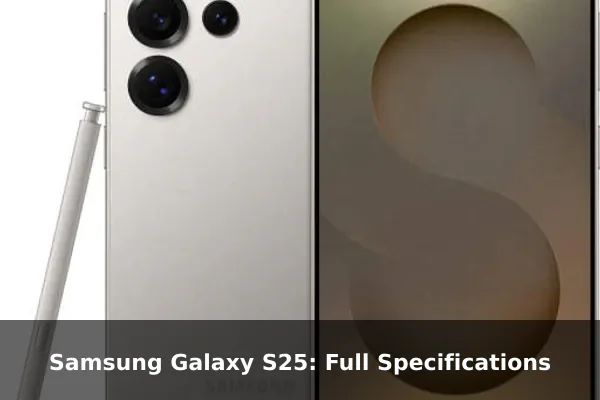
The Galaxy S25 is ideal for buyers who want a true compact flagship: 162 g, 7.2 mm thick, IP68, with a top-tier chip and seven years of updates. It is a strong pick if you prefer one-handed use over the Ultra’s larger footprint, value Samsung’s update policy, or want a smaller alternative to the S25+ without giving up Galaxy AI. Power users who lean heavily on extreme zoom photography or all-day battery may still prefer the Ultra or a higher-capacity rival.
Conclusion
The Samsung Galaxy S25 is one of the few remaining compact Android flagships that does not feel like a compromise. Its Snapdragon 8 Elite performance, bright 6.2-inch 120 Hz display, dependable triple-camera setup, and seven-year update promise make it a sensible long-term choice. Recommended for buyers who prioritize a small, durable, software-supported flagship over headline-grabbing battery capacity or zoom range. Always verify regional pricing, model code, and availability on Samsung’s official product page before purchase.
Official references
- Samsung Galaxy S25 & S25+ Official Product Page – Primary manufacturer page for Galaxy S25 features, specifications, colors, availability notes, and official product claims.
- Samsung Galaxy S25 Official SKU Specifications – Official Samsung product listing with detailed Galaxy S25 hardware specifications including display, camera, memory, network bands, connectivity, dimensions, and battery details.
- Samsung Mobile Press – Galaxy S25 Media Assets and Tech Specs – Official Samsung press resource for product images, launch materials, and tech specs useful for verifying model-specific details.
- Samsung Global Newsroom – Galaxy S25 Series Announcement – Official launch announcement confirming Galaxy S25, S25+, and S25 Ultra positioning, chipset, AI features, update policy, colors, and release context.
- Samsung Galaxy S25 Series B2B Spec Sheet – Official Samsung PDF spec sheet summarizing Galaxy S25 series specifications, display, processor, camera, memory, battery, connectivity, and footnotes.
