
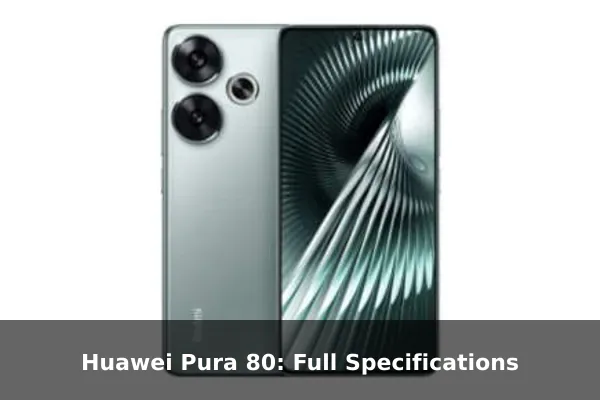
The Huawei Pura 80 is the standard model in Huawei’s 2025 Pura lineup, aimed at buyers who want flagship-style imaging, a premium body, and fast charging without moving all the way up to the Ultra variant.
Its strongest angle is balance: a bright LTPO OLED display, a variable-aperture main camera, periscope zoom, high-grade water resistance, and a large market-dependent battery, with important regional differences for software, battery capacity, and 5G access.
Full Specifications
Network
| Technology: | GSM / CDMA / HSPA / CDMA2000 / LTE / 5G |
| 2G bands: | GSM 850 / 900 / 1800 / 1900 |
| CDMA 800 | |
| 3G bands: | HSDPA 800 / 850 / 900 / 1700(AWS) / 1900 / 2100 |
| CDMA2000 1x | |
| 4G bands: | 1, 2, 3, 4, 5, 6, 7, 8, 9, 12, 17, 18, 19, 20, 26, 28, 34, 38, 39, 40, 41, 42, 66 – International |
| 5G bands: | SA/NSA – China only |
| Speed: | HSPA, LTE, 5G (China only) |
Launch
| Announced: | 2025, June 11 |
| Status: | Available. Released 2025, July 25 |
Body
| Dimensions: | 157.7 x 74.4 x 8.2 mm (6.21 x 2.93 x 0.32 in) |
| Weight: | 211 g (7.44 oz) |
| Build: | Glass front, aluminum frame, glass back |
| SIM: | Nano-SIM + Nano-SIM |
| IP68/IP69 dust tight and water resistant (high pressure water jets; immersible up to 2m for 30 min) |
Display
| Type: | LTPO OLED, 1B colors, HDR Vivid, 120Hz, 1440Hz PWM, 2800 nits (peak) |
| Size: | 6.6 inches, 105.9 cm2 (~90.3% screen-to-body ratio) |
| Resolution: | 1256 x 2760 pixels (~459 ppi density) |
| Protection: | Kunlun Glass 2 |
Platform
| OS: | EMUI 15 (International), HarmonyOS 5.1 (China) |
| Chipset: | Kirin 9010s (7 nm) |
| CPU: | Octa-core |
Memory
| Card slot: | No |
| Internal: | 256GB 12GB RAM, 512GB 12GB RAM, 1TB 12GB RAM |
Main Camera
| Triple: | 50 MP, f/1.4-4.0, 24mm (wide), 1/1.3″, PDAF, OIS 12 MP, f/3.4, 125mm (periscope telephoto), PDAF, OIS, 5x optical zoom 13 MP, f/2.2, 13mm (ultrawide) |
| Features: | Laser AF, color spectrum sensor, LED flash, panorama, HDR |
| Video: | 4K, 1080p, 1080p@480fps (interpolated), HDR Vivid, gyro-EIS, OIS |
Selfie camera
| Single: | 13 MP, f/2.0, (ultrawide), AF |
| Features: | HDR, panorama |
| Video: | 4K, 1080p, 1080p@240fps, HDR Vivid, gyro-EIS |
Sound
| Loudspeaker: | Yes, with stereo speakers |
| 3.5mm jack: | No |
Comms
| WLAN: | Wi-Fi 802.11 a/b/g/n/ac/6/7, dual-band, Wi-Fi Direct |
| Bluetooth: | 5.2, A2DP, LE, L2HC |
| Positioning: | GPS (L1+L5), GLONASS (L1), BDS (B1I+B1c+B2a+B2b), GALILEO (E1+E5a+E5b), QZSS (L1+L5), NavIC |
| NFC: | Yes |
| Infrared port: | Yes |
| Radio: | No |
| USB: | USB Type-C 2.0, OTG, DisplayPort 1.2 |
Features
| Sensors: | Fingerprint (side-mounted), accelerometer, gyro, proximity, compass |
| BDS Satellite Messaging – China only |
Battery
| Type: | Li-Po 5170 mAh – InternationalLi-Po 5600 mAh – China |
| Charging: | 66W wired 50W wireless 7.5W reverse wireless 5W reverse wired |
Misc
| Colors: | Frosted Gold, Frosted White, Frosted Black, Green |
| Models: | HED-LX9 |
| Price: | About 580 EUR |
Price and Availability
The Huawei Pura 80 offers a compelling combination of features and performance. While the base price is around €580, the actual cost may vary depending on your location and retailer. Below, you’ll find the approximate price of the Huawei Pura 80 converted into various currencies. Please note that these are estimates based on recent exchange rates as of October 12, 2026 and may not reflect the exact price you’ll find at a retailer.
- United States: $648
- Japan: ¥102,715
- United Kingdom: £490
- Australia: A$930
- Canada: C$925
- Taiwan: NT$20,697
- Denmark: kr4.335
- Saudi Arabia: ﷼2,430
- South Korea: ₩865,228
- Germany: €580
- Brazil: R$3.238
- Vietnam: ₫16.788.436
- Kenya: KSh 84,190
- India: ₹62,024
- Indonesia: Rp 11.603.639
- Nigeria: ₦863,436
- Pakistan: ₨179,427
- Philippines: ₱40,672
- Bangladesh: ৳৭৯,৮৩২

Why the Huawei Pura 80 Matters
The Huawei Pura 80 sits in an interesting place: it is not the most extreme Pura 80 model, but it keeps many of the features that make the series attractive. For readers comparing specifications, the value story is less about raw benchmark chasing and more about display quality, camera flexibility, durability, and charging. The listed price of about 580 EUR places it in upper-midrange to near-flagship territory, though real market pricing can shift by region, import channel, storage option, and warranty coverage.
This also makes the phone distinct from the Pura 80 Ultra. The standard Pura 80 is the more practical pick for buyers who want the Pura design language and Huawei imaging tools while avoiding the highest-cost model. The trade-off is that some advanced camera hardware, regional software features, and network behavior depend heavily on where the phone is sold.
Design and Durability
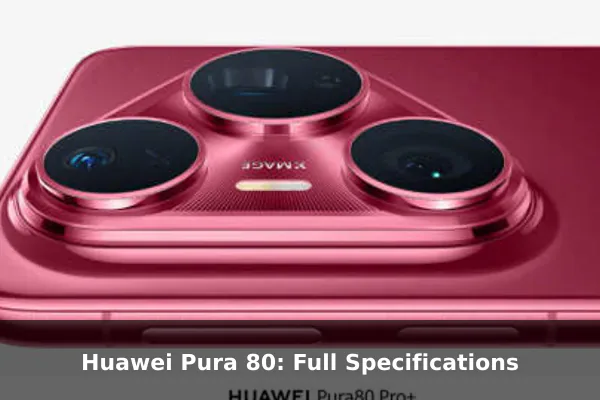
The Pura 80 uses a glass front, aluminum frame, and glass back, giving it the expected premium feel for a modern Huawei flagship-style phone. At 157.7 x 74.4 x 8.2 mm and 211 g, it is not a compact lightweight device, but it remains manageable compared with many large-screen flagships. The 6.6-inch screen size also helps keep the footprint more controlled than oversized Ultra phones.
Durability is one of the more reassuring parts of the package. The IP68/IP69 rating means the phone is designed for dust resistance, immersion under tested conditions, and high-pressure water jet resistance. That does not make it indestructible, and water resistance can reduce over time, but it is a stronger protection claim than basic splash resistance. The color choices also lean elegant rather than loud, with Frosted Gold, Frosted White, Frosted Black, and Green listed in the source data.
Display Experience
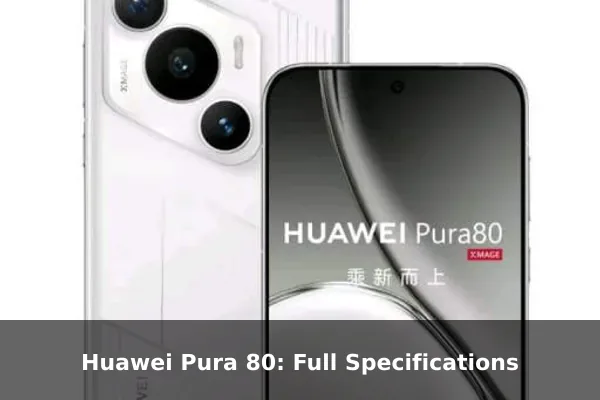
The display is a major selling point. The Pura 80 uses a 6.6-inch LTPO OLED panel with 1 billion colors, HDR Vivid, a 120Hz refresh rate, and 1440Hz PWM dimming. For daily use, that combination points to smooth scrolling, strong color depth, and better comfort for users sensitive to low-frequency flicker. The 1256 x 2760 resolution gives it a sharp pixel density of roughly 459 ppi, so text, photo previews, maps, and web pages should look crisp.
Peak brightness is listed at 2800 nits in the supplied spec data, while Huawei’s regional specification page describes the panel as an LTPO OLED with 1-120Hz adaptive refresh and 1440Hz high-frequency PWM dimming. The panel is protected by Kunlun Glass 2, which is a useful advantage for a phone likely to be bought for travel photography and outdoor use.
Performance and Storage
The Kirin 9010s chipset and octa-core CPU position the Huawei Pura 80 as a capable daily-performance phone rather than a gaming-first device built around the most aggressive global silicon. The key practical advantage is consistency: 12GB of RAM is listed across the 256GB, 512GB, and 1TB storage versions, so buyers are not forced into a higher storage tier just to get more memory.
The absence of a card slot matters. If you shoot a lot of 4K video, keep offline maps, or store large photo libraries locally, the 512GB or 1TB version is the safer configuration. The 256GB model is still reasonable for lighter users, but the Pura 80’s camera system encourages more storage-heavy use than an ordinary midrange phone.

Camera System
The camera setup is the phone’s clearest identity marker. The main 50MP wide camera has a variable f/1.4-f/4.0 aperture, optical image stabilization, PDAF, and a large 1/1.3-inch sensor class in the supplied data. That variable aperture is useful because it gives the camera more flexibility in bright scenes, low light, and close subjects where depth of field can become tricky.
The 12MP periscope telephoto camera adds long-range framing with optical stabilization and 5x optical zoom, while the 13MP ultrawide covers landscapes, architecture, group shots, and tighter indoor scenes. Huawei’s official specification page also lists an Ultra Chroma-style spectral color sensor, which supports the phone’s color and exposure processing. Video support reaches 4K on both rear and front cameras, with HDR Vivid and stabilization features listed for the main system.
Battery and Charging
Battery capacity is one of the most important regional details. The international version is listed with a 5170 mAh battery, while the China version is listed with a 5600 mAh battery. Both are large enough for a premium daily phone, but heavy users comparing imports should pay close attention to which model they are buying.
Charging is strong across the board: 66W wired, 50W wireless, 7.5W reverse wireless, and 5W reverse wired charging are listed. That gives the Pura 80 more flexibility than phones that only focus on wired charging. The reverse wireless option is especially useful for topping up earbuds or accessories, though it is not intended to replace a proper charger for another phone.
Software and Regional Differences
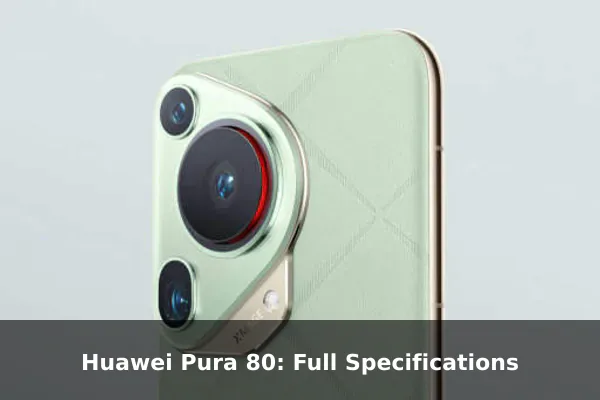
The Pura 80 is listed with EMUI 15 for international markets and HarmonyOS 5.1 for China. That distinction matters as much as the hardware because app availability, cloud services, system features, and update behavior can vary by market. Buyers importing a China model should not assume it will behave exactly like an international HED-LX9 unit, and international buyers should confirm local language, banking app, payment, and warranty support before purchase.
The same caution applies to 5G. The supplied data lists 5G SA/NSA as China only, while international network support emphasizes a broad set of LTE bands. In practical terms, the Pura 80 can be a strong 4G international phone, but shoppers outside China should verify carrier compatibility carefully if 5G is a must-have feature.
Connectivity and Everyday Features
Connectivity is broad in several areas. The phone includes Wi-Fi 7 support, Bluetooth 5.2, NFC, infrared, USB Type-C with OTG, DisplayPort 1.2 in the supplied data, and extensive satellite positioning support including GPS, GLONASS, BDS, Galileo, QZSS, and NavIC. That makes it well equipped for travel, navigation, accessories, and smart-home remote use.
The side-mounted fingerprint sensor is a practical choice, especially for users who prefer fast unlocking without relying only on face recognition. Stereo speakers are included, but there is no 3.5mm headphone jack. BDS Satellite Messaging is listed as China only, so it should be treated as a regional feature rather than a universal emergency or travel capability.
Who Should Buy the Huawei Pura 80?
The Huawei Pura 80 makes the most sense for buyers who prioritize camera versatility, display quality, durable construction, and fast wired plus wireless charging. It is especially appealing if you like Huawei’s image processing style and want a premium phone that is less expensive than the top Pura Ultra model.
It is less ideal for buyers who need guaranteed global 5G, a microSD card slot, a headphone jack, or identical software behavior across regions. For comparison shoppers, the Pura 80 should be judged as a camera-led premium phone with regional caveats, not as a universal Android flagship replacement for every market.
References
Reference sources used for cross-checking include the official Huawei Pura 80 specifications page and the GSMArena Huawei Pura 80 specification listing.
Conclusion
The Huawei Pura 80 is a polished standard flagship-style phone with a sharp LTPO OLED display, versatile triple camera system, strong charging options, and serious durability credentials. Its biggest watchpoints are regional 5G support, software differences, and the battery capacity split between international and China models. Recommended for camera-focused buyers who want the Pura experience at a more accessible level than the Ultra.
