
The vivo T4R is a slim 5G Android phone built around a large AMOLED display, a MediaTek Dimensity 7400 chipset, and a 5700 mAh battery. It sits in the value-focused part of vivo’s lineup, but its sheet reads more ambitious than a basic budget model.
This article focuses on the buying context behind the vivo T4R specifications: where the phone looks strong, where it keeps costs under control, and which users are most likely to benefit from its mix of display, durability, battery life, and camera features.
Full Specifications
Network
| Technology: | GSM / HSPA / LTE / 5G |
| 2G bands: | GSM 850 / 900 / 1800 / 1900 |
| 3G bands: | HSDPA 850 / 900 / 1700(AWS) / 2100 |
| 4G bands: | 1, 3, 5, 8, 19, 28, 38, 40, 41, 42 |
| 5G bands: | 1, 3, 5, 8, 28, 40, 77, 78 SA/NSA |
| Speed: | HSPA, LTE, 5G |
Launch
| Announced: | 2025, July 31 |
| Status: | Available. Released 2025, August 05 |
Body
| Dimensions: | 163.3 x 76.7 x 7.4 mm (6.43 x 3.02 x 0.29 in) |
| Weight: | 183.5 g (6.49 oz) |
| SIM: | Nano-SIM + Nano-SIM |
| IP68/IP69 dust tight and water resistant (high pressure water jets; immersible up to 1.5m for 30 min) MIL-STD-810H compliant* * does not guarantee ruggedness or use in extreme conditions |
Display
| Type: | AMOLED, 1B colors, 120Hz, 2160Hz PWM, HDR10+, 1300 nits (HBM), 1800 nits (peak) |
| Size: | 6.77 inches, 110.9 cm2 (~88.5% screen-to-body ratio) |
| Resolution: | 1080 x 2392 pixels (~388 ppi density) |
| Protection: | Diamond Shield Glass |
Platform
| OS: | Android 15, up to 2 major Android upgrades, Funtouch 15 |
| Chipset: | Mediatek Dimensity 7400 (4 nm) |
| CPU: | Octa-core (4×2.6 GHz Cortex-A78 & 4×2.0 GHz Cortex-A55) |
| GPU: | Mali-G615 MC2 |
Memory
| Card slot: | No |
| Internal: | 128GB 8GB RAM, 256GB 8GB RAM, 256GB 12GB RAM |
| UFS 2.2 |
Main Camera
| Dual: | 50 MP, f/1.8, (wide), 1/1.95″, 0.8µm, PDAF, OIS 2 MP, f/2.4, (depth) |
| Features: | LED flash, HDR, panorama |
| Video: | 4K@30fps, 1080p@30/60fps, gyro-EIS |
Selfie camera
| Single: | 32 MP, f/2.5, (wide) |
| Video: | 4K@30fps, 1080p@30/60fps |
Sound
| Loudspeaker: | Yes, with stereo speakers |
| 3.5mm jack: | No |
Comms
| WLAN: | Wi-Fi 802.11 a/b/g/n/ac/6, dual-band |
| Bluetooth: | 5.4, A2DP, LE |
| Positioning: | GPS, GLONASS, GALILEO, BDS, QZSS |
| NFC: | No |
| Radio: | No |
| USB: | USB Type-C 2.0, OTG |
Features
| Sensors: | Fingerprint (under display, optical), accelerometer, gyro, proximity, compass |
| Circle to Search |
Battery
| Type: | Li-Ion 5700 mAh |
| Charging: | 44W wired Reverse wired Bypass charging |
Misc
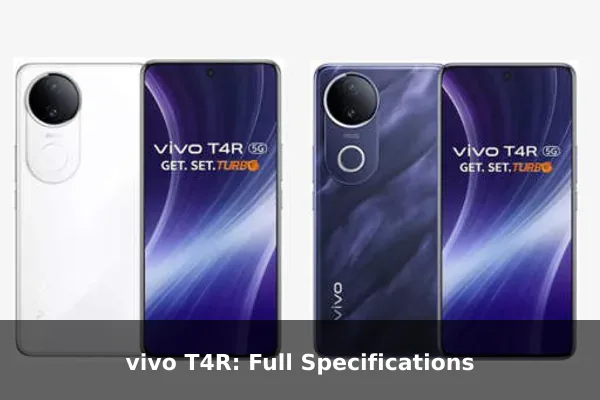
| Colors: | Arctic White, Twilight Blue |
| Price: | About 200 EUR |
Price and Availability
The vivo T4R offers a compelling combination of features and performance. While the base price is around €200, the actual cost may vary depending on your location and retailer. Below, you’ll find the approximate price of the vivo T4R converted into various currencies. Please note that these are estimates based on recent exchange rates as of July 27, 2026 and may not reflect the exact price you’ll find at a retailer.
- United States: $228
- Japan: ¥37,285
- United Kingdom: £171
- Australia: A$326
- Canada: C$321
- Taiwan: NT$7,364
- Denmark: kr1.492
- Saudi Arabia: ﷼854
- South Korea: ₩332,472
- Germany: €200
- Brazil: R$1.158
- Vietnam: ₫5.979.266
- Kenya: KSh 29,472
- India: ₹21,960
- Indonesia: Rp 4.084.509
- Nigeria: ₦310,776
- Pakistan: ₨63,291
- Philippines: ₱14,064
- Bangladesh: ৳২৮,১৪৮
Value Positioning
The vivo T4R is best understood as a practical mid-range 5G phone with a few premium-style priorities. Instead of chasing flagship camera versatility or ultra-fast charging numbers, it focuses on a slim body, a bright AMOLED panel, a large battery, IP68/IP69 protection, and reliable everyday performance. That makes it more interesting than a plain entry-level handset, especially for buyers who care about screen quality and battery endurance as much as raw benchmark scores.
The source price places it in a competitive segment where compromises matter. The key trade-off is not obvious performance weakness, because the Dimensity 7400 is a modern 4 nm chip, but rather feature selectivity. There is no microSD card slot, no 3.5 mm headphone jack, no NFC, and no radio. Buyers who still depend on any of those features should factor that in before being drawn in by the display and battery package.
Design and Durability
One of the vivo T4R’s strongest identity points is its slim build. At 7.4 mm and 183.5 g, it is reasonably light for a phone carrying a 5700 mAh battery. That balance matters because many large-battery phones become thick or heavy enough to feel less comfortable during long browsing, navigation, or video sessions. The T4R aims to keep that endurance advantage without turning into a bulky device.
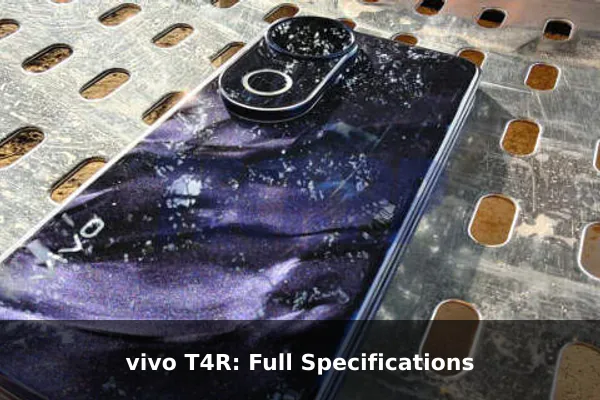
Durability is also a major part of the package. The phone is listed with IP68/IP69 dust and water resistance, including protection against immersion up to 1.5 m for 30 minutes and high-pressure water jets. The MIL-STD-810H compliance note should be read carefully: it does not make the phone a guaranteed rugged device for extreme use, but it does strengthen the case for buyers who want more reassurance against daily exposure to dust, rain, spills, and rough handling. Arctic White and Twilight Blue keep the color selection simple rather than crowded.
Display Experience
The 6.77-inch AMOLED display is one of the vivo T4R’s headline specifications. It supports 1 billion colors, a 120 Hz refresh rate, HDR10+, 2160 Hz PWM dimming, and a listed peak brightness of 1800 nits. On paper, that makes it suitable for users who spend a lot of time watching video, reading outdoors, scrolling social apps, or gaming casually. The 1080 x 2392 resolution gives a density of about 388 ppi, which is sharp enough for this class without pushing unnecessary power consumption.
Diamond Shield Glass adds another useful layer to the display story. The T4R is not just about having a large, vivid screen; it also tries to make that screen more resilient for long-term use. The approximately 88.5 percent screen-to-body ratio gives the front a modern look, while the AMOLED panel helps deliver the contrast and color richness that many buyers now expect even outside flagship pricing.
Performance and Storage
The MediaTek Dimensity 7400 is a central reason the vivo T4R feels more current than many affordable 5G phones. It uses a 4 nm process and an octa-core CPU with four Cortex-A78 performance cores and four Cortex-A55 efficiency cores. Paired with the Mali-G615 MC2 GPU, it should be well suited for everyday multitasking, streaming, messaging, navigation, photo editing, and moderate gaming.
The storage options are straightforward: 128 GB with 8 GB RAM, 256 GB with 8 GB RAM, or 256 GB with 12 GB RAM. UFS 2.2 storage is a sensible choice for this tier, though it is not the fastest standard available in higher-end phones. Since there is no card slot, the 256 GB versions are the safer picks for users who record 4K video, keep many apps installed, or store a large offline media library.
Camera System
The rear camera system is simple but focused. The main 50 MP wide camera includes PDAF and optical image stabilization, which is more meaningful than adding low-value extra lenses. OIS can help with sharper stills and steadier video, especially in lower light or when shooting handheld. The secondary 2 MP depth camera is mainly there to assist portrait separation rather than to add a distinct shooting perspective.
Video support is stronger than many value phones because both the rear and front cameras can record up to 4K at 30 fps, with 1080p options also available. The rear camera adds gyro-EIS, giving the phone a more useful feature set for casual creators. The 32 MP selfie camera is another highlight, particularly for users who often make video calls, record short clips, or want higher-resolution front-facing photos.
Battery and Charging
The 5700 mAh battery is one of the vivo T4R’s most practical advantages. Capacity alone does not guarantee excellent endurance, but when combined with a 4 nm chipset and a 1080p-class AMOLED display, the phone has the right ingredients for strong daily battery life. It should appeal to commuters, students, travelers, and users who dislike topping up before the evening.
Charging is rated at 44W wired, with reverse wired charging and bypass charging also listed. The 44W figure is not the fastest in vivo’s broader ecosystem, but it is reasonable for the segment and should be enough for convenient partial top-ups. Bypass charging is especially useful for gaming or long plugged-in sessions because it can reduce heat buildup compared with routing all power through the battery.
Software and Update Policy
The vivo T4R ships with Android 15 and Funtouch 15. The listed software support includes up to two major Android upgrades, which gives the phone a defined path beyond its launch software. That is important for buyers who plan to keep a device for several years, although some competing brands may offer longer update commitments in select models.
Circle to Search is included, giving the T4R a modern Android convenience feature for quickly searching on-screen text, images, or objects. For many users, this kind of software feature matters more in daily life than another minor camera sensor. The overall software appeal will depend on how comfortable the buyer is with Funtouch OS, but the Android 15 base keeps the phone current at launch.
Connectivity and Everyday Features
Connectivity is broad where it matters most. The vivo T4R supports GSM, HSPA, LTE, and 5G, with both SA and NSA 5G listed. Wi-Fi 6, Bluetooth 5.4, USB Type-C with OTG, and multi-system satellite positioning are also included. Stereo speakers add value for video and gaming, while the under-display optical fingerprint sensor keeps unlocking modern and convenient.
The omissions are worth noting. NFC is not listed, so contactless payment support may be absent depending on market and retailer configuration. There is also no 3.5 mm headphone jack and no FM radio. These are common cuts in modern slim phones, but they still matter for buyers with wired audio gear or payment habits built around NFC.
Who Should Buy the vivo T4R?
The vivo T4R makes the most sense for buyers who want a slim Android 5G phone with a strong screen, dependable battery capacity, and better-than-basic durability. It is a good match for users who watch a lot of content, browse heavily, travel often, or need a phone that can handle long days without feeling oversized in the hand.
It is less ideal for buyers who need expandable storage, NFC payments, a headphone jack, or a true multi-camera setup with ultrawide and telephoto lenses. For those users, the T4R’s clean and focused hardware approach may feel too limited. For everyone else, its combination of AMOLED quality, Dimensity 7400 performance, OIS main camera, 4K selfie video, and 5700 mAh battery gives it a clear role in vivo’s value 5G lineup.
Conclusion
The vivo T4R is a well-balanced 5G smartphone for buyers who prioritize display quality, slim design, durability, and battery life over extras like NFC, expandable storage, or a more versatile rear camera array. Choose it if you want a stylish, long-lasting Android phone with a strong AMOLED screen and sensible performance for everyday use.
References
- vivo India T4R 5G Official Product Page – Primary manufacturer source for official vivo T4R 5G specifications, feature claims, dimensions, battery, cameras, IP ratings, software, and disclaimers.
- vivo India Official Store T4R 5G Listing – Official retail listing with SKU variants, pricing, detailed spec table, network bands, box contents, and manufacturer information.
- MediaTek Dimensity 7400 Official Product Page – Primary chipset manufacturer source to verify the Dimensity 7400 CPU, GPU, connectivity, display, camera, memory, and storage capabilities.
- Gadgets 360 Vivo T4R 5G Launch Coverage – Reputable technology publication useful for independently cross-checking launch date, India pricing, availability, and key specifications.
- Flipkart Vivo T4R 5G Product Listing – Major official retail channel for checking live variant availability, current pricing, user-facing highlights, and listed specifications.
