
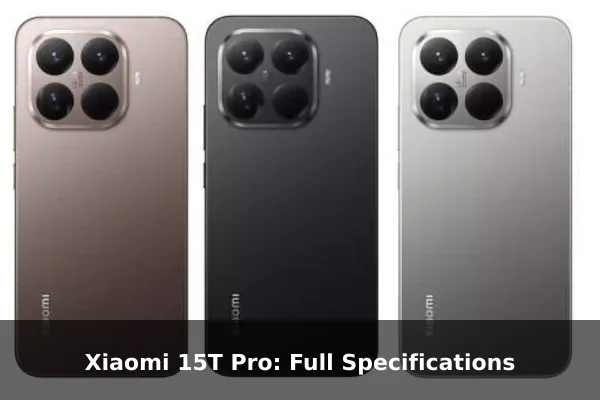
The Xiaomi 15T Pro arrives as the brand’s most accessible flagship-class phone for late 2025, pairing a Leica-tuned camera system with a MediaTek Dimensity 9400+ engine and a 6.83-inch 144Hz AMOLED panel. Announced on 24 September 2025, it slots beneath the full Xiaomi 15 series while keeping many of the headline features that buyers actually notice day to day.
This breakdown looks beyond the spec sheet to explain how the 15T Pro behaves in real use, where it makes smart trade-offs, and which type of buyer gets the most from it. Pricing began around €599 / $814.68 / £509.99, though final figures vary by region and storage, so treat these as launch references rather than fixed numbers.
Full Specifications
Network
| Technology: | GSM / HSPA / LTE / 5G |
| 2G bands: | GSM 850 / 900 / 1800 / 1900 |
| 3G bands: | HSDPA 800 / 850 / 900 / 1700(AWS) / 1900 / 2100 |
| 4G bands: | 1, 2, 3, 4, 5, 7, 8, 12, 13, 17, 18, 19, 20, 25, 26, 28, 32, 38, 39, 40, 41, 42, 48, 66, 71 |
| 5G bands: | 1, 2, 3, 5, 7, 8, 12, 20, 25, 26, 28, 38, 40, 41, 48, 66, 71, 75, 77, 78 SA/NSA |
| Speed: | HSPA, LTE, 5G |
Launch
| Announced: | 2025, September 24 |
| Status: | Available. Released 2025, September 24 |
Body
| Dimensions: | 162.7 x 77.9 x 8 mm (6.41 x 3.07 x 0.31 in) |
| Weight: | 210 g (7.41 oz) |
| Build: | Glass front (Gorilla Glass 7i), aluminum frame, fiber-reinforced plastic back |
| SIM: | · Nano-SIM + Nano-SIM + eSIM + eSIM (max 2 at a time)· Nano-SIM + Nano-SIM |
| IP68 dust tight and water resistant (immersible up to 3m for 30 min) 6M13 aluminium alloy, 330 N/mm frame rigidity, 321 N/mm device rigidity |
Display
| Type: | AMOLED, 68B colors, 144Hz, 3840Hz PWM, Dolby Vision, HDR10+, 3200 nits (peak) |
| Size: | 6.83 inches, 114.5 cm2 (~90.4% screen-to-body ratio) |
| Resolution: | 1280 x 2772 pixels, 19.5:9 ratio (~447 ppi density) |
| Protection: | Corning Gorilla Glass 7i, Mohs level 6 |
Platform
| OS: | Android 15, upgradable to Android 16, HyperOS 3 |
| Chipset: | Mediatek Dimensity 9400+ (3 nm) |
| CPU: | Octa-core (1×3.63 GHz Cortex-X925 & 3×3.3 GHz Cortex-X4 & 4×2.4 GHz Cortex-A720) |
| GPU: | Immortalis-G925 |
Memory
| Card slot: | No |
| Internal: | 256GB 12GB RAM, 512GB 12GB RAM, 1TB 12GB RAM |
| UFS 4.1 |
Main Camera
| Triple: | 50 MP, f/1.6, 23mm (wide), 1/1.31″, 1.2µm, multi-directional PDAF, OIS 50 MP, f/3.0, 115mm (periscope telephoto), 1/2.76″, 0.64µm, PDAF (10cm – ∞), OIS, 5x optical zoom 12 MP, f/2.2, 15mm, 120˚ (ultrawide), 1/3.06″, 1.12µm |
| Features: | Leica lens, Color spectrum sensor, Ultra HDR, LED flash, HDR, panorama |
| Video: | 8K@30fps, 4K@30/60/120fps, 1080p@30/60/120/240/960fps, gyro-EIS, 10-bit Rec. 2020, HDR10+ |
Selfie camera
| Single: | 32 MP, f/2.2, 21mm (wide), 1/3.44″, 0.64µm |
| Features: | HDR |
| Video: | 4K@30fps, 1080p@30/60fps, HDR10+ |
Sound
| Loudspeaker: | Yes, with stereo speakers (with Dolby Atmos) |
| 3.5mm jack: | No |
| 24-bit/192kHz Hi-Res & Hi-Res Wireless audio |
Comms
| WLAN: | Wi-Fi 802.11 a/b/g/n/ac/6e/7, dual-band, Wi-Fi Direct |
| Bluetooth: | 6.0, A2DP, LE |
| Positioning: | GPS (L1+L5), BDS (B1I+B1C+B2a+B2b), GALILEO (E1+E5a+E5b), QZSS (L1+L5), NavIC (L5), GLONASS |
| NFC: | Yes (market/region dependent) |
| Infrared port: | Yes |
| Radio: | No |
| USB: | USB Type-C 2.0, OTG |
Features
| Sensors: | Fingerprint (under display, optical), accelerometer, gyro, proximity, compass |
Battery
| Type: | 5500 mAh |
| Charging: | 90W wired, PD3.0, QC4, 100% in 36 min 50W wireless, 100% in 56 min |
Misc
| Colors: | Black, Gray, Mocha Gold |
| Models: | 2506BPN68G |
| SAR EU: | 0.99 W/kg (head) 0.99 W/kg (body) |
| Price: | € 599.00 / $ 814.68 / £ 509.99 |
Our Tests
| Performance: | AnTuTu: 2683380 (v10) GeekBench: 7914 (v6) 3DMark: 5887 (Wild Life Extreme) |
| Display: | 1419 nits max brightness (measured) |
| Loudspeaker: | -24.8 LUFS (Very good) |
| Battery: | Active use score 16:24h |
EU LABEL
| Energy: | Class A |
| Battery: | 57:43h endurance, 1600 cycles |
| Free fall: | Class A (270 falls) |
| Repairability: | Class C |
Price and Availability
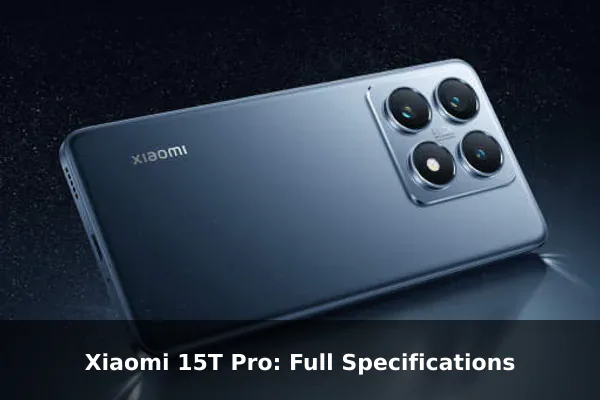
The Xiaomi 15T Pro offers a compelling combination of features and performance. While the base price is around €599, the actual cost may vary depending on your location and retailer. Below, you’ll find the approximate price of the Xiaomi 15T Pro converted into various currencies. Please note that these are estimates based on recent exchange rates as of June 24, 2026 and may not reflect the exact price you’ll find at a retailer.
- United States: $682
- Japan: ¥110,217
- United Kingdom: £517
- Australia: A$985
- Canada: C$969
- Taiwan: NT$21,607
- Denmark: kr4.471
- Saudi Arabia: ﷼2,558
- South Korea: ₩1,047,964
- Germany: €599
- Brazil: R$3.530
- Vietnam: ₫17.917.933
- Kenya: KSh 88,508
- India: ₹64,619
- Indonesia: Rp 12.163.601
- Nigeria: ₦929,099
- Pakistan: ₨189,949
- Philippines: ₱41,722
- Bangladesh: ৳৮৩,৮৩৫
Where the 15T Pro Fits in Xiaomi’s Lineup
The “T” line has always been Xiaomi’s way of delivering flagship ingredients at a friendlier price, and the 15T Pro continues that pattern. You get the powerful Dimensity 9400+ silicon, a Leica triple camera with a genuine periscope telephoto, and IP68 protection, but Xiaomi controls cost with a fiber-reinforced plastic back and USB 2.0 rather than a faster port. For shoppers comparing it against pricier 2025 flagships, that mix is the whole appeal: most of the experience, a noticeably lower entry point.
Design and Build Quality
At 162.7 x 77.9 x 8 mm and 210 g, the 15T Pro is a substantial but not unwieldy device. The aluminum frame is paired with Gorilla Glass 7i up front and a composite back, while Xiaomi quotes strong frame and device rigidity figures. IP68 dust and water resistance (up to 3 m for 30 minutes) means it shrugs off rain and accidental dunks. The EU energy label also rates it Class A for free-fall durability after 270 drops, a reassuring sign for a phone in this bracket. Colors include Black, Gray, and Mocha Gold.
Display Experience
The 6.83-inch AMOLED is a clear highlight. It runs at up to 144Hz, supports Dolby Vision and HDR10+, and uses high-frequency 3840Hz PWM dimming that is gentler on sensitive eyes. Xiaomi cites a 3200-nit peak, and independent testing measured around 1419 nits of real-world brightness, which is plenty for sunny outdoor use. With a 1280 x 2772 resolution (~447 ppi) and roughly 90.4% screen-to-body ratio, text and video look crisp and immersive, and Gorilla Glass 7i with Mohs level 6 hardness adds scratch resistance.
Performance and Software
The Dimensity 9400+ is built on a 3 nm process with a Cortex-X925 prime core and Immortalis-G925 graphics. Benchmark results back up the flagship billing: roughly 2.68 million on AnTuTu v10, a GeekBench 6 score near 7914, and strong 3DMark numbers. Paired with 12GB of LPDDR RAM and fast UFS 4.1 storage (256GB to 1TB), it handles demanding games and heavy multitasking comfortably. It ships with Android 15 and HyperOS 3, upgradable to Android 16, so it should stay current for several update cycles.
Camera System
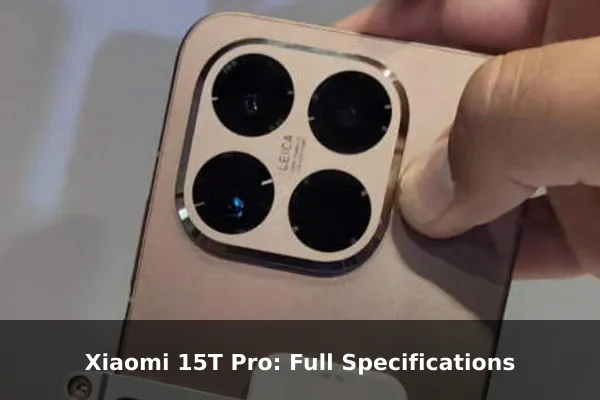
This is where the 15T Pro earns its Pro badge. The Leica-tuned setup combines a 50 MP wide with OIS, a 50 MP 5x periscope telephoto (115mm) that is rare at this price, and a 12 MP ultrawide. A color spectrum sensor helps with accurate white balance, and video tops out at 8K@30fps with 10-bit Rec. 2020 and HDR10+. The 32 MP front camera shoots 4K. For buyers who want real optical reach rather than digital crops, the periscope lens is a standout feature against many similarly priced rivals.
Battery and Charging
A 5500 mAh battery anchors the package, supported by 90W wired charging that Xiaomi rates at a full charge in about 36 minutes, plus 50W wireless. Endurance testing showed an active-use score above 16 hours, and the EU label lists a 57:43h endurance rating with a 1600-cycle longevity estimate. That combination of capacity, fast top-ups, and rated cycle life makes it a dependable all-day phone that should hold up well over time.
Connectivity and Extras
Connectivity is modern and broad: Wi-Fi 7, Bluetooth 6.0, multi-band GNSS, NFC (region dependent), an infrared blaster, and dual eSIM support alongside physical Nano-SIMs. Stereo speakers with Dolby Atmos and Hi-Res audio cover media, though there is no 3.5mm jack or microSD expansion. The main caveat is the USB Type-C 2.0 port, which limits wired data transfer speeds, a typical cost-saving choice on T-series hardware.
Who Should Buy the Xiaomi 15T Pro
The 15T Pro suits buyers who want flagship performance and a versatile Leica camera with real telephoto reach, but who do not want to pay top-tier flagship prices. Mobile photographers, gamers, and media fans get the most value. If you specifically need fast wired file transfers, expandable storage, or a headphone jack, weigh those omissions before buying.
Conclusion
The Xiaomi 15T Pro delivers a confident blend of a bright 144Hz display, capable Dimensity 9400+ performance, a standout Leica 5x periscope camera, and reliable 5500 mAh battery life with rapid charging. The trade-offs, mainly USB 2.0 speeds and no expandable storage, are easy to accept given the launch price. If you want a near-flagship experience with a genuinely useful camera system at a mid-premium price, the 15T Pro is an easy recommendation, especially for photography-focused buyers. Confirm current pricing and storage options in your region before purchasing.
References
- Xiaomi 15T Pro Specs – Xiaomi Global – Primary manufacturer specifications for dimensions, display, processor, cameras, battery, charging, bands, sensors, software, and package contents.
- Xiaomi 15T Pro Overview – Xiaomi Global – Official product overview for headline features such as Leica 5x telephoto, Dimensity 9400+, display, battery, charging, and durability claims.
- MediaTek Dimensity 9400+ – MediaTek (mediatek.com) – Official chipset source to verify Dimensity 9400+ CPU, GPU, AI, connectivity, and platform capabilities referenced in the phone specs.
- The Verge – Xiaomi 15T and 15T Pro launch coverage – Established technology publication covering launch timing, pricing, availability, and key specification comparisons for the 15T series.
- Android Central – Xiaomi 15T Pro review – Hands-on review source useful for cross-checking display, build, battery, camera hardware, software version, and real-world performance details.
