
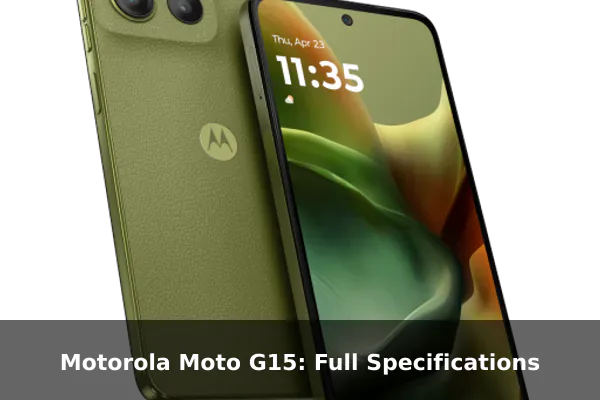
The Motorola Moto G15 is a budget Android phone built around practical hardware rather than headline-driven extras. It combines a large 6.72-inch Full HD+ display, Android 15, a 50 MP main camera, stereo speakers, expandable storage, and a 5200 mAh battery in a body that still keeps the 3.5 mm headphone jack.
Its strongest angle is value for buyers who want a modern-looking LTE phone at a low entry price. The Moto G15 is not aimed at gamers, 5G hunters, or premium-camera users, but its specification sheet gives it a clear role as an affordable everyday smartphone with unusually broad storage choices.
Full Specifications
Network
| Technology: | GSM / HSPA / LTE |
| 2G bands: | GSM 850 / 900 / 1800 / 1900 |
| 3G bands: | HSDPA 850 / 900 / 1900 / 2100 |
| 4G bands: | 1, 2, 3, 5, 7, 8, 20, 28, 38, 40, 41 |
| Speed: | HSPA, LTE |
Launch
| Announced: | 2024, December 17 |
| Status: | Available. Released 2025, February 12 |
Body
| Dimensions: | 165.7 x 76 x 8.2 mm (6.52 x 2.99 x 0.32 in) |
| Weight: | 190 g (6.70 oz) |
| Build: | Glass front (Gorilla Glass 3), plastic frame, silicone polymer back (eco leather) |
| SIM: | Nano-SIM + Nano-SIM |
| IP54 dust protected and water resistant (water splashes) |
Display
| Type: | IPS LCD |
| Size: | 6.72 inches, 109.0 cm2 (~86.6% screen-to-body ratio) |
| Resolution: | 1080 x 2400 pixels, 20:9 ratio (~392 ppi density) |
| Protection: | Corning Gorilla Glass 3, Mohs level 4 |
Platform
| OS: | Android 15 |
| Chipset: | Mediatek Helio G81 Extreme (12 nm) |
| CPU: | Octa-core (2×2.0 GHz Cortex-A75 & 6×1.7 GHz Cortex-A55) |
| GPU: | Mali-G52 MC2 |
Memory
| Card slot: | microSDXC |
| Internal: | 128GB 4GB RAM, 256GB 4GB RAM, 256GB 6GB RAM, 256GB 8GB RAM, 512GB 4GB RAM, 512GB 8GB RAM |
Main Camera
| Dual: | 50 MP, f/1.8, (wide), PDAF 5 MP, f/2.4, (ultrawide) |
| Features: | LED flash, HDR, panorama |
| Video: | 1080p@30fps |
Selfie camera
| Single: | 8 MP, f/2.0, (wide), 1.12µm |
| Video: | 1080p@30fps |
Sound
| Loudspeaker: | Yes, with stereo speakers |
| 3.5mm jack: | Yes |
Comms
| WLAN: | Wi-Fi 802.11 a/b/g/n/ac, dual-band |
| Bluetooth: | 5.0, A2DP, LE |
| Positioning: | GPS, GALILEO, GLONASS, BDS, QZSS |
| NFC: | Yes (market/region dependent) |
| Radio: | FM radio |
| USB: | USB Type-C 2.0 |
Features
| Sensors: | Fingerprint (side-mounted), accelerometer, gyro, proximity, compass |
Battery
| Type: | 5200 mAh |
| Charging: | 18W wired |
Misc
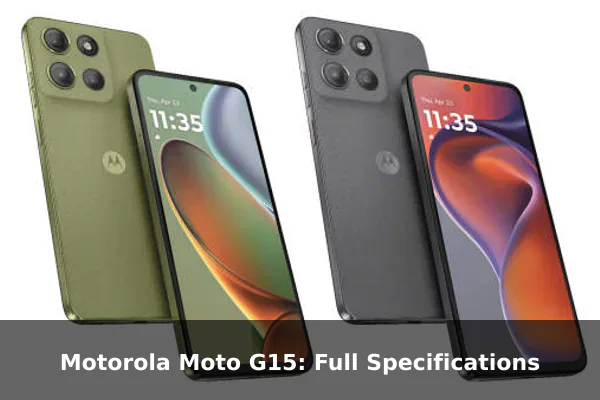
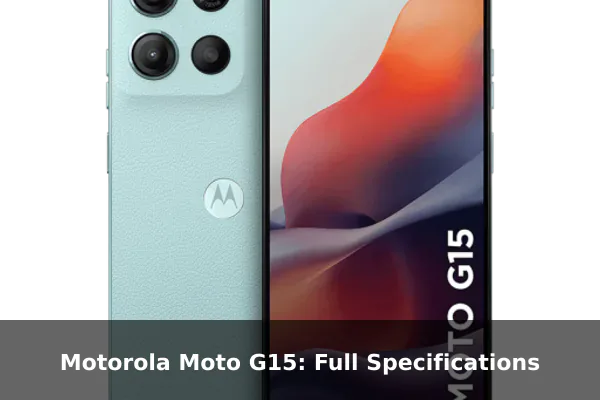
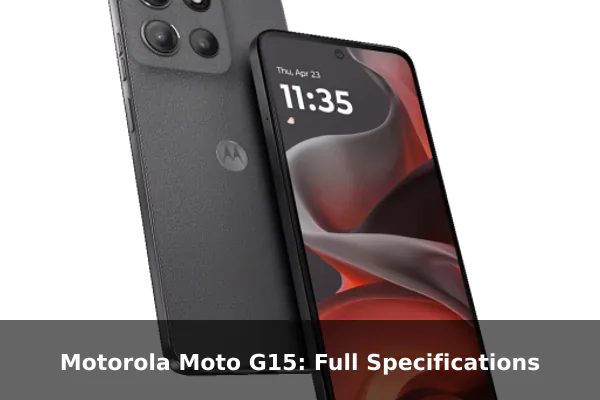
| Colors: | Gravity Grey, Iguana Green, Sunrise Orange, Sea Blue, Glacier Blue |
| Models: | XT2521-3 |
| Price: | € 99.00 / £ 99.99 |
EU LABEL
| Energy: | Class A |
| Battery: | 57:13h endurance, 1000 cycles |
| Free fall: | Class B (180 falls) |
| Repairability: | Class B |
Price and Availability
The Motorola Moto G15 offers a compelling combination of features and performance. While the base price is around €99, the actual cost may vary depending on your location and retailer. Below, you’ll find the approximate price of the Motorola Moto G15 converted into various currencies. Please note that these are estimates based on recent exchange rates as of July 22, 2026 and may not reflect the exact price you’ll find at a retailer.
- United States: $113
- Japan: ¥18,409
- United Kingdom: £84
- Australia: A$161
- Canada: C$159
- Taiwan: NT$3,652
- Denmark: kr739
- Saudi Arabia: ﷼423
- South Korea: ₩167,149
- Germany: €99
- Brazil: R$574
- Vietnam: ₫2.964.210
- Kenya: KSh 14,623
- India: ₹10,873
- Indonesia: Rp 2.019.238
- Nigeria: ₦154,759
- Pakistan: ₨31,393
- Philippines: ₱6,976
- Bangladesh: ৳১৩,৯৩১
Value Positioning
The Motorola Moto G15 is best understood as an entry-level phone with a few carefully chosen upgrades. The listed price of €99.00 / £99.99 places it firmly in budget territory, yet the phone avoids the bare-minimum feel that often appears in this class. A Full HD+ panel, Gorilla Glass 3, IP54 splash resistance, stereo speakers, Android 15, and a 5200 mAh battery give it a more complete foundation than many ultra-cheap phones.
The trade-off is just as important. This is an LTE device, not a 5G model, and the MediaTek Helio G81 Extreme is designed for everyday Android use rather than heavy gaming or advanced computational photography. That makes the Moto G15 a sensible choice for messaging, browsing, calls, maps, video streaming, mobile banking, and light social media, but not a phone to buy if future-proof network speed is the top priority.
Design and Build
Motorola gives the Moto G15 a practical but more textured design than a plain plastic budget phone. The body uses a Gorilla Glass 3 front, a plastic frame, and a silicone polymer back described as eco leather. That back material should make the phone feel warmer and grippier in the hand than glossy plastic, while also helping it stand apart visually from more generic budget designs.
At 165.7 x 76 x 8.2 mm and 190 g, the Moto G15 is a large phone, but not unusually heavy for a device with a display above 6.7 inches and a battery above 5000 mAh. The IP54 rating is another useful detail: it is dust protected and resistant to splashes, but it should not be treated like a waterproof phone. The available colors, Gravity Grey, Iguana Green, Sunrise Orange, Sea Blue, and Glacier Blue, also give buyers more personality than the usual black-and-blue-only budget lineup.
Display Experience
The 6.72-inch IPS LCD is one of the Moto G15’s most important specifications. Its 1080 x 2400 resolution produces about 392 ppi, which is sharp enough for reading, browsing, subtitles, maps, and app interfaces. In a low-cost phone, Full HD+ resolution matters because many rivals still cut back to lower-resolution panels that look softer at this size.
The screen uses a tall 20:9 aspect ratio and reaches an estimated 86.6 percent screen-to-body ratio, so it should feel spacious for scrolling and streaming. Motorola also lists Corning Gorilla Glass 3 protection with Mohs level 4 scratch resistance. The panel is still IPS LCD rather than OLED, so buyers should not expect the deep blacks and high contrast of an AMOLED phone, but the size and resolution make it a strong fit for budget media use.
Performance and Storage
The Moto G15 runs on the MediaTek Helio G81 Extreme, a 12 nm chipset with an octa-core CPU made up of two Cortex-A75 cores at 2.0 GHz and six Cortex-A55 cores at 1.7 GHz. Graphics are handled by the Mali-G52 MC2. This combination is appropriate for routine Android tasks, but it is not designed to compete with mid-range 5G chipsets or flagship processors.
The memory configurations are unusually broad: 128GB with 4GB RAM, 256GB with 4GB, 6GB, or 8GB RAM, and 512GB with 4GB or 8GB RAM. That range is useful because buyers can prioritize storage without moving to a different model. The microSDXC slot is another major advantage for users who keep offline music, videos, photos, documents, or messaging backups. For smoother multitasking, the 6GB or 8GB RAM versions are the more comfortable picks if available in your market.
Camera Setup
The rear camera system is straightforward: a 50 MP wide camera with f/1.8 aperture and PDAF, paired with a 5 MP ultrawide camera. This is a practical dual-camera layout because the second camera adds a real field-of-view difference instead of being a low-value decorative sensor. The 50 MP main camera should be the default choice for most photos, while the ultrawide camera is better reserved for daylight landscapes, buildings, and group shots.
Video recording is limited to 1080p at 30 fps on both the rear and front cameras. That is acceptable for casual clips, video messages, and social posts, but it clearly separates the Moto G15 from phones aimed at creators. The 8 MP front camera is similarly basic but functional, with 1080p video support for calls and simple selfie recording.
Battery and Charging
Battery capacity is a major selling point. The Moto G15 carries a 5200 mAh battery, giving it more capacity than the common 5000 mAh baseline used across many budget Android phones. Combined with an LTE-only modem and a modest chipset, that capacity should support long everyday endurance, especially for users focused on messaging, browsing, calls, and streaming over Wi-Fi.
The EU label data adds useful context: the phone is rated Energy Class A, with 57:13h endurance, 1000 battery cycles, Class B free-fall resistance for 180 falls, and Class B repairability. Those labels make the Moto G15 easier to compare against other phones beyond just battery size. Charging is 18W wired, which is adequate but not fast by current standards, so the battery is more about lasting longer than refilling quickly.
Software and Daily Use
The Moto G15 ships with Android 15, which is a valuable point for an affordable phone released in early 2025. Starting on a current Android version helps the device feel more modern out of the box, especially for app compatibility, privacy controls, and interface behavior. Motorola’s software approach is typically close to clean Android, although update timing and feature availability can vary by region and carrier.
Daily-use hardware is well covered. The side-mounted fingerprint reader keeps unlocking simple, while the accelerometer, gyro, proximity sensor, and compass support common apps and navigation features. Stereo speakers and the headphone jack make the phone friendlier for music, videos, calls, and wired audio accessories than many more expensive phones that have dropped the port.
Connectivity
Connectivity is comprehensive for a 4G phone. The Moto G15 supports GSM, HSPA, and LTE, with 4G bands including 1, 2, 3, 5, 7, 8, 20, 28, 38, 40, and 41. That band list suits broad LTE use in many regions, though buyers should still check local carrier compatibility before purchase, especially when importing.
Wi-Fi 802.11 a/b/g/n/ac with dual-band support, Bluetooth 5.0, USB Type-C 2.0, FM radio, and satellite positioning through GPS, GALILEO, GLONASS, BDS, and QZSS give the phone a well-rounded communication package. NFC is listed as market or region dependent, so contactless payment support should not be assumed for every unit. Dual Nano-SIM support also makes the Moto G15 useful for separating personal and work numbers or combining local and travel SIMs.
Who Should Buy It?
The Moto G15 makes the most sense for buyers who want a low-cost Android phone with a large sharp display, long battery life, expandable storage, and reliable everyday features. It is also a good fit for students, secondary-phone users, family members who do not need 5G, and anyone who values practical hardware such as stereo speakers, FM radio, dual SIM, and a headphone jack.
It is less suitable for users who play demanding 3D games, record lots of high-resolution video, rely on 5G coverage, or want premium display contrast. The best configuration to look for is one with at least 6GB RAM if pricing stays reasonable, because the extra memory should age better than the base 4GB versions.
Conclusion
The Motorola Moto G15 is a value-first LTE smartphone with a strong mix of basics: a large Full HD+ display, Android 15, expandable storage, stereo speakers, a 50 MP main camera, and a 5200 mAh battery. Its lack of 5G and modest charging speed are clear limitations, but they are understandable at this price level. Buy it if you want an affordable everyday Android phone with strong battery and storage flexibility; skip it if 5G, gaming power, or advanced video features matter most.
References
- Motorola Moto G15 Official Product Page – Primary manufacturer page with Moto G15 specifications, features, colors, storage/RAM, battery, display, camera, connectivity, and in-box details.
- Motorola Support: Specifications – moto g15 – Official Motorola support specification sheet for verifying detailed hardware specs, dimensions, battery, display, bands, sensors, and market-variation notes.
- Motorola Help: About your hardware – moto g15 – Official user-help documentation showing Moto G15 hardware layout, ports, cameras, NFC sensor area, SIM/SD tray, and physical controls.
- MediaTek Helio G81 Official Product Page – Primary chipset source for checking CPU, GPU, memory, camera, wireless, GNSS, Bluetooth, Wi-Fi, and FM radio capabilities related to the Moto G15 processor.
- Gadgets360 Moto G15 Launch Coverage – Established technology publication useful for corroborating launch timing, positioning, and key specifications against official Motorola details.
