
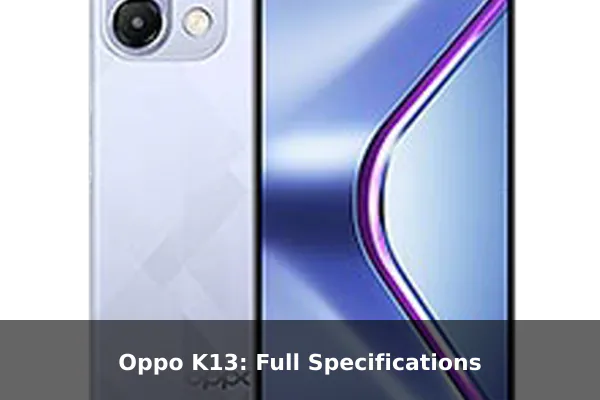
The Oppo K13 is a mid-range 5G smartphone built around a large battery, a 120Hz AMOLED display, and Qualcomm’s Snapdragon 6 Gen 4 platform. It sits below OPPO’s more performance-branded K13 Turbo models, but it still targets buyers who want long endurance, smooth everyday speed, and practical features at a lower price point.
With a 7000 mAh silicon-carbon battery, 80W wired charging, stereo speakers, IP65 protection, and Android 15 with ColorOS 15, the K13 has a clear value-first identity. This article focuses on what those specifications mean in daily use, while the full technical table can be checked separately for every band, model number, and variant.
Full Specifications
Network
| Technology: | GSM / HSPA / LTE / 5G |
| 2G bands: | GSM 850 / 900 / 1800 / 1900 |
| 3G bands: | HSDPA 850 / 900 / 2100 |
| 4G bands: | 1, 3, 5, 8, 28, 34, 38, 39, 40, 41, 42, 48 – China |
| 5G bands: | 1, 5, 8, 28, 41, 77, 78 SA/NSA – China |
| Speed: | HSPA, LTE, 5G |
Launch
| Announced: | 2025, April 21 |
| Status: | Available. Released 2025, April 25 |
Body
| Dimensions: | 163.2 x 76.1 x 8.5 mm (6.43 x 3.00 x 0.33 in) |
| Weight: | 208 g (7.34 oz) |
| SIM: | Nano-SIM + Nano-SIM |
| IP65 dust tight and water resistant (low pressure water jets) |
Display
| Type: | AMOLED, 120Hz, 1920Hz PWM, 600 nits (typ), 1200 nits (peak) |
| Size: | 6.67 inches, 107.4 cm2 (~86.5% screen-to-body ratio) |
| Resolution: | 1080 x 2400 pixels, 20:9 ratio (~395 ppi density) |
Platform
| OS: | Android 15, up to 2 major Android upgrades, ColorOS 15 |
| Chipset: | Qualcomm Snapdragon 6 Gen 4 (4 nm) |
| CPU: | Octa-core (1×2.3 GHz Cortex-A720s & 3×2.2 GHz Cortex-A720s & 4×1.8 GHz Cortex-A520s) |
| GPU: | Adreno 810 |
Memory
| Card slot: | No |
| Internal: | 128GB 8GB RAM, 256GB 8GB RAM, 256GB 12GB RAM, 512GB 12GB RAM |
| UFS 3.1 |
Main Camera
| Dual: | 50 MP, f/1.9, 27mm (wide), 1/2.88″, PDAF 2 MP, f/2.4, (depth) |
| Features: | LED flash, HDR, panorama |
| Video: | 4K@30fps, 1080p@30/60/120fps, gyro-EIS |
Selfie camera
| Single: | 16 MP, f/2.5, 23mm (wide), 1/3.0″, 1.0µm |
| Video: | 1080p@30fps, gyro-EIS |
Sound
| Loudspeaker: | Yes, with stereo speakers |
| 3.5mm jack: | No |
| Snapdragon Sound |
Comms
| WLAN: | Wi-Fi 802.11 a/b/g/n/ac/6, dual-band |
| Bluetooth: | 5.2, A2DP, LE, aptX HD |
| Positioning: | GPS, GALILEO, GLONASS, BDS, QZSS |
| NFC: | NFC (China only) |
| Infrared port: | Yes |
| Radio: | No |
| USB: | USB Type-C 2.0, OTG |
Features
| Sensors: | Fingerprint (under display, optical), accelerometer, gyro, proximity, compass |
| Circle to Search |
Battery
| Type: | Si/C Li-Ion 7000 mAh |
| Charging: | 80W wired, 33W PPS, PD, QC, 62% in 30 min, 100% in 56 min |
Misc
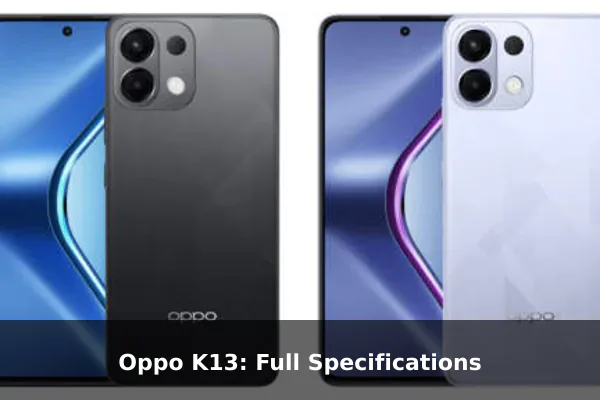
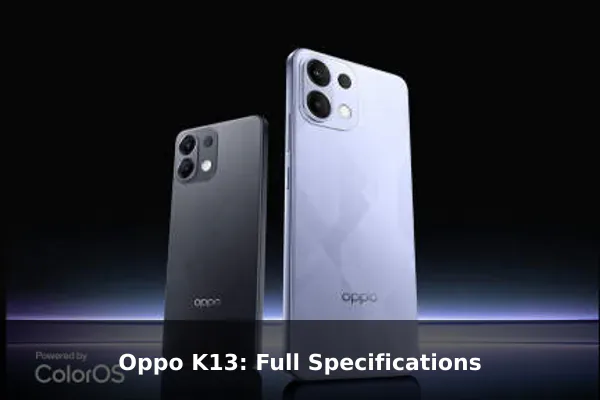
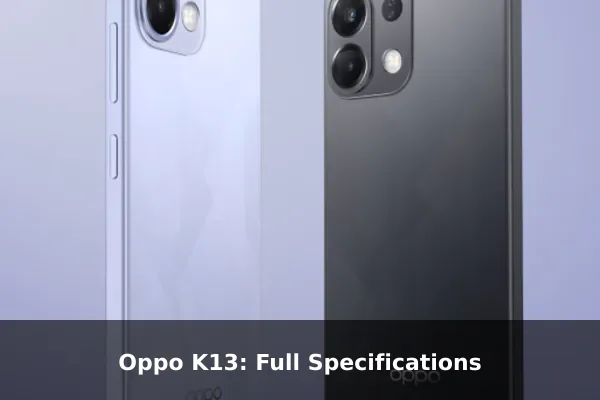
| Colors: | Icy Purple, Prism Black, White |
| Models: | CPH2729, PLD110 |
| Price: | About 190 EUR |
Price and Availability
The Oppo K13 offers a compelling combination of features and performance. While the base price is around €190, the actual cost may vary depending on your location and retailer. Below, you’ll find the approximate price of the Oppo K13 converted into various currencies. Please note that these are estimates based on recent exchange rates as of August 15, 2026 and may not reflect the exact price you’ll find at a retailer.
- United States: $220
- Japan: ¥34,994
- United Kingdom: £162
- Australia: A$310
- Canada: C$305
- Taiwan: NT$7,031
- Denmark: kr1.420
- Saudi Arabia: ﷼824
- South Korea: ₩310,948
- Germany: €190
- Brazil: R$1.141
- Vietnam: ₫5.736.298
- Kenya: KSh 28,401
- India: ₹20,973
- Indonesia: Rp 3.913.559
- Nigeria: ₦298,851
- Pakistan: ₨61,013
- Philippines: ₱13,499
- Bangladesh: ৳২৬,৯৮৪
Value Positioning
The Oppo K13 is best understood as a battery-focused 5G phone with several features that usually matter more than benchmark headlines. Its reported price class of about 190 EUR places it in a competitive budget-to-mid-range segment, yet the hardware mix is stronger than a basic entry-level device. The Snapdragon 6 Gen 4 chipset, UFS 3.1 storage, AMOLED panel, and 80W charging give it a more balanced profile than phones that focus only on screen size or camera count.
The most important value point is that OPPO has not treated endurance as the only selling point. A 7000 mAh battery can make a phone thick or slow to charge, but the K13 pairs that capacity with fast charging and a relatively modern 4 nm chip. That combination should appeal to users who spend long hours on mobile data, gaming, messaging, streaming, navigation, and social apps without wanting to plan their day around a charger.
Design and Build
The phone measures 163.2 x 76.1 x 8.5 mm and weighs 208 g, so it is not a compact or featherweight model. The trade-off is easy to understand: the K13 carries a much larger-than-average battery, and that extra capacity has to live somewhere. Even so, the 8.5 mm thickness is still reasonable for a 7000 mAh device, especially for buyers who value endurance over the thinnest possible frame.
IP65 dust tight and water resistant protection is a useful addition in this price range. It is not the same as a higher submersion-focused IP rating, but it does mean the phone is better prepared for dust exposure and low-pressure water jets. The available colors, Icy Purple, Prism Black, and White, give the device a cleaner mainstream look rather than an aggressive gaming-phone style.
Display Experience
The 6.67-inch AMOLED display is one of the K13’s stronger everyday advantages. Its 1080 x 2400 resolution works out to about 395 ppi, which is sharp enough for reading, browsing, maps, video captions, and social media feeds. The 20:9 aspect ratio also keeps the phone familiar for vertical scrolling and widescreen video playback.
The 120Hz refresh rate should make scrolling and supported animations feel smoother than standard 60Hz panels. OPPO also lists 1920Hz PWM dimming, which may be relevant for users sensitive to display flicker, although comfort can still vary from person to person. Brightness is rated at 600 nits typical and 1200 nits peak, so the display should be usable outdoors, though flagship-level sunlight performance should not be expected.
Performance Hardware
At the center of the Oppo K13 is the Qualcomm Snapdragon 6 Gen 4, a 4 nm chipset with an octa-core CPU layout and Adreno 810 graphics. For this class of phone, the platform is a meaningful upgrade path over older budget 5G chips because it should offer better efficiency and steadier performance for common workloads. App switching, video streaming, camera processing, web browsing, and light-to-moderate gaming are the natural targets.
The memory options also help the phone’s long-term usability. Buyers can choose 128GB with 8GB RAM, 256GB with 8GB RAM, 256GB with 12GB RAM, or 512GB with 12GB RAM, depending on market availability. There is no memory card slot, so choosing the right storage tier matters. The use of UFS 3.1 is a positive detail because faster storage can make app launches, file transfers, and game loading feel more responsive than older eMMC-based phones.
Camera Setup
The rear camera system is simple: a 50 MP wide camera with PDAF plus a 2 MP depth sensor. This is not a multi-purpose camera phone with ultrawide, telephoto, or macro hardware. Instead, the K13 focuses on a main camera that should handle everyday stills, portraits, documents, and casual social media photos, with the depth sensor assisting background separation in supported modes.
Video recording support is more interesting than the camera count suggests. The rear camera can record up to 4K at 30fps and 1080p at 30, 60, or 120fps with gyro-EIS. That gives users some flexibility for sharper clips, smoother motion, or slow-motion-style capture. The 16 MP front camera records 1080p at 30fps with gyro-EIS, which is practical for video calls, short clips, and social posts, though it remains a conventional single selfie camera.
Battery and Charging
Battery life is the main reason to pay attention to this phone. The 7000 mAh silicon-carbon Li-Ion battery is far larger than the 5000 mAh packs still common across many mid-range devices. In real-world use, that capacity should matter most to commuters, students, field workers, delivery riders, travelers, and anyone who spends much of the day away from a wall outlet.
Charging is also unusually strong for a value-focused device. OPPO lists 80W wired charging, along with 33W PPS, PD, and QC support. The claimed charging figures are 62 percent in 30 minutes and 100 percent in 56 minutes. As always, charging speed can depend on temperature, charger compatibility, battery condition, and usage while plugged in, but the headline specification means the K13 does not ask users to accept slow charging in exchange for a very large battery.
Software and Updates
The Oppo K13 ships with Android 15 and ColorOS 15. That gives it a current software base for its launch period, including modern Android privacy controls, notification behavior, and OPPO’s own interface features. The phone is also listed with up to two major Android upgrades, which is useful clarity for buyers comparing it against devices with unclear update commitments.
Circle to Search is another notable feature because it brings a more modern search workflow to a mid-range phone. Instead of relying only on screenshots or manual text entry, users can search on-screen content more directly where supported. For a phone in this segment, that kind of feature helps the K13 feel more current than its price might suggest.
Connectivity and Audio
The K13 supports GSM, HSPA, LTE, and 5G, with the supplied band list focused on China variants. This matters for import buyers: network compatibility should be checked carefully before purchasing outside the intended market. A phone can support 5G generally while still missing important local bands for a specific carrier.
Wireless connectivity includes Wi-Fi 6, Bluetooth 5.2, and major positioning systems such as GPS, GALILEO, GLONASS, BDS, and QZSS. NFC is listed as China only, so contactless payment support may depend heavily on the exact model and region. The infrared port is a useful practical extra for controlling compatible appliances, while stereo speakers and Snapdragon Sound support strengthen the media experience. The missing 3.5 mm headphone jack is the main audio limitation for wired-headset users.
Who Should Buy the Oppo K13?
The Oppo K13 makes the most sense for buyers who prioritize endurance, display quality, and reliable daily performance over premium camera versatility. It is a strong fit for users who want a big AMOLED screen, 5G support, fast charging, modern Android software, and enough storage options to avoid running out of space too quickly.
It is less ideal for shoppers who need an ultrawide camera, telephoto zoom, expandable storage, a headphone jack, or compact dimensions. It is also worth checking local availability and model support carefully, especially because some connectivity details and NFC support are region-specific. As a value phone, the K13’s strength is not that it does everything, but that it puts battery life, charging speed, and core usability first.
Conclusion
The Oppo K13 is a practical 5G phone built for long battery life, smooth AMOLED viewing, and dependable everyday performance. Its biggest compromises are the simple camera system, lack of microSD support, and no headphone jack, but the 7000 mAh battery, 80W charging, Snapdragon 6 Gen 4 chip, stereo speakers, and IP65 rating make it a strong value choice. Recommended for buyers who want a long-lasting Android phone before they want a camera-heavy one.
References
- OPPO India – OPPO K13 5G Specifications – Primary manufacturer specifications for the OPPO K13 5G, including model number, dimensions, display, cameras, battery, charging, bands, sensors, SAR, and OS.
- OPPO India – OPPO K13 5G Product Page – Official product page for feature claims such as Snapdragon 6 Gen 4, 7000mAh battery, 80W SUPERVOOC charging, display highlights, cooling, and camera features.
- OPPO India Newsroom – OPPO K13 5G Launch Release – Official launch announcement with launch date, India pricing, variants, availability, key specifications, IP rating, and software update commitments.
- Qualcomm – Snapdragon 6 Gen 4 Mobile Platform – Primary chipset reference for the Snapdragon 6 Gen 4 platform used in the OPPO K13 5G, useful for validating CPU, GPU, connectivity, and platform capabilities.
- Gadgets 360 – OPPO K13 5G Specs – Established technology reference page useful as a secondary cross-check for launch date, India pricing, variants, and core specifications.
