
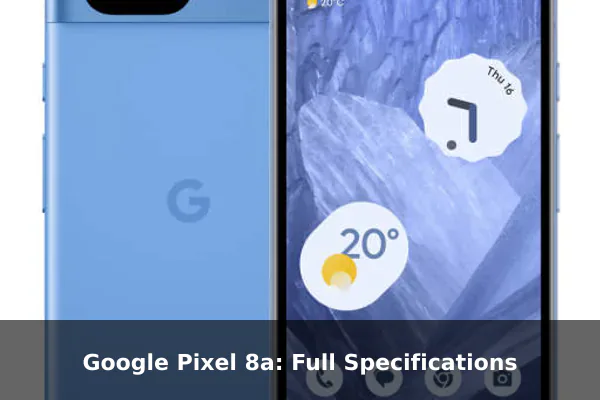
Google Pixel 8a is Google’s compact mid-range Android phone built around the Tensor G3 platform, a bright 120Hz OLED display, long software support, and the familiar Pixel camera processing style.
This article focuses on what the Pixel 8a means as a daily-use phone, not just the spec sheet. The dedicated full specifications table will cover the exact bands, camera details, dimensions, storage variants, and test figures separately.
Full Specifications
Network
| Technology: | GSM / HSPA / LTE / 5G |
| 2G bands: | GSM 850 / 900 / 1800 / 1900 |
| 3G bands: | HSDPA 800 / 850 / 900 / 1700(AWS) / 1900 / 2100 |
| 4G bands: | 1, 2, 3, 4, 5, 7, 8, 12, 17, 18, 19, 20, 26, 28, 32, 38, 40, 41, 42, 66 – G6GPR (International) |
| 1, 2, 3, 4, 5, 7, 8, 12, 13, 14, 17, 20, 25, 26, 28, 29, 30, 38, 41, 48, 66, 71 – G8HHN (USA), GKV4X (NA) | |
| 5G bands: | 1, 2, 3, 5, 7, 8, 12, 20, 26, 28, 38, 40, 41, 66, 75, 76, 77, 78 SA/NSA/Sub6 – G6GPR (International) |
| 1, 2, 3, 5, 7, 8, 12, 20, 25, 26, 28, 29, 30, 38, 41, 48, 66, 70, 71, 77, 78 SA/NSA/Sub6 – GKV4X (NA) | |
| 1, 2, 3, 5, 7, 8, 20, 28, 48, 66, 71, 77, 78, 260, 261 SA/NSA/Sub6/mmWave – G8HHN (USA) | |
| Speed: | HSPA, LTE (CA), 5G |
Launch
| Announced: | 2024, May 07 |
| Status: | Available. Released 2024, May 14 |
Body
| Dimensions: | 152.1 x 72.7 x 8.9 mm (5.99 x 2.86 x 0.35 in) |
| Weight: | 188 g (6.63 oz) |
| Build: | Glass front (Gorilla Glass 3), aluminum frame, plastic back |
| SIM: | Nano-SIM + eSIM |
| IP67 dust/water resistant (up to 1m for 30 min) |
Display
| Type: | OLED, HDR, 120Hz, 2000 nits (peak) |
| Size: | 6.1 inches, 90.3 cm2 (~81.6% screen-to-body ratio) |
| Resolution: | 1080 x 2400 pixels, 20:9 ratio (~430 ppi density) |
| Protection: | Corning Gorilla Glass 3, Mohs level 5 |
Platform
| OS: | Android 14, upgradable to Android 15, up to 7 major Android upgrades |
| Chipset: | Google Tensor G3 (4 nm) |
| CPU: | Nona-core (1×3.0 GHz Cortex-X3 & 4×2.45 GHz Cortex-A715 & 4×2.15 GHz Cortex-A510) |
| GPU: | Immortalis-G715s MC10 |
Memory
| Card slot: | No |
| Internal: | 128GB 8GB RAM, 256GB 8GB RAM |
| UFS 3.1 |
Main Camera
| Dual: | 64 MP (16 MP eff.), f/1.9, 26mm (wide), 1/1.73″, 0.8µm, dual pixel PDAF, OIS 13 MP, f/2.2, 120˚ (ultrawide), 1.12µm |
| Features: | Dual-LED flash, Pixel Shift, Ultra HDR, panorama, Best Take |
| Video: | 4K@30/60fps, 1080p@30/60/120/240fps, OIS |
Selfie camera
| Single: | 13 MP, f/2.2, 20mm (ultrawide), 1.12µm |
| Features: | HDR, panorama |
| Video: | 4K@30fps, 1080p@30/60fps |
Sound
| Loudspeaker: | Yes, with stereo speakers |
| 3.5mm jack: | No |
Comms
| WLAN: | Wi-Fi 802.11 a/b/g/n/ac/6e, dual/tri-band (market/region dependent) |
| Bluetooth: | 5.3, A2DP, LE |
| Positioning: | GPS, GLONASS, GALILEO, BDS, QZSS, NavIC |
| NFC: | Yes |
| Radio: | No |
| USB: | USB Type-C 3.2 |
Features
| Sensors: | Fingerprint (under display, optical), accelerometer, gyro, proximity, compass, barometer |
| Circle to Search |
Battery
| Type: | Li-Po 4492 mAh |
| Charging: | 18W wired, PD3.0 7.5W wireless Bypass charging |
Misc
| Colors: | Obsidian, Porcelain, Bay, Aloe |
| Models: | GKV4X, G6GPR, G8HHN, G576D |
| Price: | € 299.99 / $ 240.00 / £ 239.25 / ₹ 36,999 |
Our Tests
| Performance: | AnTuTu: 1193520 (v10) GeekBench: 4384 (v6) 3DMark: 2427 (Wild Life Extreme) |
| Display: | 1508 nits max brightness (measured) |
| Loudspeaker: | -26.5 LUFS (Good) |
| Battery: | Active use score 11:25h |
| Battery (old): | Endurance rating 83h |
EU LABEL
| Energy: | Class B |
| Battery: | 40:06h endurance, 1000 cycles |
| Free fall: | Class A (270 falls) |
| Repairability: | Class B |
Price and Availability
The Google Pixel 8a offers a compelling combination of features and performance. While the base price is around €300, the actual cost may vary depending on your location and retailer. Below, you’ll find the approximate price of the Google Pixel 8a converted into various currencies. Please note that these are estimates based on recent exchange rates as of July 28, 2026 and may not reflect the exact price you’ll find at a retailer.
- United States: $341
- Japan: ¥55,879
- United Kingdom: £257
- Australia: A$488
- Canada: C$482
- Taiwan: NT$11,029
- Denmark: kr2.239
- Saudi Arabia: ﷼1,280
- South Korea: ₩501,361
- Germany: €300
- Brazil: R$1.739
- Vietnam: ₫8.958.400
- Kenya: KSh 44,264
- India: ₹32,728
- Indonesia: Rp 6.160.619
- Nigeria: ₦465,532
- Pakistan: ₨94,833
- Philippines: ₱21,074
- Bangladesh: ৳৪২,১৩০
Value and Positioning
The Google Pixel 8a sits in the part of the market where long-term software support, camera reliability, and compact usability matter more than having the largest screen or fastest charging number. Its strongest value argument is that it brings many core Pixel 8-series traits into a less expensive model: Tensor G3, AI-assisted software features, an OLED panel with a high refresh rate, IP-rated protection, wireless charging, and a multi-year Android upgrade commitment.
That combination makes the Pixel 8a especially relevant for buyers comparing it with mid-range Samsung Galaxy A-series phones, older discounted flagships, and performance-focused Chinese-market alternatives. Some rivals offer larger batteries or faster charging, but the Pixel 8a leans into consistency: clean Android, dependable imaging, broad 5G support across regional models, and official software backing that should keep the phone useful for longer.
Design and Durability
The Pixel 8a keeps Google’s recognizable camera bar design, giving it a clear family identity beside the Pixel 8 and Pixel 8 Pro. Its 6.1-inch class body is easier to handle than many current Android phones, and the rounded shape helps it feel less bulky despite a weight that is not especially light for its size.
Build quality is practical rather than luxurious. The front uses Gorilla Glass 3, the frame is aluminum, and the back is plastic. That material mix helps control cost and may make the rear less fragile than glass, although the front protection is not Google’s newest glass option. The IP67 rating is a meaningful advantage in this price class, adding resistance against dust and short accidental water exposure. It is not a rugged phone, but it is better prepared for daily mishaps than many cheaper Android models.
Display Experience
The OLED display is one of the Pixel 8a’s most important upgrades over older Pixel A-series models. The move to a 120Hz refresh rate makes scrolling, app switching, and general navigation feel noticeably smoother, while HDR support and high peak brightness help the phone remain usable outdoors and more enjoyable for video playback.
The 1080 x 2400 resolution is sharp at this size, so text and interface elements should look crisp without the battery cost of a higher-resolution panel. The measured brightness result in the source data also supports the idea that the Pixel 8a is not merely bright on paper. The main compromise is the older Gorilla Glass 3 protection, so a screen protector is still sensible for users who keep phones for several years.
Tensor G3 Performance
Google’s Tensor G3 gives the Pixel 8a a more flagship-like foundation than many mid-range phones. It is not designed to chase the highest gaming benchmarks in its class, but it is well suited to the Pixel experience: camera processing, speech features, on-device intelligence, everyday multitasking, and responsive Android performance.
The benchmark results in the source data point to strong overall performance for regular use, with enough headroom for demanding apps and mainstream games. The 8GB RAM configuration is also appropriate for modern Android, although buyers should choose storage carefully because there is no microSD card slot. The 256GB model is the safer long-term option for users who record a lot of 4K video, download offline media, or keep several years of photos locally.
Cameras for Everyday Photography
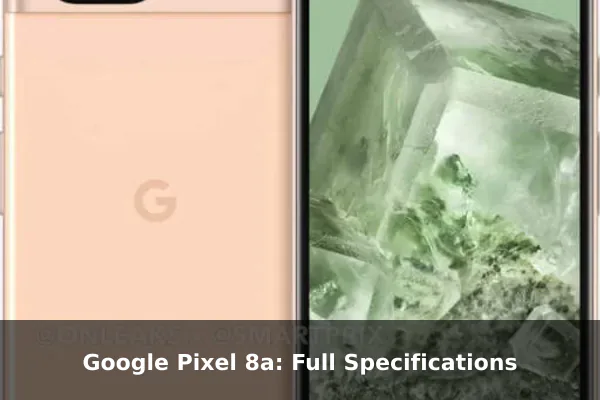
The Pixel 8a’s camera setup is not about having the most lenses. Instead, it relies on a high-resolution main camera with optical stabilization, an ultrawide camera, and Google’s computational photography pipeline. That makes it a strong option for users who want quick, reliable point-and-shoot photos without spending time in manual modes.
The main camera is the important one here. Optical image stabilization helps in lower light and video, while Pixel processing supports features such as Ultra HDR, Best Take, and Pixel Shift. The ultrawide camera adds flexibility for landscapes, interiors, and group shots, although it should not be expected to match the main sensor in difficult lighting. Video support is also solid for the class, with 4K recording on both rear and front cameras. For buyers who care about portraits, social clips, travel photos, and family shots, the Pixel 8a remains one of the more camera-focused phones in its segment.
Battery and Charging
The Pixel 8a has a battery capacity that fits its compact size, and the active-use result in the source data suggests it can handle a normal day for many users. The OLED panel, Tensor G3, and Android power management all play a role here, so real endurance will depend heavily on screen brightness, 5G use, navigation, camera recording, and gaming.
Charging is the weaker side of the package. Wired charging is modest compared with many Android competitors, and wireless charging is convenient but not fast. The inclusion of wireless charging still matters because many mid-range phones skip it entirely. Buyers who want a phone that refills extremely quickly during short breaks should look elsewhere, but users who charge overnight or at a desk are less likely to find this limiting.
Software Longevity and Pixel Features
Software support is one of the clearest reasons to choose the Pixel 8a. It launched with Android 14 and is listed as upgradable with a long major Android upgrade commitment. That makes it unusually future-proof for a mid-range Android phone and improves its value for people who keep phones for four years or more.
The Pixel software experience is also clean and feature-focused. Circle to Search, Pixel camera tools, call and voice features where supported, and regular Pixel updates help distinguish it from Android phones that rely mostly on hardware specifications. The main caveat is that some AI and calling features can vary by country, language, and network support, so buyers should check local availability if one specific feature is essential.
Connectivity and Regional Model Notes
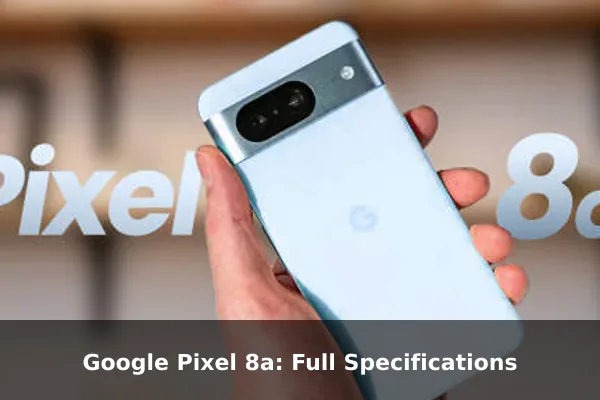
The Pixel 8a supports GSM, HSPA, LTE, and 5G, with multiple regional model numbers covering different band combinations. This matters because the international, North American, and U.S. variants do not have identical 5G support. The U.S. G8HHN variant includes mmWave bands, while other versions focus on Sub-6 5G.
For most buyers, the practical advice is simple: buy the model intended for your region. That gives the best chance of proper carrier compatibility, supported 5G bands, warranty coverage, and regulatory compliance. Beyond mobile networks, the Pixel 8a is well equipped with Wi-Fi 6e support where regionally available, Bluetooth 5.3, NFC, broad satellite positioning systems, and USB-C 3.2. The missing 3.5mm headphone jack is expected at this point but still worth noting for wired-audio users.
Who Should Buy the Pixel 8a?
The Pixel 8a is best for buyers who want a smaller Android phone with a strong camera, clean software, reliable update support, and enough performance for several years. It is also a sensible choice for users moving from an older Pixel A-series device who want a smoother display, newer processor, better brightness, and longer support window.
It is less ideal for people who prioritize very fast charging, expandable storage, the biggest possible battery, or heavy gaming performance per dollar. Those buyers may find stronger hardware value elsewhere. But for a balanced Android phone that focuses on the core daily experience, the Pixel 8a remains one of the most complete compact mid-range choices.
Conclusion
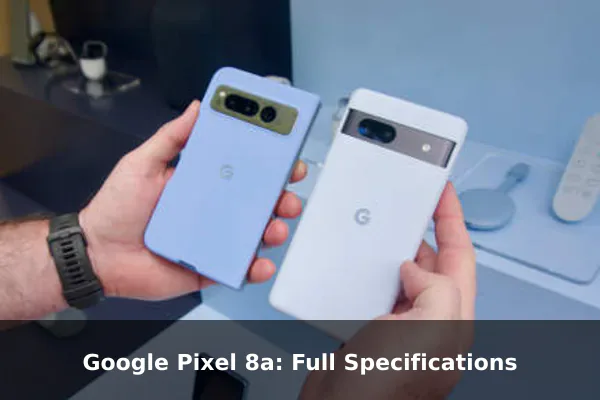
Google Pixel 8a is a compact, camera-first Android phone with a bright 120Hz OLED display, Tensor G3 performance, IP67 protection, wireless charging, and unusually long software support. Its charging speed and non-expandable storage are the main trade-offs, but the overall package is strong. Recommended for buyers who want a reliable Pixel experience at a lower price than Google’s flagship models.
References
- Google Pixel Phone Hardware Tech Specs – Official Google support page with Pixel 8a display, dimensions, battery, memory, storage, processor, cameras, connectivity bands, colors, in-box contents, warranty, and update commitment.
- Google Store Pixel 8a Tech Specs – Official product specification page from Google Store; useful as the primary source for consumer-facing Pixel 8a specifications and available configurations.
- Google Pixel 8a Safety & Regulatory Guide – Official safety and regulatory documentation covering Pixel 8a model numbers, SAR values, RF exposure, wireless compliance, frequency bands, and regional regulatory details.
- Google Pixel Software Updates Policy – Official Google source for the Pixel 8a software support period, including OS, security, and Pixel Drop update commitments.
- FCC Equipment Authorization Search – Official U.S. regulator database for checking Pixel 8a equipment authorization filings and radio compliance details by FCC ID or grantee code.
