
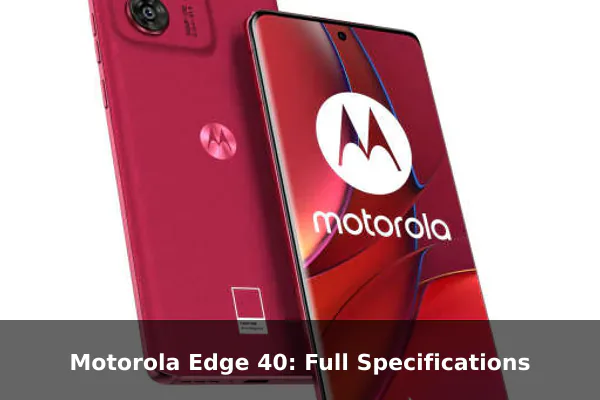
The Motorola Edge 40 sits in a sweet spot of the mid-premium Android segment, pairing a curved 6.55-inch P-OLED panel with a 144Hz refresh rate, a Mediatek Dimensity 8020 chipset, and 68W TurboPower charging. Announced on May 4, 2023, it targets buyers who want flagship-style ergonomics, IP68 protection, and a clean Motorola software experience without paying flagship money.
Compared with its siblings, the Edge 40 takes a more compact, lightweight approach than the Edge 40 Pro and offers stronger imaging hardware than the Edge 40 Neo. With dual SIM and eSIM support, broad 5G band coverage, and Ready For desktop-style productivity, it positions itself as a versatile daily driver for users moving up from entry-level Android phones.
Full Specifications
Network
| Technology: | GSM / HSPA / LTE / 5G |
| 2G bands: | GSM 850 / 900 / 1800 / 1900 |
| 3G bands: | HSDPA 850 / 900 / 1700(AWS) / 1900 / 2100 |
| 4G bands: | 1, 2, 3, 4, 5, 7, 8, 12, 13, 17, 20, 26, 28, 32, 38, 39, 40, 41, 42, 43, 66 |
| 5G bands: | 1, 2, 3, 5, 7, 8, 20, 28, 38, 40, 41, 66, 77, 78 SA/NSA/Sub6 |
| Speed: | HSPA, LTE (CA), 5G |
Launch
| Announced: | 2023, May 04 |
| Status: | Available. Released 2023, May 04 |
Body
| Dimensions: | 158.4 x 72 x 7.6 mm (6.24 x 2.83 x 0.30 in) |
| Weight: | 167 g or 171 g (5.89 oz) |
| Build: | Glass front, aluminum frame, plastic back or eco leather back |
| SIM: | Nano-SIMNano-SIM + eSIMNano-SIM + Nano-SIM |
| IP68 dust tight and water resistant (immersible up to 1.5m for 30 min) |
Display
| Type: | P-OLED, 144Hz, HDR10+, 1200 nits (peak) |
| Size: | 6.55 inches, 103.6 cm2 (~90.8% screen-to-body ratio) |
| Resolution: | 1080 x 2400 pixels, 20:9 ratio (~402 ppi density) |
Platform
| OS: | Android 13, up to 2 major Android upgrades |
| Chipset: | Mediatek Dimensity 8020 (6 nm) |
| CPU: | Octa-core (4×2.6 GHz Cortex-A78 & 4×2.0 GHz Cortex-A55) |
| GPU: | Mali-G77 MC9 |
Memory
| Card slot: | No |
| Internal: | 128GB 8GB RAM, 256GB 8GB RAM |
| UFS 3.1 |
Main Camera
| Dual: | 50 MP, f/1.4, (wide), 1/1.55″, 1.0µm, multi-directional PDAF, OIS 13 MP, f/2.2, 120˚ (ultrawide), 1/3.0″, 1.12µm, AF |
| Features: | Dual-LED flash, HDR, panorama |
| Video: | 4K@30fps, 1080p@30/60/120fps, 720p@960fps, HDR10, gyro-EIS |
Selfie camera
| Single: | 32 MP, f/2.4, (wide), 1/3.0″, 0.7µm |
| Features: | HDR |
| Video: | 4K@30fps, 1080p@30/120fps |
Sound
| Loudspeaker: | Yes, with stereo speakers |
| 3.5mm jack: | No |
Comms
| WLAN: | Wi-Fi 802.11 a/b/g/n/ac/6e, tri-band, Wi-Fi Direct |
| Bluetooth: | 5.2, A2DP, LE |
| Positioning: | GPS, GLONASS, GALILEO, BDS |
| NFC: | Yes |
| Radio: | No |
| USB: | USB Type-C 2.0, OTG |
Features
| Sensors: | Fingerprint (under display, optical), accelerometer, gyro, proximity, compass |
| Smart Connect (Ready For) support |
Battery
| Type: | Li-Po 4400 mAh |
| Charging: | 68W wired 15W wireless |
Misc
| Colors: | Nebula Green, Lunar Blue, Eclipse Black, Viva Magenta |
| Models: | XT2303-2 |
| Price: | € 210.09 / $ 419.99 / £ 230.07 / ₹ 29,999 |
Our Tests
| Performance: | AnTuTu: 688347 (v9) GeekBench: 3320 (v5.1), 3603 (v6) GFXBench: 33fps (ES 3.1 onscreen) |
| Display: | 1043 nits max brightness (measured) |
| Camera: | Photo / Video |
| Loudspeaker: | -24.2 LUFS (Very good) |
| Battery (old): | Endurance rating 98h |
Price and Availability
The Motorola Edge 40 offers a compelling combination of features and performance. While the base price is around €210, the actual cost may vary depending on your location and retailer. Below, you’ll find the approximate price of the Motorola Edge 40 converted into various currencies. Please note that these are estimates based on recent exchange rates as of June 2, 2026 and may not reflect the exact price you’ll find at a retailer.
- United States: $244
- Japan: ¥39,018
- United Kingdom: £182
- Australia: A$341
- Canada: C$338
- Taiwan: NT$7,657
- Denmark: kr1.568
- Saudi Arabia: ﷼917
- South Korea: ₩369,208
- Germany: €210
- Brazil: R$1.229
- Vietnam: ₫6.384.142
- Kenya: KSh 31,656
- India: ₹23,212
- Indonesia: Rp 4.373.917
- Nigeria: ₦333,138
- Pakistan: ₨68,159
- Philippines: ₱15,103
- Bangladesh: ৳৩০,০০৩
Why the Motorola Edge 40 Still Makes Sense
The Edge 40 leans into Motorola’s traditional strengths: a clean Android build, a slim and light chassis, and a fast-charging battery. For users who prioritize comfort in the hand and quick top-ups over raw benchmark dominance, the package is appealing. According to the official Motorola product page, the device pairs IP68 ingress protection with a curved display and an eco-leather back option, which is unusual at this price tier.
Design, Build Quality, and Durability
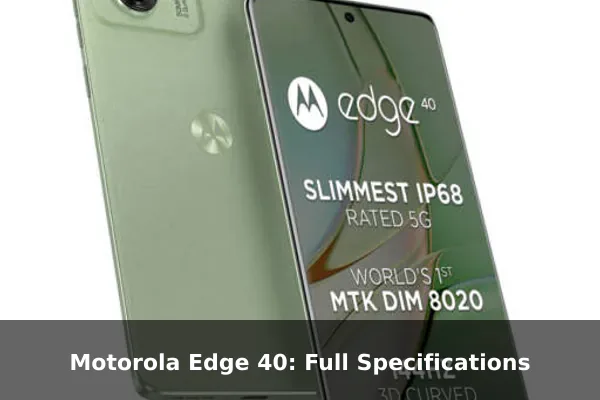
Measuring 158.4 x 72 x 7.6 mm and weighing roughly 167 to 171 grams depending on the finish, the Edge 40 is noticeably thinner and lighter than many mid-range competitors. The frame is aluminum, the front uses glass, and the back is offered in plastic or vegan eco leather across Nebula Green, Lunar Blue, Eclipse Black, and the Pantone Viva Magenta colorway. The IP68 rating, validated on Motorola’s official support pages, allows immersion up to 1.5 meters for 30 minutes, giving real peace of mind for daily splashes, rain, and accidental dunks.
Display: A Curved 144Hz P-OLED Built for Motion
The 6.55-inch P-OLED panel runs at FHD+ 1080 x 2400 resolution with a 20:9 aspect ratio and around 402 ppi density. It supports HDR10+ playback and a 144Hz refresh rate, which is faster than the 120Hz panels typical in this segment. Motorola lists peak brightness at 1200 nits, and independent measurements have recorded around 1043 nits in real-world use. The curved edges, slim bezels, and ~90.8% screen-to-body ratio create an immersive feel that punches above the price bracket for video, gaming, and scrolling.
Performance: Dimensity 8020 in Daily Use
Under the hood, the Mediatek Dimensity 8020 is built on a 6 nm process with four Cortex-A78 cores at 2.6 GHz and four Cortex-A55 efficiency cores at 2.0 GHz, paired with a Mali-G77 MC9 GPU. MediaTek’s official documentation highlights its focus on sustained gaming performance and power efficiency rather than peak burst speed. In practice, benchmark figures around AnTuTu 688,347 and GeekBench 6 multi-core 3,603 place it comfortably above many similarly priced rivals. RAM is fixed at 8GB LPDDR4X-equivalent memory, with 128GB or 256GB of UFS 3.1 storage. There is no microSD slot, so picking the larger tier is wise for media-heavy users.
Camera System: A Bright f/1.4 Main Sensor
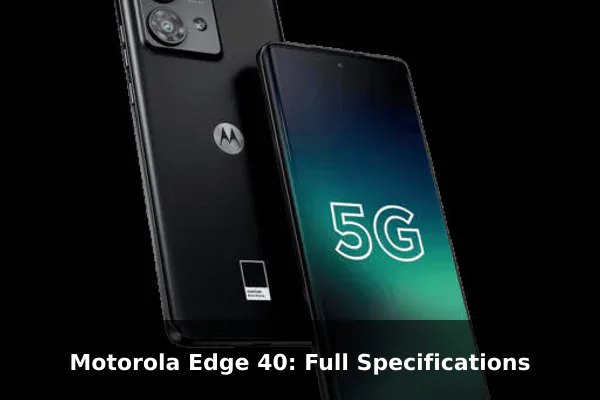
The dual rear setup is led by a 50 MP f/1.4 main sensor on a 1/1.55-inch surface with 1.0µm pixels, multi-directional PDAF, and optical image stabilization. The very wide aperture helps it gather more light than most rivals in low-light scenes, while OIS supports steadier video and longer handheld shutter speeds. The secondary camera is a 13 MP f/2.2 ultrawide with a 120-degree field of view and autofocus, allowing it to double as a macro option. Video recording tops out at 4K at 30fps on both the rear and the 32 MP f/2.4 front camera, with HDR10 and gyro-EIS for stabilization. While there is no dedicated telephoto, the imaging package is well balanced for casual photography and social-media content creation.
Battery and Charging
A 4400 mAh Li-Po battery powers the Edge 40. While that capacity is slightly below the 5000 mAh average in this segment, Motorola compensates with 68W TurboPower wired charging and 15W wireless charging, the latter being uncommon at this price. Real-world endurance testing has placed it around 98 hours in mixed use scenarios, which matches Motorola’s marketing of all-day battery life. Fast charging means short top-ups are practical, and the bundled charger should refill the cell in under an hour.
Software, Updates, and Ready For
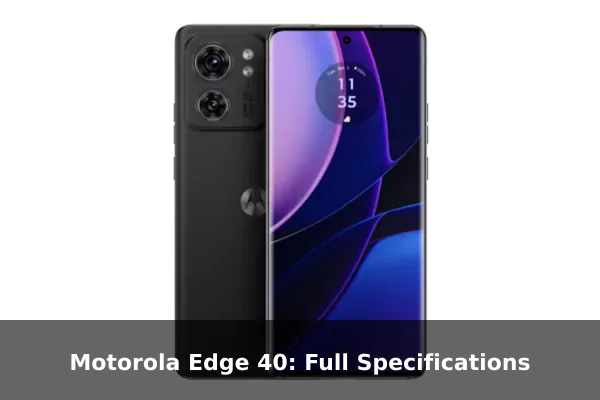
The Edge 40 launched with Android 13 and Motorola’s near-stock My UX layer, eligible for up to 2 major Android upgrades according to the company’s support policy. Useful Motorola extras include Moto Gestures, Peek Display, and Smart Connect (Ready For), which can extend the phone to an external display for desktop-style workflows. Buyers who value quick updates and minimal bloat will appreciate the lightweight software approach, although the update window is shorter than what Samsung and Google currently offer.
Connectivity, Audio, and Biometrics
Connectivity is comprehensive: 5G Sub6 on SA and NSA networks, Wi-Fi 6E tri-band, Bluetooth 5.2, NFC for contactless payments, and dual-frequency GNSS spanning GPS, GLONASS, GALILEO, and BDS. The USB Type-C 2.0 port supports OTG accessories, but there is no 3.5mm headphone jack and no FM radio. Audio is delivered through stereo speakers, which measured around -24.2 LUFS in independent loudness testing, rated as very good. Biometrics include an under-display optical fingerprint sensor along with the usual accelerometer, gyro, proximity, and compass sensors.
Who Should Buy the Motorola Edge 40
The Edge 40 best suits buyers who want a thin, well-built Android phone with a high refresh curved OLED, fast wired and wireless charging, and broad 5G band support, without stretching toward flagship pricing. It is also a strong fit for users upgrading from a budget device who care about IP68 durability, a clean software experience, and a bright main camera that performs well in dim conditions. Heavy mobile gamers seeking peak GPU performance or photographers needing a dedicated telephoto may want to look at more specialized rivals.
Conclusion
The Motorola Edge 40 delivers a balanced, premium-feeling mid-ranger that emphasizes ergonomics, display quality, and charging speed over raw spec-sheet bragging rights. If you value a compact curved P-OLED, IP68 protection, wireless charging, and clean Motorola software, it remains a sensible recommendation; just be sure to choose the 256GB variant given the lack of expandable storage. Always verify final pricing and availability with Motorola’s official channels in your region before purchase.
Official references
- Motorola Support – motorola edge 40 specifications – Official Motorola specification table for core product facts such as chipset, RAM, storage, display, battery, cameras, dimensions, IP rating, SIM, bands, Wi-Fi, Bluetooth, and NFC.
- Motorola Hong Kong – motorola edge 40 product page – Official product page for Motorola Edge 40, useful for cross-checking manufacturer feature claims, design, display, charging, camera, and water-resistance details.
- Motorola Help – motorola edge 40 user guide PDF – Official English user guide for device features, settings, hardware behavior, connectivity, NFC, charging, and software-related details.
- Motorola Support – motorola edge 40 SAR – Official Motorola SAR and radio-frequency exposure reference for safety and compliance facts.
- MediaTek – Dimensity 8020 official product page – Official chipset reference for verifying the Motorola Edge 40 processor capabilities, CPU configuration, GPU, memory support, display support, connectivity, and modem features.
