
The vivo i QOO Z10 is a battery-first 5G Android phone that tries to stretch mid-range value without dropping the premium-feeling basics. Its headline combination is simple: a large AMOLED display, Snapdragon 7s Gen 3 power, 90W charging, and a very large 7300mAh battery.
This article takes a buyer-focused look at the vivo i QOO Z10 rather than repeating the full specification sheet. The main angle is how its India and Indonesia variants compare, where the phone feels strongest, and which trade-offs matter before choosing a storage version.
Full Specifications
Network
| Technology: | GSM / HSPA / LTE / 5G |
| 2G bands: | GSM 850 / 900 / 1800 / 1900 |
| 3G bands: | HSDPA 800 / 850 / 900 / 2100 |
| 4G bands: | 1, 3, 5, 8, 28, 38, 40, 41 – India |
| 1, 3, 5, 7, 8, 19, 20, 28, 38, 40, 41 – Indonesia | |
| 5G bands: | 1, 3, 5, 8, 28, 38, 40, 41, 77, 78 SA/NSA – India |
| 1, 3, 5, 7, 8, 20, 28, 38, 40, 41, 77, 78 SA/NSA – Indonesia | |
| Speed: | HSPA, LTE, 5G |
Launch
| Announced: | 2025, April 11 |
| Status: | Available. Released 2025, April 16 |
Body
| Dimensions: | 163.4 x 76.4 x 7.9 mm (6.43 x 3.01 x 0.31 in) |
| Weight: | 199 g (7.02 oz) |
| SIM: | Nano-SIM + Nano-SIM |
| Splash resistant MIL-STD-810H compliant* * does not guarantee ruggedness or use in extreme conditions |
Display
| Type: | AMOLED, 120Hz, 3840Hz PWM, 1300 nits (HBM), 5000 nits (peak) |
| Size: | 6.77 inches, 110.9 cm2 (~88.8% screen-to-body ratio) |
| Resolution: | 1080 x 2392 pixels (~388 ppi density) |
Platform
| OS: | Android 15, up to 2 major Android upgrades, Funtouch 15 |
| Chipset: | Qualcomm SM7635 Snapdragon 7s Gen 3 (4 nm) |
| CPU: | Octa-core (1×2.5 GHz Cortex-A720 & 3×2.4 GHz Cortex-A720 & 4×1.8 GHz Cortex-A520) |
| GPU: | Adreno 810 |
Memory
| Card slot: | No |
| Internal: | 128GB 8GB RAM, 256GB 8GB RAM, 256GB 12GB RAM, 512GB 12GB RAM |
| UFS 2.2 |
Main Camera
| Dual: | 50 MP, f/1.8, (wide), 1/1.95″, 0.8µm, PDAF, OIS 2 MP, f/2.4, (depth) |
| Features: | LED flash, HDR, panorama |
| Video: | 4K@30fps, 1080p@30/60fps, gyro-EIS |
Selfie camera
| Single: | 32 MP, f/2.0, (wide) |
| Video: | 1080p@30fps |
Sound
| Loudspeaker: | Yes |
| 3.5mm jack: | No |
Comms
| WLAN: | Wi-Fi 802.11 a/b/g/n/ac, dual-band – IndiaWi-Fi 802.11 a/b/g/n/ac/6/7, dual-band – Indonesia |
| Bluetooth: | 5.2(IN), 5.4(IDN), A2DP, LE |
| Positioning: | GPS, GLONASS, GALILEO, BDS, QZSS |
| NFC: | Yes (market/region dependent) |
| Infrared port: | Yes |
| Radio: | No |
| USB: | USB Type-C 2.0, OTG |
Features
| Sensors: | Fingerprint (under display, optical), accelerometer, gyro, proximity, compass |
| Circle to Search |
Battery
| Type: | Si/C Li-Ion 7300 mAh |
| Charging: | 90W wired Reverse wired |
Misc
| Colors: | Stellar Black, Glacier Silver |
| SAR: | 0.99 W/kg (head) 0.87 W/kg (body) |
| Price: | ₹ 12,998 |
Price and Availability
The vivo i QOO Z10 offers a compelling combination of features and performance. While the base price is around ₹12,998, the actual cost may vary depending on your location and retailer. Below, you’ll find the approximate price of the vivo i QOO Z10 converted into various currencies. Please note that these are estimates based on recent exchange rates as of July 24, 2026 and may not reflect the exact price you’ll find at a retailer.
- United States: $134
- Japan: ¥22,022
- United Kingdom: £101
- Australia: A$193
- Canada: C$190
- Taiwan: NT$4,345
- Denmark: kr882
- Saudi Arabia: ﷼504
- South Korea: ₩198,079
- Germany: €118
- Brazil: R$683
- Vietnam: ₫3.521.503
- Kenya: KSh 17,440
- India: ₹12,998
- Indonesia: Rp 2.410.182
- Nigeria: ₦184,501
- Pakistan: ₨37,402
- Philippines: ₱8,307
- Bangladesh: ৳১৬,৬১৪
Value Position
The vivo i QOO Z10 is built around a clear value promise: long battery life, modern 5G support, and a display that looks closer to an upper mid-range phone than a basic budget device. The raw source price places it in a competitive segment, but the more important point is what vivo and iQOO prioritize at that level. Instead of chasing a complicated camera array or metal-and-glass luxury build, the phone concentrates on a large battery, fast wired charging, optical stabilization on the main camera, and a recent Qualcomm 4nm chipset.
That makes the Z10 easier to judge than many specification-heavy phones. If your buying decision is mostly about screen quality, battery endurance, and everyday speed, the package is strong. If you want expandable storage, a headphone jack, wireless charging, or a more versatile rear camera setup, the compromises are visible. The Z10 is not trying to be a miniature flagship; it is trying to make daily use feel less restricted.
Design And Durability
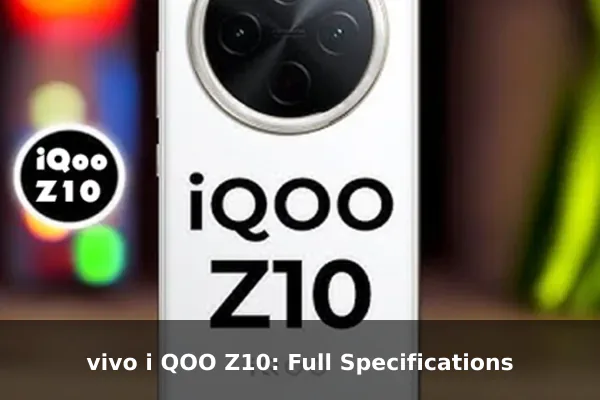
At 163.4 x 76.4 x 7.9 mm and 199 g, the vivo i QOO Z10 is large but not unusually thick for a phone carrying a 7300mAh battery. That is one of its more interesting design achievements. Many high-capacity phones feel bulky immediately, while this model stays under 8 mm in the source data. The weight is still noticeable, especially for one-handed reading or long gaming sessions, but it is understandable given the battery capacity.
The phone uses dual Nano-SIM slots and includes splash resistance with a MIL-STD-810H-related durability note. That should be read carefully: the source wording does not guarantee ruggedness or suitability for extreme conditions. In practical terms, the Z10 should be treated as a regular smartphone with some added resistance against everyday exposure, not as a rugged outdoor handset. The under-display optical fingerprint sensor also helps the design feel more modern than side-mounted alternatives common in lower-priced models.
Display Experience
The 6.77-inch AMOLED screen is one of the biggest reasons to consider the Z10. A 1080 x 2392 resolution gives it a sharp enough pixel density for streaming, browsing, social media, and gaming, while the 120Hz refresh rate should make scrolling and supported games feel smoother. The display also lists 1300 nits HBM and 5000 nits peak brightness, though peak figures normally apply only to limited conditions and should not be read as full-screen sustained brightness.
Another noteworthy detail is the 3840Hz PWM dimming claim. For buyers sensitive to flicker, that may be more meaningful than another small bump in resolution. Combined with AMOLED contrast and the large panel size, the Z10 is well suited to video playback and reading-heavy use. The main limitation is that this remains a flat specification discussion: real-world color tuning, outdoor readability, and touch behavior can vary by software version and market firmware.
Performance And Storage
The Snapdragon 7s Gen 3 is a sensible choice for this phone. It is a 4nm Qualcomm platform with an octa-core CPU arrangement led by Cortex-A720 performance cores and paired with the Adreno 810 GPU. That should be comfortably above entry-level performance for multitasking, messaging, navigation, camera processing, and mainstream games. It is not positioned as Qualcomm’s top gaming chip, but it gives the Z10 enough headroom to feel current.
The storage options matter because there is no microSD card slot. Buyers can choose from 128GB with 8GB RAM, 256GB with 8GB RAM, 256GB with 12GB RAM, or 512GB with 12GB RAM. Since the phone uses UFS 2.2 storage, app loading and file access should be respectable, though not at the level of newer flagship UFS standards. For most people, the 256GB versions are the safer long-term choice; the 512GB model is better if you keep many games, offline videos, and 4K clips.
Camera Setup
The rear camera system is deliberately simple: a 50MP wide camera with PDAF and OIS, supported by a 2MP depth sensor. The main sensor is the camera to care about. Optical image stabilization is valuable for low-light stills and steadier handheld video, and the phone supports 4K recording at 30fps plus 1080p at 30 or 60fps with gyro-EIS. That gives it a stronger imaging base than phones that rely only on electronic stabilization.
The secondary 2MP depth camera is less exciting. It may help portrait separation in some modes, but it does not replace an ultrawide, telephoto, or macro camera. The 32MP front camera is promising for selfies and video calls, although the listed selfie video recording is 1080p at 30fps in the source data. Buyers who mostly shoot people, documents, food, and everyday scenes should be satisfied; buyers who want flexible focal lengths should look higher up the range.
Battery And Charging
Battery life is the Z10’s defining feature. A 7300mAh silicon-carbon lithium-ion battery is significantly larger than the 5000mAh packs still common across many Android phones. Capacity alone does not guarantee a specific number of hours because network strength, refresh rate, screen brightness, gaming load, and background apps all matter, but the hardware foundation is clearly endurance-focused.
The 90W wired charging support is equally important because a battery this large would otherwise take a long time to refill. Reverse wired charging also makes the phone more flexible in emergencies, allowing it to share power with accessories or another device using the right cable. There is no wireless charging listed, which is expected for the segment and easier to accept given the wired charging speed.
Software And Features
The vivo i QOO Z10 runs Android 15 with Funtouch 15, and the source data lists up to two major Android upgrades. That gives the phone a defined upgrade path, though buyers who keep phones for four or five years may want longer operating system support. Funtouch OS typically emphasizes customization, gaming tools, battery controls, and practical day-to-day features, so the Z10 should feel feature-rich out of the box.
Circle to Search is listed among the features, which gives the phone a useful modern Android convenience for quickly searching on-screen content. The sensor set is also complete for the class: accelerometer, gyroscope, proximity sensor, compass, and an under-display optical fingerprint reader. The missing 3.5mm headphone jack is the main everyday omission for wired-audio users.
Connectivity And Regional Differences
One reason this Z10 article needs a regional angle is that the India and Indonesia versions are not identical in every connectivity detail. Both support GSM, HSPA, LTE, and 5G with SA and NSA coverage, but the listed 4G and 5G bands differ by market. Indonesia adds support for bands such as 4G band 7 and 5G n7/n20 in the source data, while the India variant follows a different local band mix. Buyers importing the phone should check band support before purchase.
Wi-Fi and Bluetooth also vary by region in the supplied data. India is listed with Wi-Fi 802.11 a/b/g/n/ac dual-band and Bluetooth 5.2, while Indonesia is listed with newer Wi-Fi support and Bluetooth 5.4 in the source set. NFC is market or region dependent, so it should not be assumed on every unit. The infrared port is a useful extra, and USB Type-C 2.0 with OTG covers the basics, though it is not a high-speed wired data interface.
Who Should Buy It
The vivo i QOO Z10 is best for buyers who want a long-lasting Android phone with a large, smooth AMOLED display and reliable everyday performance. It is especially easy to recommend to commuters, students, field workers, heavy video watchers, and mobile gamers who value battery margin more than a thin flagship camera system. The 90W charging also helps if you often forget to charge overnight.
It is less ideal for users who need expandable storage, wired headphones, premium water resistance guarantees, or multiple useful rear cameras. The phone’s strongest configuration is likely a 256GB or 512GB version because the missing card slot makes storage planning important. In short, the Z10 is a practical power-user phone, not a camera-first or compact-phone choice.
Conclusion
The vivo i QOO Z10 stands out for its 7300mAh battery, 90W charging, 120Hz AMOLED screen, Snapdragon 7s Gen 3 chipset, and stabilized 50MP main camera. Its trade-offs are clear: no microSD slot, no 3.5mm jack, limited rear camera variety, and region-dependent connectivity features. For buyers who prioritize endurance, display quality, and balanced Android performance, it is a strong recommendation.
References
- iQOO Indonesia – Z10 5G Specifications – Official Indonesian specification page for dimensions, variants, OS, chipset, battery, charging, display, cameras, network bands, connectivity, sensors, box contents, and local pricing.
- iQOO Indonesia – Z10 5G Product Page – Official product overview with feature claims and disclaimers for battery, charging, display brightness, Sony IMX882 camera, durability, and lab-test caveats.
- iQOO India – Z10 Specifications – Official India specification page useful for cross-checking regional variant differences in storage, colors, network bands, connectivity, and included features.
- Qualcomm – Snapdragon 7s Gen 3 Mobile Platform – Primary chipset source for Snapdragon 7s Gen 3 CPU clock, process node, GPU/AI, connectivity, camera ISP, and platform capability claims.
