
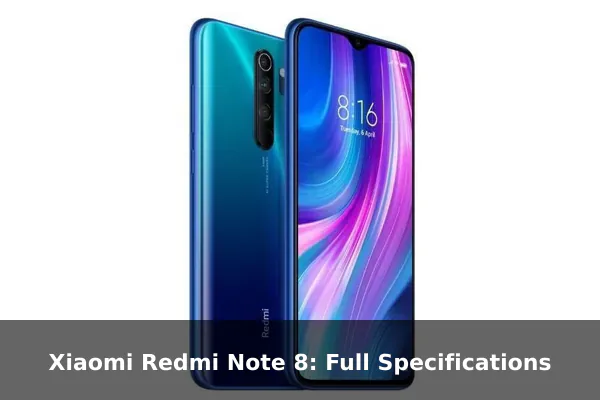
The Xiaomi Redmi Note 8 arrived in 2019 as one of the most talked-about budget phones of its generation, pairing a then-rare 48 MP quad-camera array with the efficient Snapdragon 665 platform. Although Xiaomi now lists the device as discontinued, it remains a reference point for anyone tracing how the Redmi Note line built its reputation for delivering flagship-style features at an entry-level price, originally launching around 220 EUR.
This page focuses on what the Redmi Note 8 actually offers in day-to-day use and how its hardware choices have aged. Rather than simply listing numbers, the analysis below weighs each major area — design, display, performance, cameras, battery, software, and connectivity — against the expectations of a modern buyer or collector, with the full specification table provided separately beneath this article.
Full Specifications
Network
| Technology | GSM / HSPA / LTE |
| 2G bands | GSM 850 / 900 / 1800 / 1900 |
| 3G bands | HSDPA 850 / 900 / 1700(AWS) / 1900 / 2100 |
| HSDPA 850 / 900 / 2100 | |
| 4G bands | 1, 2, 3, 4, 5, 7, 8, 20, 38, 40 |
| 1, 3, 5, 8, 38, 40, 41 | |
| Speed | HSPA 42.2/5.76 Mbps, LTE (4CA) Cat12 600/50 Mbps |
Launch
| Announced | 2019, August 29. Released 2019, October 16 |
| Status | Discontinued |
Body
| Dimensions | 158.3 x 75.3 x 8.4 mm (6.23 x 2.96 x 0.33 in) |
| Weight | 190 (6.70 oz) |
| Build | Glass front (Gorilla Glass 5), glass back (Gorilla Glass 5), plastic frame |
| SIM | Nano-SIM + Nano-SIM |
Display
| Type | IPS LCD |
| Size | 6.3 inches, 97.4 cm2 (~81.7% screen-to-body ratio) |
| Resolution | 1080 x 2340 pixels, 19.5:9 ratio (~409 ppi density) |
| Protection | Corning Gorilla Glass 5 |
Platform
| OS | Android 9.0 (Pie), upgradable to Android 11, MIUI 12.5 |
| Chipset | Qualcomm SDM665 Snapdragon 665 (11 nm) |
| CPU | Octa-core (4×2.0 GHz Kryo 260 Gold & 4×1.8 GHz Kryo 260 Silver) |
| GPU | Adreno 610 |
Memory
| Card slot | microSDXC (dedicated slot) |
| Internal | 32GB 3GB RAM, 64GB 4GB RAM, 64GB 6GB RAM, 128GB 4GB RAM, 128GB 6GB RAM |
| eMMC 5.1 |
Main Camera
| Quad | 48 MP, f/1.8, 26mm (wide), 1/2.0", 0.8µm, PDAF 8 MP, f/2.2, 120˚ (ultrawide), 1/4.0", 1.12µm 2 MP (macro) Auxiliary lens |
| Features | LED flash, HDR, panorama |
| Video | 4K@30fps, 1080p@30/60/120fps; gyro-EIS |
Selfie camera
| Single | 13 MP, f/2.0, (wide), 1/3.1", 1.12µm |
| Features | HDR, panorama |
| Video | 1080p@30fps |
Sound
| Loudspeaker | Yes |
| 3.5mm jack | Yes |
Comms
| WLAN | Wi-Fi 802.11 a/b/g/n/ac, dual-band, Wi-Fi Direct |
| Bluetooth | 4.2, A2DP, LE |
| Positioning | GPS, GLONASS, BDS |
| NFC | No |
| Infrared port | Yes |
| Radio | FM radio |
| USB | USB Type-C 2.0, OTG |
Features
| Sensors | Fingerprint (rear-mounted), accelerometer, gyro, proximity, compass |
Battery
| Type | Li-Po 4000 mAh, non-removable |
| Charging | 18W wired |
Misc
| Colors | Neptune Blue, Moonlight White, Space Black, Nebula Purple, Cosmic Purple |
| Models | M1908C3JH, M1908C3JG, M1908C3JI |
| SAR | 0.26 W/kg (head) 1.00 W/kg (body) |
| SAR EU | 0.19 W/kg (head) 1.09 W/kg (body) |
| Price | About 220 EUR |
Our Tests
| Performance | AnTuTu: 141915 (v7), 161572 (v8) GeekBench: 5590 (v4.4), 1339 (v5.1) GFXBench: 5.9fps (ES 3.1 onscreen) |
| Display | Contrast ratio: 1521:1 (nominal) |
| Camera | Photo / Video |
| Loudspeaker | Voice 78dB / Noise 72dB / Ring 81dB |
| Audio quality | Noise -94.0dB / Crosstalk -93.3dB |
| Battery (old) | Endurance rating 108h |
Price and Availability
The Xiaomi Redmi Note 8 offers a compelling combination of features and performance. While the base price is around €220, the actual cost may vary depending on your location and retailer. Below, you’ll find the approximate price of the Xiaomi Redmi Note 8 converted into various currencies. Please note that these are estimates based on recent exchange rates as of June 9, 2026 and may not reflect the exact price you’ll find at a retailer.
- United States: $254
- Japan: ¥40,638
- United Kingdom: £190
- Australia: A$360
- Canada: C$354
- Taiwan: NT$8,012
- Denmark: kr1.642
- Saudi Arabia: ﷼951
- South Korea: ₩387,730
- Germany: €220
- Brazil: R$1.310
- Vietnam: ₫6.654.743
- Kenya: KSh 32,839
- India: ₹24,278
- Indonesia: Rp 4.603.939
- Nigeria: ₦342,861
- Pakistan: ₨70,578
- Philippines: ₱15,648
- Bangladesh: ৳৩১,১৪৭
Value: What 220 EUR Bought in 2019
At launch the Redmi Note 8 sat at roughly 220 EUR, a price that explained much of its popularity. For that money Xiaomi included a 48 MP main sensor, a glass sandwich body with Gorilla Glass 5 on both sides, a 4000 mAh battery, and a microSDXC slot — a combination rivals usually reserved for pricier tiers. Today, with the model discontinued, its value proposition has shifted from “best budget buy” to a capable secondary or backup device, and any pricing you encounter now reflects the used or new-old-stock market rather than the original retail figure.
Design and Build Quality
The Redmi Note 8 measures 158.3 x 75.3 x 8.4 mm and weighs 190 g, giving it a reassuringly solid feel without being unwieldy. Xiaomi wrapped it in a glass front and glass back, both protected by Corning Gorilla Glass 5, mounted on a plastic frame to keep costs down. The dual Nano-SIM tray with a dedicated microSD slot is a practical touch for users who want expandable storage and two numbers at once. Color options spanned Neptune Blue, Moonlight White, Space Black, Nebula Purple, and Cosmic Purple, lending the otherwise affordable phone a more premium visual identity.
Display Experience
The 6.3-inch IPS LCD panel delivers a 1080 x 2340 resolution at a 19.5:9 ratio, working out to roughly 409 ppi and an 81.7% screen-to-body ratio. While it is not an OLED, the measured contrast ratio of around 1521:1 is respectable for the class, and the small waterdrop notch keeps the front largely uninterrupted. Gorilla Glass 5 protection adds a measure of scratch resistance that was uncommon at this price. For browsing, video, and everyday reading the panel remains perfectly usable, though it lacks the high refresh rates that later Redmi Note models introduced.
Performance and Everyday Speed
Power comes from the Qualcomm Snapdragon 665, an 11 nm chip with an octa-core Kryo 260 CPU (4×2.0 GHz and 4×1.8 GHz) paired with the Adreno 610 GPU. In benchmarks the phone recorded an AnTuTu score of about 161,572 (v8) and a GeekBench single-core result near 1339 (v5.1), figures that translate to smooth navigation and reliable multitasking rather than gaming-grade muscle. Memory configurations ranged from 32GB/3GB up to 128GB/6GB using eMMC 5.1 storage, so opting for a 4GB or 6GB variant makes a noticeable difference to longevity. Heavy 3D titles run at modest settings, as the 5.9fps GFXBench onscreen figure suggests.
Camera System
The headline feature is the rear quad camera, led by a 48 MP f/1.8 wide sensor with PDAF, joined by an 8 MP f/2.2 ultrawide with a 120-degree field of view, a 2 MP macro, and an auxiliary depth lens. Video tops out at 4K@30fps with gyro-EIS for steadier handheld clips, plus 1080p options up to 120fps. On the front, a 13 MP f/2.0 selfie camera handles social shots and 1080p@30fps video. In good light the main sensor produces detailed, shareable images; the ultrawide adds flexibility, while the macro and depth lenses are more situational extras than daily-use tools.
Battery and Charging
A 4000 mAh non-removable Li-Po cell powers the Redmi Note 8, and combined with the power-efficient Snapdragon 665 it earned an endurance rating of around 108 hours in testing. That comfortably covers a full day of mixed use for most people. Charging is handled over USB Type-C at 18W, and Xiaomi historically bundled a compatible charger in the box — useful context given that accessory inclusion varies by region and by whether you buy new-old-stock or used today.
Software and Updates
The phone shipped with Android 9.0 (Pie) under MIUI and was officially upgradable to Android 11 with MIUI 12.5. As a discontinued device it no longer receives major OS or security updates, which is the single most important consideration for anyone buying one now. It remains capable for messaging, media, and light apps, but security-conscious users should weigh the lack of ongoing patches before relying on it as a primary handset.
Connectivity and Extras
Connectivity covers 4G LTE with Cat12 speeds up to 600 Mbps, dual-band Wi-Fi 802.11ac, Bluetooth 4.2, and positioning via GPS, GLONASS, and BDS. Xiaomi retained two enthusiast favorites here: a 3.5mm headphone jack and an infrared port for controlling TVs and appliances, alongside FM radio. Notably, there is no NFC, so mobile tap-to-pay is unavailable. A rear-mounted fingerprint sensor plus the usual accelerometer, gyro, proximity, and compass round out the feature set.
Who Should Consider It
The Redmi Note 8 makes the most sense as an affordable backup phone, a first device for a younger user, or a collector’s example of a landmark budget model. Buyers who need long-term software support, NFC payments, or high-refresh gaming should look to newer Redmi Note releases instead. Always verify the model number (M1908C3JH, M1908C3JG, or M1908C3JI) and confirm regional band compatibility before purchasing.
Conclusion
The Xiaomi Redmi Note 8 was a defining budget phone of its era, blending a versatile 48 MP camera, a sturdy Gorilla Glass 5 build, dependable battery life, and thoughtful extras like a headphone jack and IR blaster at an accessible price. Its main limitations today are the absence of NFC and, more importantly, the end of official software support. If you want a low-cost secondary device or a nostalgic, well-rounded handset and can accept those caveats, it still holds up; but anyone seeking a daily driver with current updates and modern features should choose a newer model in the Redmi Note family.
Official references
- Xiaomi India Redmi Note 8 Specifications – Official Xiaomi product specifications for Redmi Note 8, covering processor, memory, cameras, battery, display, connectivity, dimensions, sensors, and package contents.
- Xiaomi Global RF Exposure Certification – Official Xiaomi certification page listing Redmi Note 8 model numbers M1908C3JG and M1908C3JH with SAR/RF exposure compliance values.
- FCC Equipment Authorization System (fcc.gov) – Primary U.S. regulator database for verifying radio certification filings; search FCC ID 2AFZZC3JG for Redmi Note 8 model M1908C3JG details.
- Qualcomm Snapdragon 665 Mobile Platform – Official chipset reference for verifying Snapdragon 665 CPU, GPU, modem, camera, and platform capabilities used by Redmi Note 8.
- Corning Gorilla Glass Redmi Note 8 Product Page – Official Corning page confirming Redmi Note 8 uses Corning Gorilla Glass 5 on the front and back.
