

The Xiaomi Poco M7 Plus arrives as a budget-tier contender aimed at buyers who want a big screen, a massive battery, and entry-level 5G without stretching their wallet. Announced on August 13, 2025, with an expected release on August 19, 2025, it slots into Poco’s value-first M-series lineup with a price tag around 140 EUR, positioning it squarely against other sub-150-euro 5G phones.
What makes this release interesting is the unusual combination Poco has chosen: a 6.9-inch 144Hz IPS LCD panel paired with a 7000 mAh Si/C lithium-ion cell and the Snapdragon 6s Gen 3 chipset. On paper, that mix prioritizes endurance and smooth scrolling over flagship-grade imaging or premium materials, so this article focuses on how those trade-offs translate into day-to-day usefulness for the budget shopper.
Full Specifications
Network
| Technology: | GSM / HSPA / LTE / 5G |
| 2G bands: | GSM 850 / 900 / 1800 / 1900 |
| 3G bands: | HSDPA 850 / 900 / 2100 |
| 4G bands: | 1, 3, 5, 8, 20, 28, 40, 41 |
| 5G bands: | 1, 3, 5, 8, 20, 28, 40, 78 SA/NSA |
| Speed: | HSPA, LTE, 5G |
Launch
| Announced: | 2025, August 13 |
| Status: | Coming soon. Exp. release 2025, August 19 |
Body
| Dimensions: | 168.5 x 80.5 x 8.4 mm (6.63 x 3.17 x 0.33 in) |
| Weight: | 217 g (7.65 oz) |
| SIM: | Nano-SIM + Nano-SIM |
| IP64 dust tight and water resistant (water splashes) |
Display
| Type: | IPS LCD, 144Hz, 700 nits (typ), 850 nits (HBM) |
| Size: | 6.9 inches, 116.9 cm2 (~86.2% screen-to-body ratio) |
| Resolution: | 1080 x 2340 pixels, 19.5:9 ratio (~374 ppi density) |
| Protection: | Corning Gorilla Glass 3 |
Platform
| OS: | Android 15, up to 2 major Android upgrades, HyperOS 2 |
| Chipset: | Qualcomm SM6375 Snapdragon 6s Gen 3 (6 nm) |
| CPU: | Octa-core (2×2.3 GHz Cortex-A78 & 6×2.0 GHz Cortex-A55) |
| GPU: | Adreno 619 |
Memory
| Card slot: | microSDXC (uses shared SIM slot) |
| Internal: | 128GB 6GB RAM, 128GB 8GB RAM |
Main Camera
| Dual: | 50 MP, f/1.8, (wide), PDAF Auxiliary lens |
| Features: | LED flash, HDR |
| Video: | 1080p@30fps |
Selfie camera
| Single: | 8 MP, f/2.0, (wide) |
| Features: | HDR |
| Video: | 1080p@30fps |
Sound
| Loudspeaker: | Yes |
| 3.5mm jack: | No |
Comms
| WLAN: | Wi-Fi 802.11 a/b/g/n/ac, dual-band |
| Bluetooth: | 5.1, A2DP, LE |
| Positioning: | GPS, GLONASS, GALILEO, BDS |
| NFC: | Yes (market/region dependent) |
| Infrared port: | Yes |
| Radio: | No |
| USB: | USB Type-C 2.0 |
Features
| Sensors: | Fingerprint (side-mounted), accelerometer, compass |
| Virtual proximity sensing |
Battery
| Type: | Si/C Li-Ion 7000 mAh |
| Charging: | 33W wired 18W reverse wired |
Misc
| Colors: | Chrome Silver, Aqua Blue, Carbon Black |
| SAR: | 0.86 W/kg (head) 0.81 W/kg (body) |
| Price: | About 140 EUR |
Price and Availability
The Xiaomi Poco M7 Plus offers a compelling combination of features and performance. While the base price is around €140, the actual cost may vary depending on your location and retailer. Below, you’ll find the approximate price of the Xiaomi Poco M7 Plus converted into various currencies. Please note that these are estimates based on recent exchange rates as of June 6, 2026 and may not reflect the exact price you’ll find at a retailer.
- United States: $162
- Japan: ¥25,916
- United Kingdom: £121
- Australia: A$229
- Canada: C$225
- Taiwan: NT$5,102
- Denmark: kr1.045
- Saudi Arabia: ﷼607
- South Korea: ₩251,038
- Germany: €140
- Brazil: R$827
- Vietnam: ₫4.250.181
- Kenya: KSh 21,002
- India: ₹15,444
- Indonesia: Rp 2.931.905
- Nigeria: ₦218,781
- Pakistan: ₨45,005
- Philippines: ₱9,980
- Bangladesh: ৳১৯,৮৪৩
Value Proposition at Around 140 EUR
At roughly 140 EUR, the Poco M7 Plus competes in one of the most crowded segments of the smartphone market. Poco’s pitch is straightforward: bundle a large display, a high refresh rate, 5G connectivity, and an oversized battery into one package. Few rivals in this bracket combine all four, especially with the newer Si/C battery chemistry, which makes the M7 Plus an easy recommendation to consider for buyers who care more about endurance than camera versatility. As always with introductory pricing, regional taxes and retailer markups can shift the final cost, so treat the 140 EUR figure as indicative rather than fixed.
Design and Build Quality
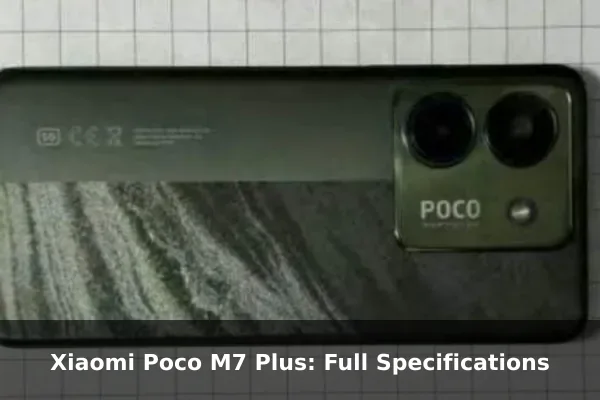
Measuring 168.5 x 80.5 x 8.4 mm and weighing 217 g, the M7 Plus is a large and noticeably heavy handset. The footprint is driven by the 6.9-inch display, and the 8.4 mm thickness is reasonable considering the 7000 mAh cell inside. Poco offers it in Chrome Silver, Aqua Blue, and Carbon Black, giving buyers a mix of neutral and statement finishes. The IP64 rating protects against dust ingress and water splashes, which is welcome at this price, although it is not a substitute for the IP68 immersion ratings found on pricier phones. The side-mounted fingerprint scanner doubles as the power key, and an IR blaster on top adds a small but practical touch for controlling appliances.
Display Experience
The 6.9-inch IPS LCD runs at 1080 x 2340 pixels with a 144Hz refresh rate, peaking at 700 nits in typical use and 850 nits in high-brightness mode. The 19.5:9 aspect ratio and roughly 86.2% screen-to-body ratio give it a stretched, immersive feel that suits video and casual gaming. Pixel density sits at about 374 ppi, sharp enough for most reading and streaming. The trade-off is the LCD panel: contrast and black levels lag behind the AMOLED screens that some competitors fit at similar prices. Corning Gorilla Glass 3 provides a basic level of scratch protection, although a case and screen protector remain advisable.
Performance and Software
The Qualcomm Snapdragon 6s Gen 3 is built on a 6 nm process and combines two 2.3 GHz Cortex-A78 cores with six 2.0 GHz Cortex-A55 cores, paired with the Adreno 619 GPU. This is a midrange-leaning entry chip aimed at smooth everyday tasks, social apps, video streaming, and light gaming rather than demanding 3D titles. Buyers can pick 6 GB or 8 GB of RAM with 128 GB of internal storage, expandable via a microSDXC card that shares the second SIM slot. Out of the box, the phone runs HyperOS 2 on top of Android 15, with Poco committing to up to two major Android upgrades. That support window is shorter than some rivals offer, so software longevity is something to weigh against the strong hardware basics.
Cameras: Practical, Not Ambitious
Imaging is the area where Poco has clearly cut to hit the price point. The rear camera setup is a dual arrangement led by a 50 MP f/1.8 wide sensor with PDAF, supported by an auxiliary lens that mainly assists with metadata rather than delivering a true secondary focal length. Video tops out at 1080p at 30 fps on both the rear and the 8 MP f/2.0 selfie shooter, with HDR available on stills. For daylight social-media photography and basic video calls, the kit should be adequate, but anyone expecting ultrawide framing, telephoto reach, or 4K capture will need to look further up the range.
Battery and Charging Endurance
The standout feature is the 7000 mAh Si/C lithium-ion battery, which Poco rates with 33W wired charging and 18W reverse wired output. The silicon-carbon chemistry allows for higher capacity in a similar volume compared with conventional cells, and at this size, two-day use should be realistic for most owners. The 33W charging speed is modest given the capacity, so a full top-up will take noticeably longer than on phones with 67W or 80W charging, but the ability to act as a power bank for accessories via reverse wired charging adds practical utility for travel.
Connectivity Coverage
Connectivity is well-rounded for the segment. The phone supports 5G on bands 1, 3, 5, 8, 20, 28, 40, and 78 in both SA and NSA modes, alongside broad 4G LTE coverage. Wi-Fi tops out at dual-band 802.11ac rather than Wi-Fi 6, which is a small concession to the price. Bluetooth 5.1, NFC (depending on the region), an infrared port, and USB Type-C 2.0 round out the package, along with GPS, GLONASS, Galileo, and BeiDou positioning. The omission to note is the missing 3.5 mm headphone jack, which forces wireless audio or a USB-C dongle.
Who Should Buy the Poco M7 Plus
The M7 Plus suits buyers who prioritize screen size, refresh rate, and battery life over photography or premium materials. Students, heavy media consumers, delivery drivers, and anyone who keeps a phone for two-plus charging-light days will benefit most from the 7000 mAh cell. Gamers chasing high frame rates in demanding titles or content creators who need ultrawide cameras and 4K video should look at higher-tier Poco F-series or Redmi Note Pro models instead.
Conclusion
The Xiaomi Poco M7 Plus is a focused budget 5G phone that leans hard into endurance and screen real estate. If you can accept the IPS LCD panel, the basic camera output, and the two-update software window, the 7000 mAh Si/C battery, 144Hz 6.9-inch display, and roughly 140 EUR price tag make it a sensible pick for value-led buyers who want a phone that simply keeps going. Confirm regional pricing, 5G band support, and NFC availability with a local retailer before purchase, as these can vary by market.
Official references
- POCO India official product page – Official India-market product page for POCO M7 Plus; use as the primary anchor for model name, key specifications, colors, battery/display claims, and market-specific details.
- Qualcomm Snapdragon 6s Gen 3 Mobile Platform – Official chipset reference for confirming processor name, CPU speed, modem, process node, and supported platform features.
- Xiaomi Security Center – Smartphone & Tablet Updates – Official Xiaomi/POCO security update policy and support-status reference; useful for software support and security patch claims.
- POCO India Warranty – Official warranty terms for India-market POCO devices; useful for support, warranty, and service context.
- Xiaomi India Spare Parts Price List – Official service-page reference for India repair/spare-part availability and costs; useful for ownership and serviceability context.
