
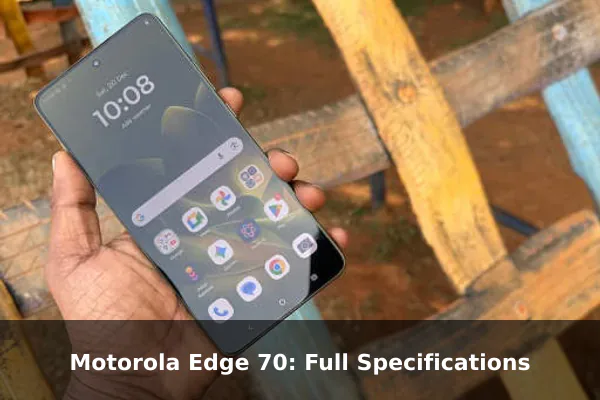
The Motorola Edge 70 is a thin, premium-leaning Android phone built around a 6 mm body, a 6.7-inch P-OLED display, and the Snapdragon 7 Gen 4 platform. It targets buyers who want flagship-style design and strong everyday specifications without moving fully into ultra-premium territory.
This article looks beyond the raw specification sheet to explain what the Edge 70’s hardware choices mean in daily use, from durability and display quality to cameras, battery life, software support, and connectivity.
Full Specifications
Network
| Technology: | GSM / CDMA / HSPA / LTE / 5G |
| 2G bands: | GSM 850 / 900 / 1800 / 1900 |
| CDMA 800 | |
| 3G bands: | HSDPA 850 / 900 / 1700(AWS) / 1900 / 2100 |
| 4G bands: | 1, 2, 3, 4, 5, 7, 8, 12, 13, 17, 18, 19, 20, 25, 26, 28, 32, 34, 38, 39, 40, 41, 42, 43, 48, 66 |
| 5G bands: | 1, 2, 3, 5, 7, 8, 20, 26, 28, 38, 40, 41, 66, 75, 77, 78 SA/NSA/Sub6 |
| Speed: | HSPA, LTE, 5G |
Launch
| Announced: | 2025, October 29 |
| Status: | Available. Released 2025, October 29 |
Body
| Dimensions: | 159.9 x 74 x 6 mm (6.30 x 2.91 x 0.24 in) |
| Weight: | 159 g (5.61 oz) |
| Build: | Glass front (Gorilla Glass 7i), aluminum frame |
| SIM: | · Nano-SIM + eSIM – International· Nano-SIM + Nano-SIM – China |
| IP68/IP69 dust tight and water resistant (high pressure water jets; immersible up to 1.5m for 30 min) MIL-STD-810H compliant* * does not guarantee ruggedness or use in extreme conditions |
Display
| Type: | P-OLED, 1B colors, 120Hz, PWM, HDR10+, 4500 nits (peak) |
| Size: | 6.7 inches, 107.4 cm2 (~90.8% screen-to-body ratio) |
| Resolution: | 1220 x 2712 pixels, 20:9 ratio (~446 ppi density) |
| Protection: | Corning Gorilla Glass 7i, Mohs level 4 |
Platform
| OS: | Android 16, up to 3 or 4 major Android upgrades (market/region dependent) |
| Chipset: | Qualcomm SM7750-AB Snapdragon 7 Gen 4 (4 nm) |
| CPU: | Octa-core (1×2.8 GHz Cortex-720 & 4×2.4 GHz Cortex-720 & 3×1.8 GHz Cortex-520) |
| GPU: | Adreno 722 |
Memory
| Card slot: | No |
| Internal: | 256GB 8GB RAM, 256GB 12GB RAM, 512GB 12GB RAM |
| UFS 3.1 |
Main Camera
| Dual: | 50 MP, f/1.8, 24mm (wide), 1/1.56″, 1.0µm, multi-directional PDAF, OIS 50 MP, f/2.0, 12mm, 120˚ (ultrawide), 1/2.76″, 0.64µm, PDAF |
| Features: | LED flash, HDR, panorama |
| Video: | 4K@30/60fps, 1080p@30/60/120/240fps, gyro-EIS |
Selfie camera
| Single: | 50 MP, f/2.0, 21mm (wide), 1/2.76″, 0.64µm |
| Features: | HDR |
| Video: | 4K@30fps, 1080p@30/120fps |
Sound
| Loudspeaker: | Yes, with stereo speakers (with Dolby Atmos) |
| 3.5mm jack: | No |
Comms
| WLAN: | Wi-Fi 802.11 a/b/g/n/ac/6e, dual-band or tri-band |
| Bluetooth: | 5.4, A2DP, LE |
| Positioning: | GPS, GALILEO, GLONASS, BDS, QZSS |
| NFC: | Yes |
| Radio: | No |
| USB: | USB Type-C 2.0, OTG |
Features
| Sensors: | Fingerprint (under display, optical), accelerometer, gyro, proximity, compass |
| Smart Connect support |
Battery
| Type: | Si/C Li-Ion 4800 mAh |
| Charging: | 68W wired 15W wireless |
Misc
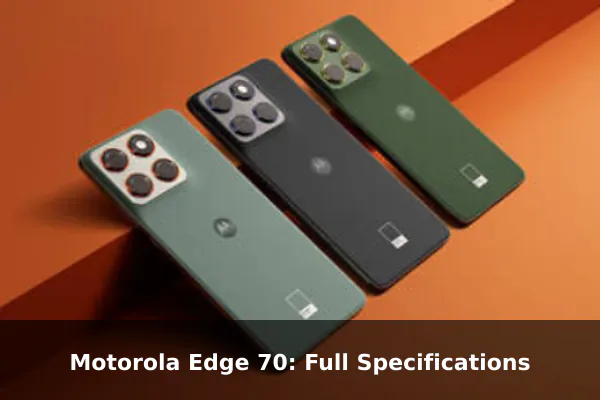
| Colors: | Pantone: Gadget Gray, Lily Pad, Bronze Green |
| Models: | XT2601-2, XT2603-2 |
| Price: | € 768.31 / $ 1,040.00 / £ 695.00 / ₹ 30,999 |
Our Tests
| Performance: | AnTuTu: 1125461 (v10), 1390960 (v11) GeekBench: 4185 (v6) 3DMark: 2085 (Wild Life Extreme) |
| Loudspeaker: | -24.2 LUFS (Very good) |
| Battery: | Active use score 13:36h |
EU LABEL
| Energy: | Class A |
| Battery: | 50:14h endurance, 1000 cycles |
| Free fall: | Class A (270 falls) |
| Repairability: | Class B |
Price and Availability
The Motorola Edge 70 offers a compelling combination of features and performance. While the base price is around €768, the actual cost may vary depending on your location and retailer. Below, you’ll find the approximate price of the Motorola Edge 70 converted into various currencies. Please note that these are estimates based on recent exchange rates as of August 7, 2026 and may not reflect the exact price you’ll find at a retailer.
- United States: $886
- Japan: ¥140,159
- United Kingdom: £658
- Australia: A$1,259
- Canada: C$1,241
- Taiwan: NT$28,559
- Denmark: kr5.734
- Saudi Arabia: ﷼3,322
- South Korea: ₩1,262,229
- Germany: €768
- Brazil: R$4.535
- Vietnam: ₫23.100.380
- Kenya: KSh 114,792
- India: ₹84,349
- Indonesia: Rp 15.883.217
- Nigeria: ₦1,207,444
- Pakistan: ₨246,064
- Philippines: ₱53,841
- Bangladesh: ৳১,০৯,৬৫৭
Value Positioning
The Motorola Edge 70 sits in an interesting part of the Android market: it is clearly more ambitious than a standard mid-range phone, but it is not trying to compete only through maximum chipset power. Its value comes from combining a very thin body, a bright OLED display, high-resolution cameras, wireless charging, IP68/IP69 protection, and official durability claims in one package.
The listed source price data suggests that market pricing may vary heavily by region, so the dedicated price block should be treated as the better place to compare local availability. For specification-focused buyers, the main question is whether the Edge 70’s design, display, and camera package matter more than having a top-tier Snapdragon 8-series chip.
Design and Durability
The headline design detail is the 6 mm thickness. At 159 g, the Edge 70 is also lighter than many large-screen phones, which should make it easier to handle for long reading, navigation, and camera sessions. The aluminum frame and Gorilla Glass 7i front give it a more premium construction than basic plastic-backed models.
Motorola also lists IP68/IP69 dust and water resistance, along with MIL-STD-810H compliance. That combination is notable for a slim phone, but it should be read carefully: MIL-STD wording does not make a device indestructible, and water resistance can degrade with age, impact, or repair. Still, the Edge 70 is unusually well covered on paper for buyers who want a sleek phone with stronger environmental protection.
Display Experience
The 6.7-inch P-OLED panel is one of the strongest parts of the Edge 70 specification set. It combines a 1220 x 2712 resolution, 120Hz refresh rate, HDR10+ support, 1 billion colors, and a quoted 4500-nit peak brightness. In practical terms, this is the kind of display setup that should suit streaming, social feeds, photography review, and outdoor use better than standard 1080p OLED panels.
The roughly 446 ppi density keeps text and interface elements sharp, while the tall 20:9 format gives the phone a modern media-friendly shape. The mention of PWM is also relevant for sensitive users, although the source data does not provide a dimming frequency. If display comfort is a priority, buyers should still check hands-on impressions before committing.
Performance and Storage
The Snapdragon 7 Gen 4 is a modern 4 nm chipset aimed at efficient upper-midrange performance rather than absolute flagship speed. Its CPU layout and Adreno 722 GPU should be more than enough for everyday multitasking, messaging, navigation, camera use, and many games. The supplied benchmark figures also point to a phone with strong general performance for its class.
Storage options include 256GB and 512GB configurations with up to 12GB of RAM, backed by UFS 3.1 storage. There is no microSD card slot, so buyers who keep many 4K videos, offline maps, or large game libraries should choose the storage tier carefully. The 512GB model is the more future-proof choice if local media storage matters.
Camera Setup
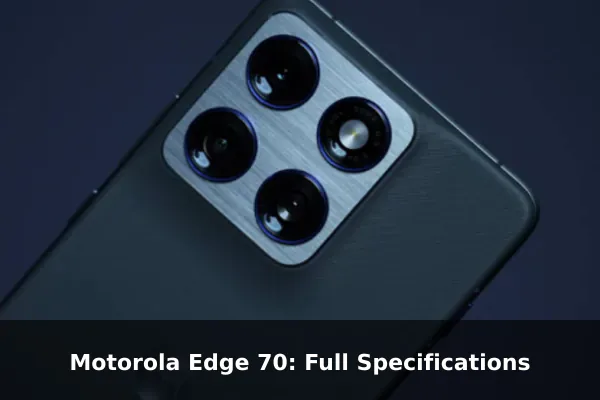
The Edge 70 uses a dual rear camera system led by a 50 MP wide camera with optical image stabilization and multi-directional PDAF. That is the more important camera for daily shooting, because OIS helps with lower-light photos and steadier video. The second rear camera is also 50 MP, using an ultrawide lens with autofocus, which is useful for landscapes, interiors, group photos, and close-up flexibility where supported.
There is no dedicated telephoto camera in the listed hardware, so zoom performance will depend on cropping and processing rather than optical reach. On the positive side, video support is strong for this category, with rear 4K recording at up to 60fps and high-frame-rate 1080p modes. The 50 MP front camera with 4K video also makes the phone more appealing for video calls, selfies, and creator-style clips.
Battery and Charging
The 4800 mAh silicon-carbon battery is a sensible match for a very thin device. It is not the largest capacity in the Android market, but the active use score of 13 hours and 36 minutes suggests respectable endurance. The EU label endurance figure and 1000-cycle rating also give buyers more context than a capacity number alone.
Charging is another advantage. The Edge 70 supports 68W wired charging and 15W wireless charging, which makes it more versatile than phones that offer fast wired charging but skip wireless charging entirely. Heavy users may still want a charger nearby during travel days, but the combination of battery results and charging flexibility looks competitive.
Software and Smart Features
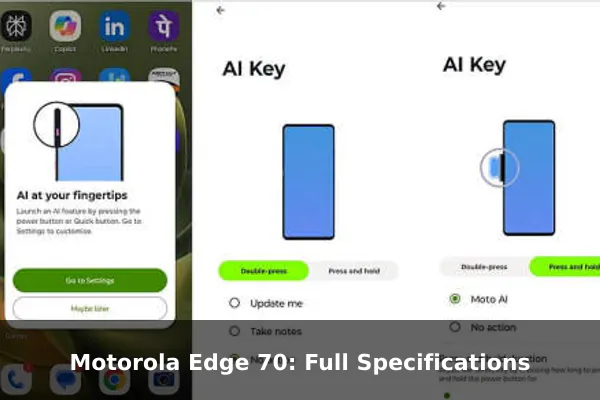
The phone ships with Android 16, which is a strong starting point for buyers who care about software freshness. Motorola lists up to three or four major Android upgrades depending on market or region, so shoppers should verify the exact policy for the model sold locally. That regional note matters because update promises can differ between variants.
Smart Connect support is also part of the package. For users already invested in Motorola or Lenovo-style cross-device workflows, that can make the Edge 70 more useful as a productivity phone, especially for file sharing, screen extension, and connected-device tasks where supported.
Connectivity and Daily Use
The connectivity list is broad, with GSM, CDMA, HSPA, LTE, and Sub-6 5G support across many listed bands. It also includes Wi-Fi 6e, Bluetooth 5.4, NFC, multi-system satellite positioning, USB-C with OTG, and dual-SIM arrangements that vary by international and China models.
The trade-offs are straightforward: there is no 3.5 mm headphone jack, no FM radio, and the USB port is listed as USB 2.0 rather than a faster data standard. Stereo speakers with Dolby Atmos support help the media experience, and the measured loudspeaker result is described as very good, so the phone should work well for casual video and speakerphone use.
Who Should Buy It?
The Motorola Edge 70 is best suited to buyers who want a stylish, thin Android phone with a premium display, durable rating set, good main and ultrawide cameras, and modern charging options. It makes particular sense for users who value comfort and design as much as raw processor hierarchy.
Buyers focused on optical zoom, expandable storage, a headphone jack, or maximum gaming performance may prefer a different model. But for a balanced daily phone with a distinctive slim profile and strong official specification support, the Edge 70 has a clear identity.
Conclusion
The Motorola Edge 70 stands out as a slim, lightweight Android phone that still offers a sharp 120Hz OLED display, capable 50 MP cameras, solid durability ratings, wireless charging, and modern connectivity. It is recommended for buyers who want a refined all-rounder with premium design priorities rather than a spec sheet built only around peak chipset power.
References
- Motorola official product page – motorola edge 70 – Primary Motorola product page for headline specs, design claims, display, cameras, battery, charging, durability, software support, and availability notes.
- Motorola Support – Specifications: motorola edge 70 – Official detailed specification sheet for the 12GB/512GB variant, including bands, SIM configuration, dimensions, display, cameras, battery, and charging.
- Motorola Support – Specifications: motorola edge 70 8GB/256GB variant – Official detailed specification sheet for another regional/storage variant; useful because Motorola notes specifications can vary by market.
- Motorola News – edge 70 launch announcement – Official launch announcement confirming positioning, release timing, core features, and availability context.
- Qualcomm Snapdragon 7 Gen 4 Mobile Platform – Primary chipset source to verify Snapdragon 7 Gen 4 platform capabilities used by the phone.
