
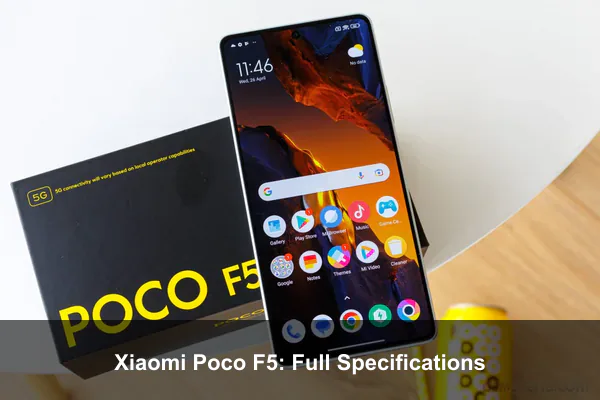
The Xiaomi Poco F5 remains one of the most interesting performance-first phones in the upper midrange segment. It combines a fast Snapdragon platform, a high-refresh AMOLED panel, and practical hardware choices that still feel relevant.
This article focuses on real-world buying value, not just raw numbers, so you can quickly judge whether the Poco F5 still makes sense for gaming, daily use, media, and long-term ownership.
Full Specifications
Network
| Technology | GSM / HSPA / LTE / 5G |
| 2G bands | GSM 850 / 900 / 1800 / 1900 |
| 3G bands | HSDPA 850 / 900 / 1700(AWS) / 1900 / 2100 |
| 4G bands | 1, 2, 3, 4, 5, 7, 8, 20, 28, 38, 40, 41, 66 |
| 5G bands | 1, 3, 5, 7, 8, 20, 28, 38, 40, 41, 77, 78 SA/NSA |
| Speed | HSPA, LTE, 5G |
Launch
| Announced | 2023, May 09 |
| Status | Available. Released 2023, May |
Body
| Dimensions | 161.1 x 75 x 7.9 mm (6.34 x 2.95 x 0.31 in) |
| Weight | 181 g (6.38 oz) |
| Build | Glass front (Gorilla Glass 5), plastic back, plastic frame |
| SIM | Nano-SIM + Nano-SIM |
| IP53 dust protected and water resistant (vertical water sprays) |
Display
| Type | AMOLED, 68B colors, Dolby Vision, HDR10+, 120Hz, 500 nits (typ), 1000 nits (peak) |
| Size | 6.67 inches, 107.4 cm2 (~88.9% screen-to-body ratio) |
| Resolution | 1080 x 2400 pixels, 20:9 ratio (~395 ppi density) |
| Protection | Corning Gorilla Glass 5 |
Platform
| OS | Android 13, upgradable to Android 15, HyperOS |
| Chipset | Qualcomm SM7475-AB Snapdragon 7+ Gen 2 (4 nm) |
| CPU | Octa-core (1×2.91 GHz Cortex-X2 & 3×2.49 GHz Cortex-A710 & 4×1.8 GHz Cortex-A510) |
| GPU | Adreno 725 |
Memory
| Card slot | No |
| Internal | 256GB 8GB RAM, 256GB 12GB RAM |
| UFS 3.1 |
Main Camera
| Triple | 64 MP, f/1.8, (wide), 1/2.0", 0.7µm, PDAF, OIS 8 MP, f/2.2, 120˚ (ultrawide), 1/4.0", 1.12µm 2 MP (macro) |
| Features | LED flash, HDR, panorama |
| Video | 4K@30fps, 1080p@30/60/120fps, gyro-EIS |
Selfie camera
| Single | 16 MP, f/2.5, (wide) |
| Video | 1080p@30/60fps |
Sound
| Loudspeaker | Yes, with stereo speakers |
| 3.5mm jack | Yes |
| 24-bit/192kHz Hi-Res audio |
Comms
| WLAN | Wi-Fi 802.11 a/b/g/n/ac/6, dual-band |
| Bluetooth | 5.3, A2DP, LE |
| Positioning | GPS (L1), GLONASS (G1), BDS (B1I), GALILEO (E1), QZSS (L1) |
| NFC | Yes (market/region dependent) |
| Infrared port | Yes |
| Radio | No |
| USB | USB Type-C 2.0, OTG |
Features
| Sensors | Fingerprint (side-mounted), accelerometer, gyro, proximity, compass |
Battery
| Type | Li-Po 5000 mAh |
| Charging | 67W wired, PD3.0, QC4, 100% in 46 min |
Misc
| Colors | Black, Blue, White |
| Models | 23049PCD8G, 23049PCD8I |
| SAR | 1.09 W/kg (head) 1.08 W/kg (body) |
| SAR EU | 0.99 W/kg (head) 1.00 W/kg (body) |
| Price | € 399.95 / $ 294.99 |
Our Tests
| Performance | AnTuTu: 931174 (v9) GeekBench: 3939 (v5.1), 4348 (v6) GFXBench: 66fps (ES 3.1 onscreen) |
| Display | 963 nits max brightness (measured) |
| Camera | Photo / Video |
| Loudspeaker | -24.3 LUFS (Very good) |
| Battery | Active use score 11:52h |
| Battery (old) | Endurance rating 118h |
Price and Availability
The Xiaomi Poco F5 offers a compelling combination of features and performance. While the base price is around €400, the actual cost may vary depending on your location and retailer. Below, you’ll find the approximate price of the Xiaomi Poco F5 converted into various currencies. Please note that these are estimates based on recent exchange rates as of April 21, 2026 and may not reflect the exact price you’ll find at a retailer.
- United States: $471
- Japan: ¥74,812
- United Kingdom: £348
- Australia: A$657
- Canada: C$643
- Taiwan: NT$14,812
- Denmark: kr2.985
- Saudi Arabia: ﷼1,767
- South Korea: ₩692,457
- Germany: €400
- Brazil: R$2.344
- Vietnam: ₫12.282.489
- Kenya: KSh 60,777
- India: ₹43,838
- Indonesia: Rp 8.066.846
- Nigeria: ₦636,095
- Pakistan: ₨131,360
- Philippines: ₱28,189
- Bangladesh: ৳৫৭,৮৩৪
Value in Today’s Midrange Market
Poco F5 stands out by prioritizing usable speed and balanced daily hardware instead of flashy extras. For buyers comparing phones around this class, it offers a strong mix of smooth performance, capable charging, and multimedia features that are often split across competing models.
Design and Build Practicality
The phone is slim and relatively light for a 5000 mAh device, making it easier to carry over long days. Its IP53 rating and Gorilla Glass 5 protection provide basic durability for normal use, though it is still better treated as a careful-use device rather than a rugged one.
Display Experience for Daily Use
The 120Hz AMOLED screen delivers the combination most users want: fluid scrolling, deep contrast, and strong outdoor readability. Dolby Vision and HDR10+ support also make it a better fit for streaming and video-focused users than many standard midrange panels.
Performance and Gaming Headroom
The Snapdragon 7+ Gen 2 remains the core reason to consider this device. It delivers fast app launches, stable multitasking, and strong gaming behavior for its class, with benchmark results that still place it as a performance-focused option rather than a basic mainstream pick.
Camera Setup: What Matters Most
The main camera with OIS is the practical highlight, giving more reliable handheld shots and steadier video capture. The secondary ultrawide and macro units are serviceable, but the overall camera system is best viewed as “good enough plus stabilization” instead of photography-first.
Battery and Charging Convenience
Battery life is solid for an active full-day routine, and 67W charging keeps downtime short. For users who value quick top-ups before commuting or gaming sessions, this charging profile is one of the phone’s most useful day-to-day strengths.
Software and Longevity Outlook
With Android 13 at launch and upgrade support up to Android 15 under HyperOS, software life is reasonable but not flagship-long. It is suitable for buyers who refresh every few years and want stable, familiar Xiaomi ecosystem behavior without paying flagship prices.
Connectivity and Everyday Extras
5G support, Wi-Fi 6, Bluetooth 5.3, NFC (region dependent), and an infrared blaster give it broad connectivity flexibility. The stereo speakers and 3.5mm headphone jack are especially valuable for users who still want wired audio without adapters.
Who Should Buy Xiaomi Poco F5
This phone is best for users who prioritize speed, display quality, and charging over advanced zoom photography or premium materials. It is a smart pick for gamers, media consumers, and performance-focused buyers seeking strong all-round usability in a midrange budget.
Conclusion
Xiaomi Poco F5 remains a strong performance-value smartphone with a fast chipset, quality display, and practical charging setup. If your priority is smooth everyday speed and balanced features over camera prestige, it is still an easy recommendation.
