
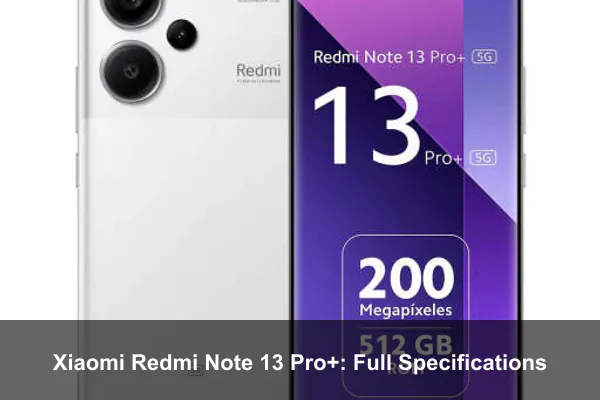
The Xiaomi Redmi Note 13 Pro+ arrived in September 2023 as the ceiling of the Redmi Note 13 family, pairing a 200 MP main camera with 120W charging and an IP68 rating that was still rare in this price bracket. It is the device that pushed the affordable Redmi formula closer to flagship territory, sitting above the standard Redmi Note 13 Pro with a faster chip, curved AMOLED panel, and far quicker charging.
This guide breaks down what those numbers mean in daily use, where the phone makes sensible compromises, and how its Dimensity 7200 Ultra platform holds up today. Use it as a practical reference before deciding whether the Pro+ is still the smarter buy against its newer Note 14 Pro+ successor.
Full Specifications

Network
| Technology: | GSM / CDMA / HSPA / EVDO / LTE / 5G |
| 2G bands: | GSM 850 / 900 / 1800 / 1900 |
| CDMA 800 | |
| 3G bands: | HSDPA 800 / 850 / 900 / 1700(AWS) / 1900 / 2100 – International |
| HSDPA 850 / 900 / 2100 – India | |
| CDMA2000 1xEV-DO | |
| 4G bands: | 1, 2, 3, 4, 5, 7, 8, 12, 13, 17, 18, 19, 20, 26, 28, 32, 38, 40, 41, 66 – International |
| 1, 3, 5, 8, 38, 40, 41 – India | |
| 1, 3, 5, 8, 19, 34, 38, 39, 40, 41 – China | |
| 5G bands: | 1, 3, 5, 7, 8, 20, 28, 38, 40, 41, 66, 77, 78 SA/NSA- International |
| 1, 3, 5, 8, 28, 38, 40, 41, 77, 78 SA/NSA – India | |
| 1, 3, 5, 8, 28, 38, 41, 77, 78 SA/NSA – China | |
| Speed: | HSPA, LTE (CA), 5G |
Launch
| Announced: | 2023, September 21 |
| Status: | Available. Released 2023, September 21 |
Body
| Dimensions: | 161.4 x 74.2 x 8.9 mm (6.35 x 2.92 x 0.35 in) |
| Weight: | 199 g or 204.5 g (7.02 oz) |
| Build: | Glass front (Gorilla Glass Victus), glass back or silicone polymer back (eco leather) |
| SIM: | Nano-SIM + eSIMNano-SIM + Nano-SIM |
| IP68 dust tight and water resistant (immersible up to 1.5m for 30 min) |
Display
| Type: | AMOLED, 68B colors, 120Hz, 1920Hz PWM, Dolby Vision, HDR10+, 1800 nits (peak) |
| Size: | 6.67 inches, 107.4 cm2 (~89.7% screen-to-body ratio) |
| Resolution: | 1220 x 2712 pixels, 20:9 ratio (~446 ppi density) |
| Protection: | Corning Gorilla Glass Victus |
Platform
| OS: | Android 13, up to 3 major Android upgrades, HyperOS |
| Chipset: | Mediatek Dimensity 7200 Ultra (4 nm) |
| CPU: | Octa-core (2×2.8 GHz Cortex-A715 & 6×2.0 GHz Cortex-A510) |
| GPU: | Mali-G610 MC4 |
Memory
| Card slot: | No |
| Internal: | 256GB 8GB RAM, 256GB 12GB RAM, 512GB 8GB RAM, 512GB 12GB RAM, 512GB 16GB RAM |
| UFS 3.1 |
Main Camera
| Triple: | 200 MP, f/1.7, 23mm (wide), 1/1.4″, 0.56µm, multi-directional PDAF, OIS 8 MP, f/2.2, 16mm, 120˚ (ultrawide), 1/4.0″, 1.12µm 2 MP, f/2.4, (macro) |
| Features: | Dual-LED dual-tone flash, HDR, panorama |
| Video: | 4K@24/30fps, 1080p@30/60/120fps, gyro-EIS |
Selfie camera
| Single: | 16 MP, f/2.4, (wide) |
| Features: | HDR, panorama |
| Video: | 1080p@30/60fps |
Sound
| Loudspeaker: | Yes, with stereo speakers |
| 3.5mm jack: | No |
| 24-bit/192kHz Hi-Res & Hi-Res wireless audio |
Comms
| WLAN: | Wi-Fi 802.11 a/b/g/n/ac/6, dual-band, Wi-Fi Direct |
| Bluetooth: | 5.3, A2DP, LE |
| Positioning: | GPS, GLONASS, BDS, GALILEO, QZSS |
| NFC: | Yes (market/region dependent) |
| Infrared port: | Yes |
| Radio: | No |
| USB: | USB Type-C 2.0, OTG |
Features
| Sensors: | Fingerprint (under display, optical), accelerometer, gyro, proximity, compass |
Battery
| Type: | Li-Po 5000 mAh |
| Charging: | 120W wired, PD3.0, 100% in 19 min |
Misc
| Colors: | Midnight Black (Fushion Black), Moonlight White (Fushion White), Aurora Purple, Fushion Purple, Camo Green |
| Models: | 23090RA98C, 23090RA98G, 23090RA98I |
| SAR: | 1.09 W/kg (head) 0.85 W/kg (body) |
| SAR EU: | 0.98 W/kg (head) 1.00 W/kg (body) |
| Price: | € 209.90 / $ 280.00 / £ 251.26 / ₹ 25,499 |
Our Tests
| Performance: | AnTuTu: 683899 (v9), 779812 (v10)
GeekBench: 2353 (v5), 2597 (v6) |
| Display: | 1283 nits max brightness (measured) |
| Loudspeaker: | -26.3 LUFS (Good) |
| Battery: | Active use score 10:38h |
Price and Availability
The Xiaomi Redmi Note 13 Pro+ offers a compelling combination of features and performance. While the base price is around €210, the actual cost may vary depending on your location and retailer. Below, you’ll find the approximate price of the Xiaomi Redmi Note 13 Pro+ converted into various currencies. Please note that these are estimates based on recent exchange rates as of June 12, 2026 and may not reflect the exact price you’ll find at a retailer.
- United States: $242
- Japan: ¥38,869
- United Kingdom: £181
- Australia: A$346
- Canada: C$339
- Taiwan: NT$7,667
- Denmark: kr1.567
- Saudi Arabia: ﷼909
- South Korea: ₩370,214
- Germany: €210
- Brazil: R$1.249
- Vietnam: ₫6.364.490
- Kenya: KSh 31,379
- India: ₹23,177
- Indonesia: Rp 4.354.355
- Nigeria: ₦327,394
- Pakistan: ₨67,534
- Philippines: ₱14,854
- Bangladesh: ৳২৯,৮২৭
Why the Redmi Note 13 Pro+ Still Makes Sense
Launched around €209.90 / $280 / £251.26 / ₹25,499, the Redmi Note 13 Pro+ packs hardware that reads like a checklist from a much costlier phone: a 200 MP OIS camera, IP68 protection, 120W charging, and a 1800-nit AMOLED display. Few rivals near this price combine all four. Even with the Note 14 Pro+ now on shelves, the older Pro+ frequently drops in price while keeping the core experience intact, making it one of the better value-per-spec choices in the upper mid-range.
Design and Build Quality
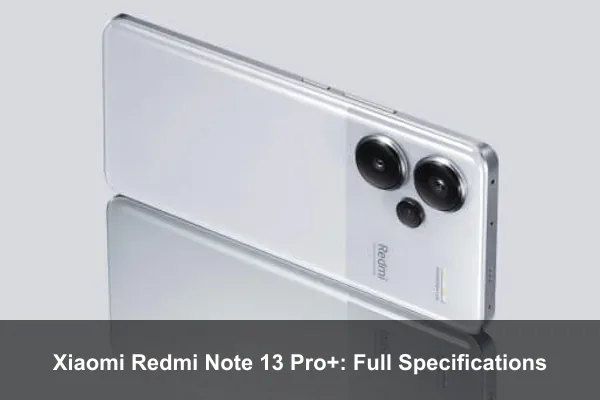
At 161.4 x 74.2 x 8.9 mm and roughly 199-204.5 g, the phone feels substantial but balanced. Xiaomi offers a glass back or a textured silicone-polymer eco-leather finish depending on the colorway, spanning Midnight Black, Moonlight White, Aurora Purple, Fusion Purple, and Camo Green. The headline here is the IP68 rating, certifying full dust resistance and immersion up to 1.5 m for 30 minutes. A Gorilla Glass Victus front adds scratch resistance, putting the build well above the typical mid-range standard.
Display Experience
The 6.67-inch AMOLED panel is a standout. It runs at 120Hz, resolves 1220 x 2712 pixels (~446 ppi), and supports Dolby Vision and HDR10+. Xiaomi quotes 1800 nits peak brightness, and independent testing measured around 1283 nits in practice, which keeps the screen readable outdoors. A 1920Hz PWM dimming rate helps reduce flicker fatigue in low light. For streaming, gaming, and reading, this display punches above the phone’s price.
Performance and Software
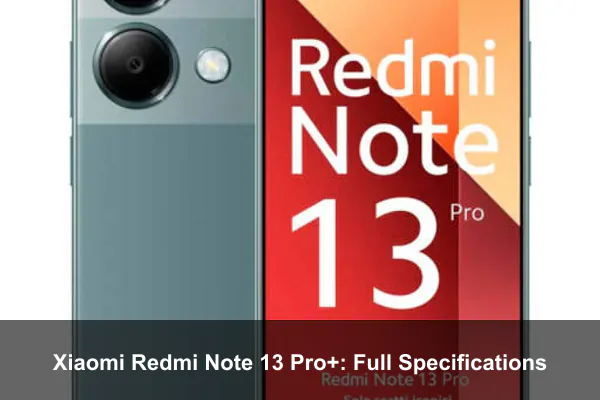
The MediaTek Dimensity 7200 Ultra (4 nm) anchors performance, paired with a Mali-G610 MC4 GPU and up to 16GB of RAM with UFS 3.1 storage. Benchmark results land around 683,899 (AnTuTu v9) and 779,812 (v10), with GeekBench scores of 2353 (v5) and 2597 (v6). That translates to smooth everyday use and capable gaming at medium-to-high settings. It ships on Android 13 with HyperOS and is rated for up to three major Android upgrades, so software support is reasonable rather than class-leading.
Camera Capabilities
The 200 MP f/1.7 main sensor with OIS is the marquee feature, using pixel binning for bright, detailed daytime shots and offering lossless-style cropping at lower output resolutions. It is backed by an 8 MP ultrawide and a 2 MP macro, plus a 16 MP front camera. Video tops out at 4K@30fps with gyro-EIS stabilization. The supporting lenses are modest, so the experience leans heavily on that strong primary sensor, but for the money the main camera delivers consistently likeable results.
Battery and Charging
A 5000 mAh battery is standard for the class, but the 120W wired charging is not. Xiaomi claims a full charge in roughly 19 minutes, which all but eliminates charging anxiety. Real-world endurance testing returned an active-use score of about 10 hours 38 minutes, comfortably enough for a full day. Note there is no wireless charging and no card slot, so storage must be chosen at purchase.
Connectivity and Extras
Connectivity is well-rounded: 5G (SA/NSA), Wi-Fi 6, Bluetooth 5.3, NFC (region dependent), an infrared blaster, and USB Type-C 2.0 with OTG. Audio comes through stereo speakers measured at a solid -26.3 LUFS, with 24-bit/192kHz Hi-Res support, though there is no 3.5mm jack. An under-display optical fingerprint sensor handles biometrics. The IR port is a handy bonus for controlling home appliances.
Who Should Buy It
The Redmi Note 13 Pro+ suits buyers who want flagship-style headline features-high-resolution camera, fast charging, water resistance, and a bright AMOLED-without paying flagship prices. It is less ideal for those who prioritize the longest software support, expandable storage, or wireless charging. Content creators on a budget and media-heavy users will appreciate it most.
Conclusion
The Xiaomi Redmi Note 13 Pro+ remains a compelling upper mid-range option that blends a 200 MP OIS camera, IP68 durability, a brilliant 120Hz AMOLED, and genuinely rapid 120W charging into one affordable package. Its trade-offs-no microSD slot, no wireless charging, and only modest secondary cameras-are easy to accept at this price. If you can find it discounted against the Note 14 Pro+, it is an easy recommendation for anyone wanting maximum standout features per dollar.
