
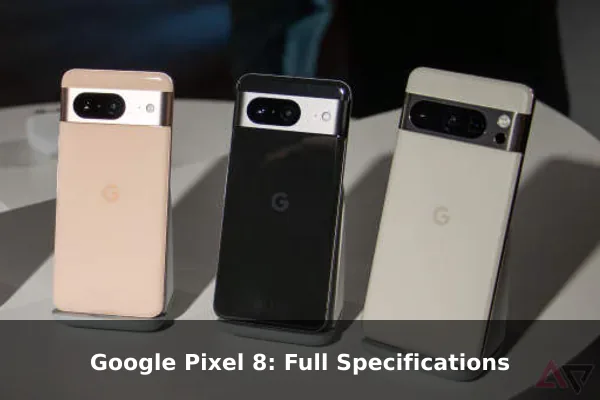
The Google Pixel 8 arrived in October 2023 as the compact, AI-first flagship that distilled Google’s software ambitions into a 6.2-inch body. Built around the Tensor G3 chipset and a promise of up to seven years of major Android upgrades, it is a device designed to stay relevant far longer than its launch-day spec sheet might suggest.
This article looks at the Pixel 8 as a long-term value proposition rather than a raw numbers race. We weigh its measured lab results, its photography-led camera system, and its software longevity against what buyers actually feel day to day, so you can decide whether this small Google flagship still deserves a place in your pocket.
Full Specifications
Network
| Technology: | GSM / HSPA / LTE / 5G |
| 2G bands: | GSM 850 / 900 / 1800 / 1900 |
| 3G bands: | HSDPA 800 / 850 / 900 / 1700(AWS) / 1900 / 2100 |
| 4G bands: | 1, 2, 3, 4, 5, 7, 8, 12, 13, 14, 17, 18, 19, 20, 25, 26, 28, 29, 30, 38, 40, 41, 46, 48, 66, 71 – GKWS6, G9BQD |
| 5G bands: | 1, 2, 3, 5, 7, 8, 12, 20, 25, 26, 28, 29, 30, 38, 40, 41, 48, 66, 70, 71, 77, 78, 258, 260, 261 SA/NSA/Sub6/mmWave – GKWS6 |
| 1, 2, 3, 5, 7, 8, 12, 20, 25, 26, 28, 29, 30, 38, 40, 41, 48, 66, 70, 71, 77, 78 SA/NSA/Sub6 – G9BQD | |
| Speed: | HSPA, LTE (CA), 5G |
Launch
| Announced: | 2023, October 04 |
| Status: | Available. Released 2023, October 12 |
Body
| Dimensions: | 150.5 x 70.8 x 8.9 mm (5.93 x 2.79 x 0.35 in) |
| Weight: | 187 g (6.60 oz) |
| Build: | Glass front (Gorilla Glass Victus), glass back (Gorilla Glass Victus), aluminum frame |
| SIM: | Nano-SIM + eSIM |
| IP68 dust tight and water resistant (immersible up to 1.5m for 30 min) |
Display
| Type: | OLED, 120Hz, HDR10+, 1400 nits (HBM), 2000 nits (peak) |
| Size: | 6.2 inches, 91.1 cm2 (~85.5% screen-to-body ratio) |
| Resolution: | 1080 x 2400 pixels, 20:9 ratio (~428 ppi density) |
| Protection: | Corning Gorilla Glass Victus |
Platform
| OS: | Android 14, upgradable to Android 15, up to 7 major Android upgrades |
| Chipset: | Google Tensor G3 (4 nm) |
| CPU: | Nona-core (1×3.0 GHz Cortex-X3 & 4×2.45 GHz Cortex-A715 & 4×2.15 GHz Cortex-A510) |
| GPU: | Immortalis-G715s MC10 |
Memory
| Card slot: | No |
| Internal: | 128GB 8GB RAM, 256GB 8GB RAM |
| UFS 3.1 |
Main Camera
| Dual: | 50 MP (12 MP eff.), f/1.7, 25mm (wide), 1/1.31″, 1.2µm, dual pixel PDAF, OIS 12 MP, f/2.2, 126˚ (ultrawide), 1/2.9″, 1.25µm, AF |
| Features: | Laser AF, Dual-LED flash, Pixel Shift, Ultra HDR, panorama, Best Take |
| Video: | 4K@24/30/60fps, 1080p@30/60/120/240fps; gyro-EIS, OIS, 10-bit HDR |
Selfie camera
| Single: | 10.5 MP, f/2.2, 20mm (ultrawide), 1/3.1″, 1.22µm |
| Features: | HDR, panorama |
| Video: | 4K@24/30/60fps, 1080p@30/60fps |
Sound
| Loudspeaker: | Yes, with stereo speakers |
| 3.5mm jack: | No |
Comms
| WLAN: | Wi-Fi 802.11 a/b/g/n/ac/6e/7, tri-band, Wi-Fi Direct |
| Bluetooth: | 5.3, A2DP, LE, aptX HD |
| Positioning: | GPS (L1+L5), GLONASS (G1), GALILEO (E1+E5a), QZSS (L1+L5) |
| NFC: | Yes |
| Radio: | No |
| USB: | USB Type-C 3.2 |
Features
| Sensors: | Fingerprint (under display, optical), accelerometer, gyro, proximity, compass, barometer |
| Circle to Search |
Battery
| Type: | Li-Ion 4575 mAh |
| Charging: | 27W wired, PD3.0, PPS, 50% in 30 min 18W wireless Reverse wireless Bypass charging |
Misc
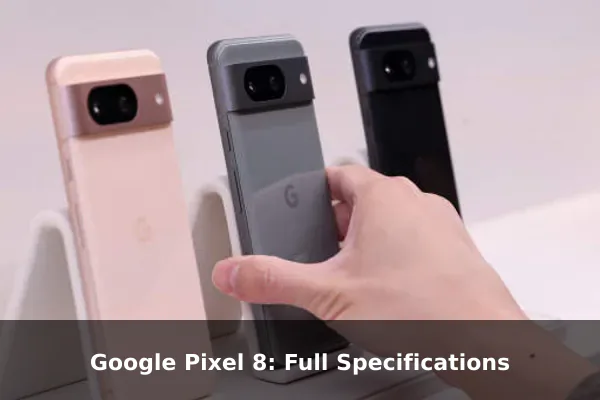
| Colors: | Obsidian, Hazel, Rose, Mint |
| Models: | GKWS6, G9BQD, GA04851-US, GZPFO, GPJ41 |
| Price: | € 323.00 / $ 252.44 / £ 278.74 |
Our Tests
| Performance: | AnTuTu: 926801 (v9), 1158631 (v10) GeekBench: 3526 (v5), 4404 (v6) GFXBench: 73fps (ES 3.1 onscreen) |
| Display: | 1446 nits max brightness (measured) |
| Camera: | Photo / Video |
| Loudspeaker: | -26.0 LUFS (Very good) |
| Battery: | Active use score 11:17h |
| Battery (old): | Endurance rating 83h |
Price and Availability
The Google Pixel 8 offers a compelling combination of features and performance. While the base price is around €323, the actual cost may vary depending on your location and retailer. Below, you’ll find the approximate price of the Google Pixel 8 converted into various currencies. Please note that these are estimates based on recent exchange rates as of November 5, 2026 and may not reflect the exact price you’ll find at a retailer.
- United States: $363
- Japan: ¥57,476
- United Kingdom: £269
- Australia: A$518
- Canada: C$507
- Taiwan: NT$11,913
- Denmark: kr2.414
- Saudi Arabia: ﷼1,361
- South Korea: ₩486,730
- Germany: €323
- Brazil: R$1.987
- Vietnam: ₫9.329.921
- Kenya: KSh 47,128
- India: ₹34,318
- Indonesia: Rp 6.589.006
- Nigeria: ₦484,061
- Pakistan: ₨100,307
- Philippines: ₱23,059
- Bangladesh: ৳৪৫,১৪১
Value and Positioning
The Pixel 8 sits in an interesting middle ground: a genuine flagship experience in a smaller, more affordable frame. With current catalog pricing landing well below its original launch figure, it has quietly become one of the stronger value buys among compact premium phones. You are not paying for a telephoto lens or a quad-HD panel here, but for Google’s software stack, camera processing, and an industry-leading update commitment. For shoppers who value longevity over spec-sheet maximalism, that trade is compelling.
Design and Build Quality
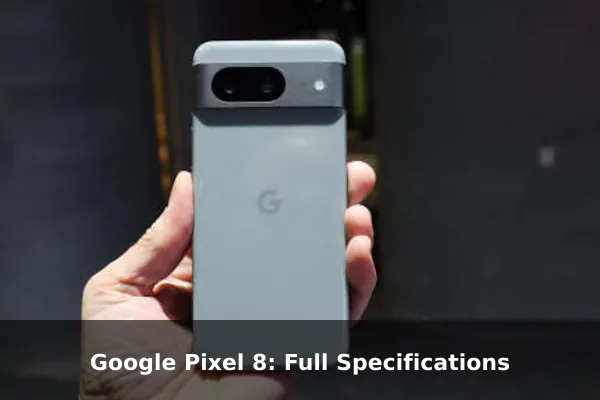
Measuring 150.5 x 70.8 x 8.9 mm and weighing 187 g, the Pixel 8 is refreshingly manageable in one hand, with softened corners and a flat frame that make it easier to grip than many of today’s slab-like giants. The sandwich of Gorilla Glass Victus front and back around an aluminum frame feels reassuringly solid, and IP68 dust and water resistance (immersible up to 1.5 m for 30 minutes) adds everyday peace of mind. Google’s signature camera visor remains the defining visual cue, and the Obsidian, Hazel, Rose, and Mint finishes keep things playful rather than clinical.
Display Experience
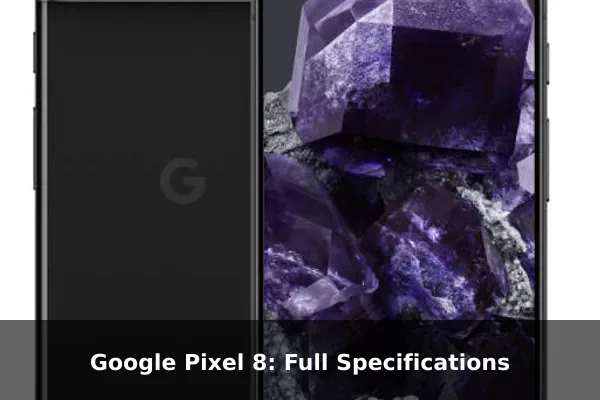
The 6.2-inch OLED panel runs at up to 120Hz with HDR10+ support, and Google rates it at 1400 nits in high-brightness mode with a 2000-nit peak. In our testing it reached a measured 1446 nits, which translates to confident outdoor legibility even under direct sun. At 1080 x 2400 pixels the roughly 428 ppi density keeps text crisp, and the 85.5% screen-to-body ratio means the compact chassis still feels immersive. It is a Full HD+ screen rather than a QHD showpiece, but for this size that is a sensible, battery-friendly choice.
Performance and Thermals
Google’s Tensor G3 (4 nm) pairs a Cortex-X3 prime core with four A715 and four A510 cores alongside the Immortalis-G715s MC10 GPU. Tensor has never chased the raw benchmark crown, and the numbers reflect that: AnTuTu scores of roughly 926,801 (v9) and 1,158,631 (v10), GeekBench results of 3526 (v5) and 4404 (v6), and about 73fps in GFXBench. In practice that is more than enough for fluid navigation, and Tensor’s real strength lies in on-device AI tasks—voice typing, photo processing, and live translation—where it consistently punches above its synthetic scores. With 8GB of RAM and UFS 3.1 storage in 128GB or 256GB capacities, multitasking stays smooth, though there is no microSD expansion.
Camera System
The dual rear setup leads with a 50 MP f/1.7 wide sensor (1/1.31″, dual-pixel PDAF, OIS) that bins down to 12 MP effective shots, joined by a 12 MP f/2.2 ultrawide with autofocus for a 126-degree field of view. Laser AF, a dual-LED flash, Pixel Shift, Ultra HDR, and Google’s Best Take feature round out a package built on computational photography rather than sheer lens count. Video tops out at 4K@60fps with 10-bit HDR, gyro-EIS, and OIS. The 10.5 MP ultrawide selfie camera also captures 4K footage. The absence of a dedicated telephoto is the main compromise, but Google’s processing keeps daylight and low-light stills among the most consistent in this price tier.
Battery and Charging
A 4575 mAh Li-Ion cell delivers an active-use score of 11:17h in our testing, comfortably seeing most users through a full day. Charging is adequate rather than spectacular: 27W wired with PD3.0 and PPS reaches roughly 50% in 30 minutes, while 18W wireless, reverse wireless, and bypass charging add useful flexibility. This is not a fast-charging champion, so buyers coming from brands with 80W-plus bricks should set expectations accordingly.
Software and Longevity
Here the Pixel 8 makes its strongest case. It ships with Android 14, is upgradable to Android 15, and carries Google’s commitment of up to seven major OS upgrades—an unusually long runway that reshapes the value equation entirely. Clean software, timely security patches, Circle to Search, and a steady stream of feature drops mean the phone should feel current for years rather than months. For many buyers, this update policy alone justifies choosing a Pixel over rivals with glossier hardware.
Connectivity
Connectivity is thoroughly modern: broad 5G band coverage (SA/NSA/Sub6/mmWave on US models), Wi-Fi 7 and 6e with tri-band support, Bluetooth 5.3 with aptX HD, NFC, and multi-band GNSS positioning (GPS L1+L5, GLONASS, GALILEO, QZSS). USB Type-C 3.2 and dual-SIM via Nano-SIM plus eSIM complete a future-ready list. There is no 3.5mm headphone jack and no FM radio, but stereo speakers measured a very good -26.0 LUFS.
Who Should Buy It
The Pixel 8 is ideal for buyers who want a compact phone, a dependable point-and-shoot camera, and the longest software support in the Android world, all at a price that has grown more attractive over time. It is less suited to power users who prioritize peak gaming benchmarks, ultra-fast charging, or optical zoom. If software smarts and manageable size top your list, it is an easy recommendation.
Conclusion
The Google Pixel 8 is not about winning spec-sheet arguments; it is about long-term confidence. A bright compact OLED, a reliable camera system, strong lab-measured endurance, and an exceptional seven-year update promise combine into a phone that ages gracefully. If you want a small flagship that will stay secure and feature-rich for years without demanding a premium outlay, the Pixel 8 remains one of the smartest buys in its class—especially at its current reduced pricing. Prices and availability can vary by region and over time, so confirm current figures with official sources before purchasing.
References
- Google Store – Pixel 8 – Official Google product page with authoritative specifications, pricing, color options, and feature descriptions for the Pixel 8.
- Google Pixel 8 Tech Specs (Google Store) – Official detailed technical specification sheet (display, Tensor G3 chipset, camera, battery, dimensions) directly from the manufacturer.
- Google Pixel Help / Support – Official Google support documentation for Pixel devices, useful for confirming software update policy, feature behavior, and accurate device details.
- The Keyword – Google Blog (Pixel 8 announcement) – Official Google announcement blog detailing the Pixel 8 launch, key features, and AI capabilities straight from the source.
- GSMArena – Google Pixel 8 – Well-established smartphone specification database widely used for cross-checking detailed hardware specs and release information.
