
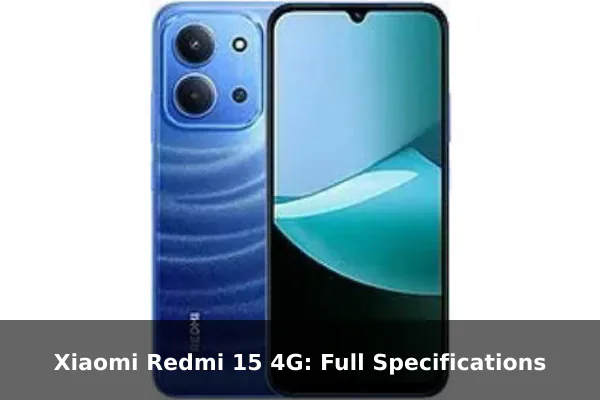
Xiaomi Redmi 15 4G is a budget Android phone built around three clear priorities: a very large display, a high-capacity battery, and practical everyday hardware. It keeps the focus on 4G connectivity instead of chasing 5G, which helps position it as a value-first Redmi option for users who care more about screen size and endurance than premium extras.
Announced and released on August 1, 2025, the Redmi 15 4G arrives with Android 15 and HyperOS 2, a Snapdragon 685 chipset, a 50 MP main rear camera, and a 7000 mAh silicon-carbon battery with 33W wired charging. Its approximate 150 EUR pricing puts it in direct competition with entry-level and lower-midrange Android phones, but its 6.9-inch 144Hz display gives it a more media-focused identity.
Full Specifications
Network
| Technology: | GSM / HSPA / LTE |
| 2G bands: | GSM 850 / 900 / 1800 / 1900 |
| 3G bands: | HSDPA 850 / 900 / 1900 / 2100 |
| 4G bands: | LTE |
| Speed: | HSPA, LTE |
Launch
| Announced: | 2025, August 01 |
| Status: | Available. Released 2025, August 01 |
Body
| Dimensions: | 171.1 x 82.1 x 8.6 mm (6.74 x 3.23 x 0.34 in) |
| Weight: | 224 g (7.90 oz) |
| SIM: | Nano-SIM + Nano-SIM |
| IP64 dust tight and water resistant (water splashes) |
Display
| Type: | IPS LCD, 144Hz |
| Size: | 6.9 inches, 116.9 cm2 (~83.2% screen-to-body ratio) |
| Resolution: | 1080 x 2340 pixels, 19.5:9 ratio (~374 ppi density) |
Platform
| OS: | Android 15, HyperOS 2 |
| Chipset: | Qualcomm SM6225 Snapdragon 685 (6 nm) |
| CPU: | Octa-core (4×2.8 GHz Cortex-A73 & 4×1.9 GHz Cortex-A53) |
| GPU: | Adreno 610 |
Memory
| Card slot: | microSDXC (uses shared SIM slot) |
| Internal: | 128GB 6GB RAM, 256GB 8GB RAM |
Main Camera
| Dual: | 50 MP, f/1.8, (wide), PDAF Auxiliary lens |
| Features: | LED flash, HDR |
| Video: | 1080p@30fps |
Selfie camera
| Single: | 8 MP, f/2.0, (wide) |
| Features: | HDR |
| Video: | 1080p@30fps |
Sound
| Loudspeaker: | Yes |
| 3.5mm jack: | No |
Comms
| WLAN: | Wi-Fi 802.11 b/g/n/ac, dual-band |
| Bluetooth: | 5.0, A2DP, LE |
| Positioning: | GPS, GLONASS, GALILEO, BDS |
| NFC: | Yes (market/region dependent) |
| Infrared port: | Yes |
| Radio: | No |
| USB: | USB Type-C 2.0 |
Features
| Sensors: | Fingerprint (side-mounted), accelerometer, compass |
| Virtual proximity sensing |
Battery
| Type: | Si/C Li-Ion 7000 mAh |
| Charging: | 33W wired |
Misc
| Colors: | Midnight Black, Titan Gray, Sandy Purple |
| Price: | About 150 EUR |
Price and Availability
The Xiaomi Redmi 15 4G offers a compelling combination of features and performance. While the base price is around €150, the actual cost may vary depending on your location and retailer. Below, you’ll find the approximate price of the Xiaomi Redmi 15 4G converted into various currencies. Please note that these are estimates based on recent exchange rates as of August 29, 2026 and may not reflect the exact price you’ll find at a retailer.
- United States: $174
- Japan: ¥27,834
- United Kingdom: £128
- Australia: A$243
- Canada: C$242
- Taiwan: NT$5,509
- Denmark: kr1.121
- Saudi Arabia: ﷼653
- South Korea: ₩240,111
- Germany: €150
- Brazil: R$901
- Vietnam: ₫4.504.939
- Kenya: KSh 22,612
- India: ₹16,632
- Indonesia: Rp 3.074.847
- Nigeria: ₦237,625
- Pakistan: ₨48,311
- Philippines: ₱10,843
- Bangladesh: ৳২১,৪৩৭
Value Positioning
The Redmi 15 4G makes the most sense when judged as a large-screen, long-lasting phone rather than as a compact all-rounder. Its appeal is not based on flagship camera hardware, premium materials, or 5G support. Instead, Xiaomi gives buyers a big FHD+ display, a modern Android software base, expandable storage, dual SIM support, and an unusually large battery at a price point that remains accessible.
That combination is useful for buyers who mainly browse, stream, message, study, navigate, and use social apps. The Snapdragon 685 is a familiar 4G chipset, so expectations should stay realistic for heavy gaming or advanced camera processing. However, for daily phone use, the overall package is balanced: enough RAM and storage options, a sharp display, and battery capacity that is clearly above the usual budget-phone average.
Design and Durability
Physically, the Redmi 15 4G is a large phone. The source dimensions and 224 g weight point to a handset that favors screen and battery size over pocket comfort. Users moving from a smaller 6.1-inch or 6.5-inch device should expect a noticeable jump in width and weight. This is not a phone for one-handed use first; it is closer to a compact tablet-style experience in a standard smartphone body.
The IP64 rating is a welcome durability detail in this class. It means the phone is dust tight and resistant to water splashes, but it should not be treated as waterproof. That distinction matters: rain, accidental splashes, or dusty outdoor use are within the spirit of the rating, while submersion is not. The side-mounted fingerprint sensor is also a practical choice, keeping unlocking fast without relying only on face unlock or in-display hardware.
Display Experience
The 6.9-inch IPS LCD is one of the most important reasons to consider this phone. Its 1080 x 2340 resolution keeps text and interface elements reasonably crisp, while the 144Hz refresh rate gives Xiaomi a strong headline feature for the price. Scrolling through feeds, supported apps, and the HyperOS interface should feel smoother than on typical 60Hz budget displays.
Because this is an IPS LCD rather than an AMOLED panel, buyers should not expect the same deep blacks or contrast found on Xiaomi’s higher-end models. Even so, the size, resolution, and refresh rate make the Redmi 15 4G a strong candidate for video streaming, reading, web browsing, maps, and casual games. The roughly 83.2 percent screen-to-body ratio also suggests a modern front layout, though the overall device footprint remains large.
Performance and Storage
The Qualcomm Snapdragon 685 is a 6 nm 4G platform with an octa-core CPU and Adreno 610 graphics. It is designed for efficient everyday performance rather than demanding flagship workloads. Messaging, calls, browsing, video playback, banking apps, light editing, and casual gaming should be the natural comfort zone. More demanding 3D games may require reduced graphics settings, and users who multitask heavily should prefer the 8GB RAM version.
Xiaomi lists the Redmi 15 4G with 128GB 6GB RAM and 256GB 8GB RAM options in the supplied data. The microSDXC slot adds flexibility, though it uses the shared SIM slot, so buyers may need to choose between a second SIM and expandable storage. That tradeoff is common in this category, but it is worth noting for users who travel with two numbers or maintain separate work and personal SIM cards.
Camera Setup
The rear camera system is led by a 50 MP wide camera with PDAF, supported by an auxiliary lens. This is a straightforward camera arrangement, and the important takeaway is that the Redmi 15 4G is built around one main usable rear camera rather than a complex multi-camera system. LED flash and HDR are included, and rear video recording reaches 1080p at 30fps.
The 8 MP front camera is similarly basic but functional for selfies, video calls, and social media. It also supports HDR and 1080p video at 30fps. Buyers looking for ultrawide photography, telephoto zoom, optical image stabilization, or 4K recording should look higher in Xiaomi’s lineup. For the Redmi 15 4G, the camera story is about everyday snapshots in good lighting, not advanced imaging flexibility.
Battery Life and Charging
The 7000 mAh silicon-carbon Li-Ion battery is the phone’s biggest practical advantage. Capacity this large gives the Redmi 15 4G a clear identity for users who dislike charging during the day. Actual endurance will depend on brightness, signal strength, refresh-rate behavior, gaming, and app usage, but the battery specification strongly favors long runtime compared with many phones in the same price range.
Charging is rated at 33W wired. That is not flagship-fast, especially given the large battery size, but it is reasonable for the segment and much better than slower 10W or 18W budget charging. The more important benefit is flexibility: a full charge should carry many users comfortably through a demanding day, and lighter users may be able to stretch longer between charges.
Software and Everyday Features
Android 15 with HyperOS 2 gives the Redmi 15 4G a current software foundation. HyperOS is Xiaomi’s ecosystem interface, so users can expect Xiaomi’s familiar approach to home screen customization, system tools, battery controls, privacy permissions, and connected-device features. Feature availability can vary by region and software version, so buyers should check the local model before purchase.
The phone also includes practical hardware features that matter in daily use. The infrared port is useful for controlling TVs, air conditioners, and other compatible appliances. The side fingerprint reader is fast and familiar. Virtual proximity sensing replaces a traditional proximity sensor, which is common in some budget models, though call-screen behavior can vary depending on tuning and usage conditions.
Connectivity and Network Notes
The Redmi 15 4G supports GSM, HSPA, and LTE, but it is not a 5G phone. That should be a deliberate buying decision. In areas where 4G coverage is strong and data needs are moderate, LTE remains perfectly usable for streaming, messaging, navigation, browsing, and hotspot use. In markets where carriers are rapidly expanding 5G-only plans or where long-term network support is a priority, a 5G alternative may be a better fit.
Connectivity includes dual-band Wi-Fi, Bluetooth 5.0, GPS, GLONASS, GALILEO, BDS, USB Type-C 2.0, and market-dependent NFC. The regional nature of NFC is important: some Redmi 15 variants may include it while others may not. The lack of a 3.5mm headphone jack is also worth noting, especially for buyers replacing older budget Redmi phones that still had wired audio ports.
Who Should Buy the Redmi 15 4G?
The Redmi 15 4G is best suited to buyers who want a large display, long battery life, expandable storage, and a low price more than they want 5G or advanced cameras. It is a practical option for students, commuters, family users, delivery riders, secondary-phone buyers, and anyone who spends long hours away from a charger.
It is less ideal for users who prefer compact phones, premium display contrast, wireless charging, 4K video, high-end gaming performance, or guaranteed NFC in every market. The most comparison-friendly way to view it is as a battery-first 4G Redmi with a big 144Hz screen. If those two points match your priorities, the rest of the specification sheet is sensible for the class.
Conclusion
Xiaomi Redmi 15 4G is a focused budget smartphone with a huge 7000 mAh battery, a 6.9-inch 144Hz display, Android 15 with HyperOS 2, and practical 4G hardware. It is not the best choice for buyers who need 5G, compact dimensions, or advanced camera tools, but it is a strong value pick for users who want a big screen and dependable battery life at a modest price.
References
- Xiaomi Global – Redmi 15 Specifications – Primary manufacturer specification page for Redmi 15, covering chipset, display, cameras, battery, charging, dimensions, storage variants, connectivity, sensors, IP rating, and package contents.
- Xiaomi Mexico – Redmi 15 Specifications – Official regional Xiaomi specs page useful for checking market-dependent differences such as network bands, NFC availability, charger inclusion, memory configuration, and regional package contents.
- Global Certification Forum – Redmi 15 Certification – Independent certification listing from GCF for Redmi 15, useful to verify model identity, certification date, and supported GSM/WCDMA/LTE bands.
- Federal Communications Commission Equipment Authorization System (fcc.gov) – Official U.S. regulator database for FCC ID 2AFZZRN2DL / Xiaomi RN2DL, useful for confirming wireless compliance, radio frequency support, SAR/user manual filings, and regulatory model details.
