
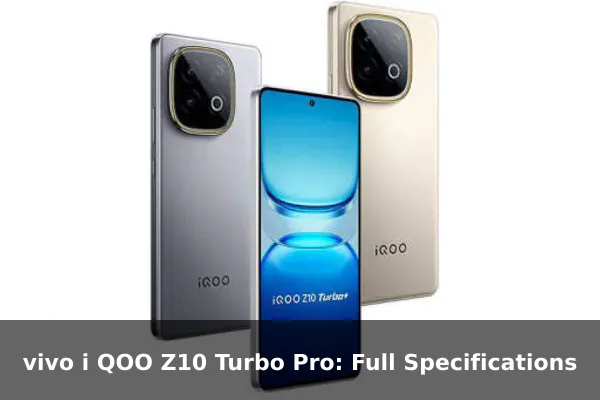
The vivo i QOO Z10 Turbo Pro is a performance-focused Android phone built around a large 7000 mAh silicon-carbon battery, 120W wired charging, and Qualcomm’s Snapdragon 8s Gen 4 platform.
Its appeal is not just raw speed. The phone combines a 144Hz AMOLED display, generous UFS 4.1 storage options, stereo speakers, modern wireless connectivity, and a practical dual-camera setup for buyers who want strong value without paying flagship prices.
Full Specifications
Network
| Technology: | GSM / HSPA / LTE / 5G |
| 2G bands: | GSM 850 / 900 / 1800 / 1900 |
| 3G bands: | HSDPA 800 / 850 / 900 / 2100 |
| 4G bands: | 1, 3, 5, 8, 18, 19, 26, 28, 34, 38, 39, 40, 41, 42, 48 |
| 5G bands: | 1, 3, 5, 8, 18, 26, 28, 38, 40, 41, 48, 77, 78 SA/NSA |
| Speed: | HSPA, LTE, 5G |
Launch
| Announced: | 2025, April 28 |
| Status: | Available. Released 2025, April 28 |
Body
| Dimensions: | 163.7 x 75.9 x 8.1 mm (6.44 x 2.99 x 0.32 in) |
| Weight: | 206 g (7.27 oz) |
| Build: | Glass front, plastic back, plastic frame |
| SIM: | Nano-SIM + Nano-SIM |
| IP65 dust tight and water resistant (low pressure water jets) |
Display
| Type: | AMOLED, 1B colors, 144Hz, 4320Hz PWM, HDR, 2000 nits (HBM), 4400 nits (peak) |
| Size: | 6.78 inches, 111.0 cm2 (~89.3% screen-to-body ratio) |
| Resolution: | 1260 x 2800 pixels, 20:9 ratio (~453 ppi density) |
Platform
| OS: | Android 15, OriginOS 5 |
| Chipset: | Qualcomm SM8735 Snapdragon 8s Gen 4 (4 nm) |
| CPU: | Octa-core (1×3.21 GHz Cortex-X4 & 3×3.0 GHz Cortex-A720 & 2×2.8 GHz Cortex-A720 & 2×2.0 GHz Cortex-A720) |
| GPU: | Adreno 825 |
Memory
| Card slot: | No |
| Internal: | 256GB 12GB RAM, 256GB 16GB RAM, 512GB 12GB RAM, 512GB 16GB RAM |
| UFS 4.1 |
Main Camera
| Dual: | 50 MP, f/1.8, (wide), 1/1.95″, 0.8µm, PDAF, OIS 8 MP, f/2.2, (ultrawide) |
| Features: | Color spectrum sensor, LED flash, HDR, panorama |
| Video: | 4K@30/60fps, 1080p, gyro-EIS, OIS |
Selfie camera
| Single: | 16 MP, f/2.5, (wide), 1/3.0″, 1.0µm |
| Video: | 1080p@30fps, gyro-EIS |
Sound
| Loudspeaker: | Yes, with stereo speakers |
| 3.5mm jack: | No |
Comms
| WLAN: | Wi-Fi 802.11 a/b/g/n/ac/6/7, dual-band |
| Bluetooth: | 6.0, A2DP, LE, aptX HD, aptX Adaptive, aptX Lossless, LHDC 5 |
| Positioning: | GPS (L1+L5), BDS (B1I+B1C+B2a), GALILEO (E1+E5a), QZSS (L1+L5), GLONASS |
| NFC: | Yes |
| Infrared port: | Yes |
| Radio: | No |
| USB: | USB Type-C 2.0, OTG |
Features
| Sensors: | Fingerprint (under display, optical), accelerometer, gyro, proximity, compass |
Battery
| Type: | Si/C Li-Ion 7000 mAh |
| Charging: | 120W wired, 100W PD, 100W PPS, 50% in 15 min, 100% in 33 min Reverse wired |
Misc
| Colors: | White, Black, Orange, Gold |
| Models: | V2453A |
| Price: | About 240 EUR |
Price and Availability
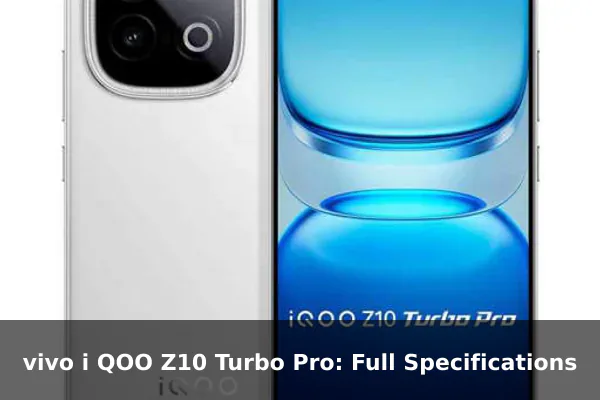
The vivo i QOO Z10 Turbo Pro offers a compelling combination of features and performance. While the base price is around €240, the actual cost may vary depending on your location and retailer. Below, you’ll find the approximate price of the vivo i QOO Z10 Turbo Pro converted into various currencies. Please note that these are estimates based on recent exchange rates as of August 6, 2026 and may not reflect the exact price you’ll find at a retailer.
- United States: $277
- Japan: ¥43,689
- United Kingdom: £206
- Australia: A$393
- Canada: C$389
- Taiwan: NT$8,954
- Denmark: kr1.791
- Saudi Arabia: ﷼1,040
- South Korea: ₩394,430
- Germany: €240
- Brazil: R$1.420
- Vietnam: ₫7.228.794
- Kenya: KSh 35,829
- India: ₹26,367
- Indonesia: Rp 4.969.722
- Nigeria: ₦376,653
- Pakistan: ₨77,051
- Philippines: ₱16,839
- Bangladesh: ৳৩৪,২৯৯
Value Positioning
The vivo i QOO Z10 Turbo Pro sits in a particularly interesting part of the Android market: it targets users who care more about speed, screen quality, charging, and endurance than luxury materials or complex camera hardware. With raw source pricing listed at about 240 EUR, the phone reads like a high-performance value model, although real-world pricing can vary by region, import channel, storage configuration, and tax.
The strongest value argument is the combination of Snapdragon 8s Gen 4, UFS 4.1 storage, a 144Hz AMOLED panel, and a 7000 mAh battery. Those are not entry-level ingredients. Buyers comparing it with typical mid-range phones should look closely at performance and battery capacity, because those are the areas where this model is clearly trying to stand out.
Design and Build

The phone measures 163.7 x 75.9 x 8.1 mm and weighs 206 g, so it is not a compact device. That size is expected for a phone carrying a 6.78-inch display and such a large battery. The 206 g weight is still manageable, but users moving from a smaller phone should expect a noticeably larger hand feel.
vivo uses a glass front with a plastic back and plastic frame. That choice helps keep cost and weight under control, but it also means the device is positioned more as a performance-value phone than a premium design object. The IP65 rating is useful, giving dust-tight protection and resistance against low-pressure water jets. It is not a full waterproofing claim, but it is a welcome practical feature for daily use.
Display Quality
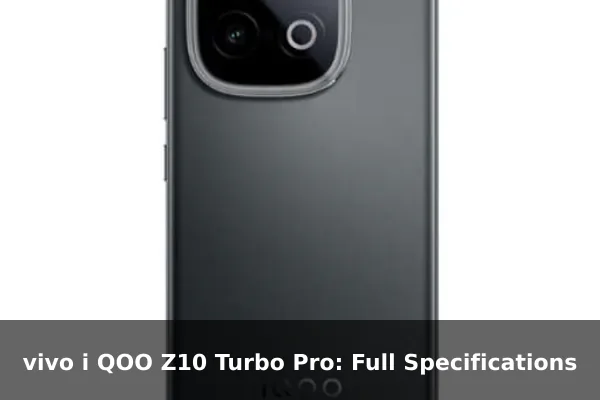
The 6.78-inch AMOLED display is one of the phone’s headline features. It supports 1 billion colors, HDR, a 144Hz refresh rate, 4320Hz PWM dimming, 2000 nits high-brightness mode, and up to 4400 nits peak brightness. On paper, that gives the Z10 Turbo Pro a display package built for gaming, streaming, and outdoor visibility.
The 1260 x 2800 resolution works out to roughly 453 ppi, which is sharp for a panel this size. The 20:9 aspect ratio also gives the phone a tall canvas for browsing, split-screen use, and video apps. Users sensitive to display flicker may also appreciate the high PWM dimming figure, although comfort still depends on personal sensitivity and brightness habits.
Performance Hardware
Performance is the clearest reason to consider this phone. The Snapdragon 8s Gen 4 is a 4 nm chipset with an octa-core CPU led by a Cortex-X4 core at 3.21 GHz, supported by Cortex-A720 cores across performance and efficiency tiers. The Adreno 825 GPU gives the phone serious graphics credentials for gaming and other GPU-heavy workloads.
Memory options are also strong: 12GB or 16GB of RAM paired with 256GB or 512GB of storage. The use of UFS 4.1 is important because storage speed affects app launching, file handling, game loading, and long-term responsiveness. There is no microSD card slot, so buyers should choose the storage version carefully at purchase.
Camera Setup
The rear camera system is simple but practical. It uses a 50 MP wide camera with PDAF and OIS, paired with an 8 MP ultrawide camera. The main sensor is the one that matters most here, and optical stabilization gives it a better foundation for low-light shots and steadier video than a basic unstabilized camera would offer.
Video recording reaches 4K at 30 or 60 fps, with gyro-EIS and OIS support. That is a strong inclusion for a value-performance phone. The ultrawide camera is useful for landscapes, interiors, and group shots, but its 8 MP resolution suggests it should be treated as a convenience camera rather than a flagship-grade secondary lens. The 16 MP front camera records 1080p video at 30 fps with gyro-EIS, which is adequate for video calls and casual social clips.
Battery and Charging
The 7000 mAh silicon-carbon battery is the specification that gives the Z10 Turbo Pro its endurance identity. Capacity this large can be valuable for gaming, navigation, hotspot use, video streaming, and long days away from a charger. Actual battery life will depend on refresh rate, 5G signal quality, screen brightness, and gaming load, but the hardware foundation is clearly stronger than the common 5000 mAh class.
Charging is equally aggressive. The phone supports 120W wired charging, along with 100W PD and 100W PPS. The listed claim of 50% in 15 minutes and 100% in 33 minutes makes it suitable for users who need fast top-ups rather than overnight-only charging. Reverse wired charging adds another practical touch for accessories or emergency power sharing.
Software Experience
The device ships with Android 15 and OriginOS 5. That matters because it starts on a current Android generation rather than relying on an older base. OriginOS is vivo’s China-focused Android interface, so buyers outside China should consider language support, regional services, notification behavior, and app compatibility before importing.
For users already comfortable with vivo or iQOO software, the hardware should feel well matched to the interface. The under-display optical fingerprint sensor, face unlock support from the front camera system, and standard motion sensors cover the expected daily conveniences. Long-term update policy should still be checked by market, because software support can vary by region and sales channel.
Connectivity and Extras
Connectivity is broad. The phone supports GSM, HSPA, LTE, and 5G with SA and NSA bands, plus dual Nano-SIM support. Wireless features include Wi-Fi 7, Bluetooth 6.0, NFC, infrared, and multi-system positioning with dual-frequency GPS support. For a phone in this price discussion, Wi-Fi 7 and advanced Bluetooth codec support are especially notable.
Audio is handled by stereo speakers, but there is no 3.5 mm headphone jack. The USB-C port supports USB 2.0 and OTG, which is fine for charging and accessories but not ideal for fast wired data transfers. The infrared port is a useful extra for controlling compatible home devices, while NFC helps with payments and quick pairing where supported.
Who Should Buy It
The vivo i QOO Z10 Turbo Pro is best suited to users who prioritize battery life, fast charging, gaming performance, and a bright high-refresh AMOLED display. It makes sense for heavy phone users, mobile gamers, students, commuters, and anyone who wants strong hardware without moving into expensive flagship territory.
It is less ideal for buyers who want a compact phone, premium glass-and-metal construction, expandable storage, a headphone jack, or a more advanced multi-camera system with telephoto zoom. Import buyers should also check network compatibility, warranty coverage, and software localization before purchasing.
Conclusion
The vivo i QOO Z10 Turbo Pro is a strong value-performance smartphone with a fast chipset, sharp 144Hz AMOLED display, huge 7000 mAh battery, and very fast wired charging. Its plastic build, no microSD slot, no headphone jack, and modest ultrawide camera are the main trade-offs. For buyers who want speed and endurance first, it is easy to recommend.
References
- vivo China – iQOO Z10 Turbo Pro Specifications – Primary manufacturer specification page for model V2453A, including dimensions, display, processor, memory, battery, charging, cameras, network bands, sensors, and OS.
- vivo China – iQOO Z10 Turbo Pro Product Page – Official product page with feature claims, launch context, battery and charging footnotes, display details, and performance notes for the iQOO Z10 Turbo Pro.
- Qualcomm – Snapdragon 8s Gen 4 Mobile Platform – Official chipset reference for verifying Snapdragon 8s Gen 4 platform capabilities such as CPU class, GPU, connectivity, Wi-Fi 7, Bluetooth, and process information.
- ZOL – iQOO Z10 Turbo Pro Parameters – Established Chinese technology publication useful as a secondary cross-check for variants, pricing, and specification listings against the official vivo source.
