
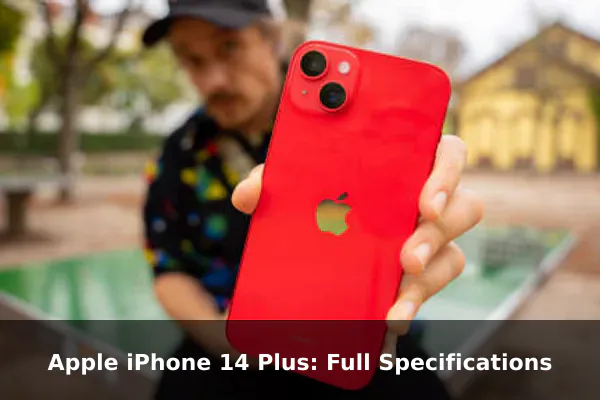
The Apple iPhone 14 Plus is the large-screen member of the iPhone 14 family, aimed at buyers who want a 6.7-inch display and strong battery life without stepping up to the Pro Max line.
It combines the A15 Bionic chip, dual 12 MP cameras, 5G connectivity, Ceramic Shield protection, Emergency SOS via satellite, and long software support in a lighter aluminum-frame design.
Full Specifications
Network
| Technology: | GSM / CDMA / HSPA / EVDO / LTE / 5G |
| 2G bands: | GSM 850 / 900 / 1800 / 1900 |
| CDMA 800 / 1900 | |
| 3G bands: | HSDPA 850 / 900 / 1700(AWS) / 1900 / 2100 |
| CDMA2000 1xEV-DO | |
| 4G bands: | 1, 2, 3, 4, 5, 7, 8, 12, 13, 17, 18, 19, 20, 25, 26, 28, 30, 32, 34, 38, 39, 40, 41, 42, 46, 48, 66 – A2886, A2888 |
| 1, 2, 3, 4, 5, 7, 8, 11, 12, 13, 14, 17, 18, 19, 20, 21, 25, 26, 28, 29, 30, 32, 34, 38, 39, 40, 41, 42, 46, 48, 53, 66, 71 – A2632, A2885 | |
| 1, 2, 3, 4, 5, 7, 8, 12, 13, 17, 18, 19, 20, 25, 26, 28, 30, 32, 34, 38, 39, 40, 41, 42, 46, 48, 66 – A2887 | |
| 5G bands: | 1, 2, 3, 5, 7, 8, 12, 20, 25, 26, 28, 30, 38, 40, 41, 48, 66, 70, 77, 78, 79 SA/NSA/Sub6 – A2886, A2888 |
| 1, 2, 3, 5, 7, 8, 12, 14, 20, 25, 26, 28, 29, 30, 38, 40, 41, 48, 53, 66, 70, 71, 77, 78, 79, 258, 260, 261 SA/NSA/Sub6/mmWave – A2632 | |
| 1, 2, 3, 5, 7, 8, 12, 14, 20, 25, 26, 28, 29, 30, 38, 40, 41, 48, 53, 66, 70, 71, 77, 78, 79 SA/NSA/Sub6 – A2885 | |
| 1, 2, 3, 5, 7, 8, 12, 20, 25, 26, 28, 30, 38, 40, 41, 48, 66, 70, 77, 78, 79 SA/NSA/Sub6 – A2887 | |
| Speed: | HSPA, LTE, 5G, EV-DO Rev.A 3.1 Mbps |
Launch
| Announced: | 2022, September 07 |
| Status: | Available. Released 2022, October 07 |
Body
| Dimensions: | 160.8 x 78.1 x 7.8 mm (6.33 x 3.07 x 0.31 in) |
| Weight: | 203 g (7.16 oz) |
| Build: | Glass front, glass back, aluminum frame |
| SIM: | Nano-SIM + eSIM + eSIM (max 2 at a time; International)eSIM + eSIM (8 or more, max 2 at a time; USA)Nano-SIM + Nano-SIM (China) |
| IP68 dust tight and water resistant (immersible up to 6m for 30 min) Apple Pay (Visa, MasterCard, AMEX certified) |
Display
| Type: | Super Retina XDR OLED, HDR10, Dolby Vision, 800 nits (HBM), 1200 nits (peak) |
| Size: | 6.7 inches, 109.8 cm2 (~87.4% screen-to-body ratio) |
| Resolution: | 1284 x 2778 pixels, 19.5:9 ratio (~458 ppi density) |
| Protection: | Ceramic Shield glass |
Platform
| OS: | iOS 16, upgradable to iOS 18.6 |
| Chipset: | Apple A15 Bionic (5 nm) |
| CPU: | Hexa-core (2×3.23 GHz Avalanche + 4×1.82 GHz Blizzard) |
| GPU: | Apple GPU (5-core graphics) |
Memory
| Card slot: | No |
| Internal: | 128GB 6GB RAM, 256GB 6GB RAM, 512GB 6GB RAM |
| NVMe |
Main Camera
| Dual: | 12 MP, f/1.5, 26mm (wide), 1/1.7″, 1.9µm, dual pixel PDAF, sensor-shift OIS 12 MP, f/2.4, 13mm, 120˚ (ultrawide) |
| Features: | Dual-LED dual-tone flash, HDR (photo/panorama) |
| Video: | 4K@24/25/30/60fps, 1080p@25/30/60/120/240fps, HDR, Dolby Vision HDR (up to 60fps), stereo sound rec. |
Selfie camera
| Single: | 12 MP, f/1.9, 23mm (wide), 1/3.6″, 1.0µm, PDAF SL 3D, (depth/biometrics sensor) |
| Features: | HDR |
| Video: | 4K@24/25/30/60fps, 1080p@25/30/60/120fps, gyro-EIS |
Sound
| Loudspeaker: | Yes, with stereo speakers |
| 3.5mm jack: | No |
Comms
| WLAN: | Wi-Fi 802.11 a/b/g/n/ac/6, dual-band, hotspot |
| Bluetooth: | 5.3, A2DP, LE |
| Positioning: | GPS, GLONASS, GALILEO, BDS, QZSS |
| NFC: | Yes |
| Radio: | No |
| USB: | Lightning, USB 2.0 |
Features
| Sensors: | Face ID, accelerometer, gyro, proximity, compass, barometer |
| Ultra Wideband (UWB) support Emergency SOS via satellite (SMS sending/receiving) |
Battery
| Type: | Li-Ion 4323 mAh (16.68 Wh) |
| Charging: | Wired, PD2.0, 50% in 30 min 15W wireless (MagSafe) 15W wireless (Qi2) – requires iOS 17.2 update |
Misc
| Colors: | Midnight, Purple, Starlight, Blue, Red, Yellow |
| Models: | A2886, A2632, A2885, A2896, A2887, iphone14,8 |
| SAR: | 1.14 W/kg (head) 1.15 W/kg (body) |
| SAR EU: | 0.99 W/kg (head) 0.98 W/kg (body) |
| Price: | € 468.99 / $ 382.00 / £ 348.45 |
Our Tests
| Performance: | AnTuTu: 797976 (v9) GeekBench: 4582 (v5.1) GFXBench: 60fps (ES 3.1 onscreen) |
| Display: | 797 nits max brightness (measured) |
| Camera: | Photo / Video |
| Loudspeaker: | -24.7 LUFS (Very good) |
| Battery (old): | Endurance rating 102h |
Price and Availability
The Apple iPhone 14 Plus offers a compelling combination of features and performance. While the base price is around €469, the actual cost may vary depending on your location and retailer. Below, you’ll find the approximate price of the Apple iPhone 14 Plus converted into various currencies. Please note that these are estimates based on recent exchange rates as of July 30, 2026 and may not reflect the exact price you’ll find at a retailer.
- United States: $536
- Japan: ¥87,656
- United Kingdom: £402
- Australia: A$771
- Canada: C$754
- Taiwan: NT$17,312
- Denmark: kr3.500
- Saudi Arabia: ﷼2,009
- South Korea: ₩775,519
- Germany: €469
- Brazil: R$2.736
- Vietnam: ₫14.088.154
- Kenya: KSh 69,166
- India: ₹51,119
- Indonesia: Rp 9.650.913
- Nigeria: ₦727,732
- Pakistan: ₨149,182
- Philippines: ₱32,823
- Bangladesh: ৳৬৫,৭৯২
Value Position
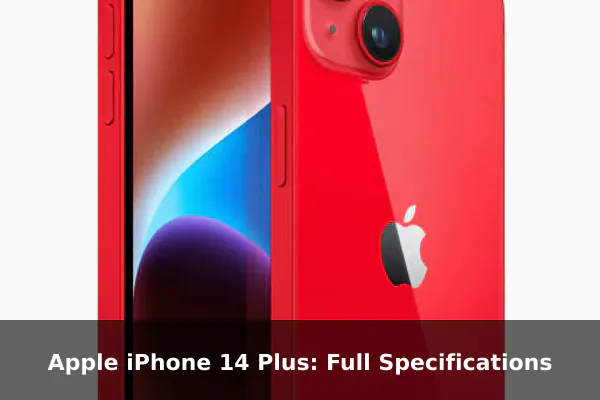
The iPhone 14 Plus is best understood as a big-screen iPhone built around comfort, endurance, and mainstream flagship features rather than Pro-level extras. It shares the same general generation as the iPhone 14 Pro and iPhone 14 Pro Max, but it keeps a simpler dual-camera system, a 60 Hz OLED display, and the A15 Bionic platform instead of the newer Pro hardware of its launch year.
That tradeoff gives it a clear place in Apple’s catalog: it is for users who want the size and battery advantages of a large iPhone, but do not need a telephoto camera, ProMotion, Always-On display, or stainless-steel construction. For many buyers, especially those upgrading from an older iPhone 11, iPhone XR, or standard iPhone 12, the jump in display quality, camera processing, battery life, and 5G support is still meaningful.
Design and Build
The phone measures 160.8 x 78.1 x 7.8 mm and weighs 203 g, so it is large but not unusually thick. The combination of glass on the front and back with an aluminum frame keeps it familiar to anyone who has used recent non-Pro iPhones. It is lighter than many large premium phones with heavier metal frames, though the width still makes one-handed use difficult for smaller hands.
Apple lists IP68 dust and water resistance, with immersion protection up to 6 meters for 30 minutes under rated conditions. That rating is useful for accidental spills and brief exposure, but it should not be treated as an invitation for regular underwater use. Ceramic Shield glass also improves front protection, though a case and screen protector remain sensible for a device this size.
Display Experience
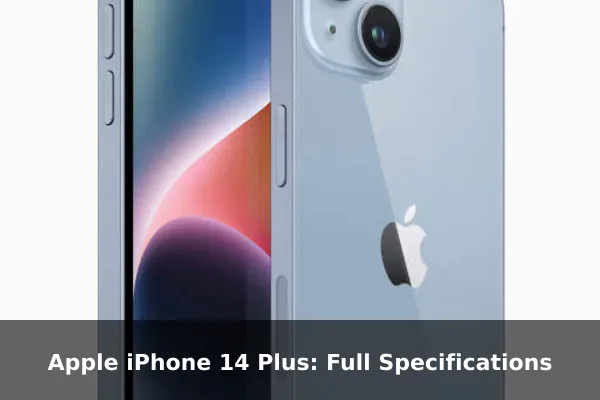
The 6.7-inch Super Retina XDR OLED display is one of the main reasons to choose the iPhone 14 Plus. Its 1284 x 2778 resolution gives it sharp text and clean image rendering, while HDR10 and Dolby Vision support make it a strong device for streaming, video playback, and photo viewing. Apple rates it at 800 nits in high brightness mode and 1200 nits peak for HDR content, with measured test data showing 797 nits maximum brightness.
The limitation is refresh rate. Unlike the Pro models, the iPhone 14 Plus does not offer 120 Hz ProMotion. Scrolling and animations are still smooth by ordinary standards, but users coming from a high-refresh Android phone or a Pro iPhone may notice the difference. If refresh rate is a priority, the Plus is less compelling; if screen size, color quality, and HDR matter more, it remains a polished display.
Performance and Storage
Apple’s A15 Bionic chip remains a strong performer in the iPhone 14 Plus. The hexa-core CPU uses two Avalanche performance cores and four Blizzard efficiency cores, paired with a 5-core Apple GPU. In the supplied test data, the device reaches 797976 in AnTuTu v9, 4582 in GeekBench 5.1, and 60 fps in GFXBench ES 3.1 onscreen.
Those figures support the phone’s real-world identity: fast enough for demanding daily use, gaming, camera processing, and long-term iOS updates. Storage choices are 128 GB, 256 GB, and 512 GB, all paired with 6 GB of RAM and NVMe storage. There is no memory card slot, so buyers who shoot a lot of 4K video should consider the 256 GB model or higher.
Camera System
The rear camera setup uses two 12 MP cameras: a wide camera with f/1.5 aperture, large 1.9 micrometer pixels, dual pixel phase detection autofocus, and sensor-shift optical image stabilization, plus a 12 MP ultrawide camera with a 120-degree field of view. This is a practical combination for everyday photography, landscapes, group shots, indoor scenes, and video.
Video is a major strength. The iPhone 14 Plus supports 4K recording at up to 60 fps, 1080p slow motion up to 240 fps, Dolby Vision HDR video up to 60 fps, stereo sound recording, and strong stabilization. The front camera is also a 12 MP unit with autofocus and 4K video support, assisted by the SL 3D sensor used for depth and Face ID. The missing piece is optical zoom: without a telephoto camera, distant subjects rely on digital cropping.
Battery and Charging
Battery life is one of the strongest reasons to consider the iPhone 14 Plus. The 4323 mAh battery is listed at 16.68 Wh, and the supplied endurance test rating is 102 hours. That puts it in a useful position for people who want a large iPhone that can handle long workdays, travel, video streaming, navigation, and social use without constant charging anxiety.
Charging support includes wired charging through Lightning with PD2.0, with Apple-style fast charging behavior reaching around 50 percent in 30 minutes under supported conditions. Wireless charging includes 15W MagSafe and, with the required iOS 17.2 update, 15W Qi2 wireless charging. The USB port remains Lightning at USB 2.0 speeds, which is adequate for charging but slow for large wired transfers.
Software and Long-Term Use
The iPhone 14 Plus launched with iOS 16 and the source data lists it as upgradable to iOS 18.6. That matters because software support is a key part of iPhone value. Buyers are not only paying for the hardware; they are also getting years of security updates, app compatibility, iCloud integration, Apple Pay support, FaceTime, iMessage, and Apple’s accessibility features.
Face ID remains the main biometric method, supported by the front TrueDepth hardware. The sensor package includes an accelerometer, gyro, proximity sensor, compass, and barometer. Ultra Wideband support also helps with compatible Apple ecosystem features, including more precise nearby-device interactions where supported.
Connectivity and Regional Models
The iPhone 14 Plus has broad network support across GSM, CDMA, HSPA, EVDO, LTE, and 5G. Model differences matter, especially for 5G bands and SIM configuration. The A2632 version includes Sub-6 and mmWave 5G bands, while other listed variants focus on Sub-6 5G. Buyers importing the phone should check the exact model number against local carrier bands before purchase.
SIM support also varies by region. International versions support Nano-SIM plus eSIM arrangements, the US version relies on eSIM with support for multiple stored profiles and two active at a time, and the China version supports dual Nano-SIM. Other wireless features include Wi-Fi 6, Bluetooth 5.3, NFC, GPS-family positioning systems, and Emergency SOS via satellite for SMS sending and receiving where the service is available.
Who Should Buy It
The iPhone 14 Plus makes the most sense for buyers who want a large display, strong battery life, dependable cameras, and iOS longevity without paying for a Pro Max. It is a particularly sensible upgrade from older LCD iPhones, smaller iPhones with weak battery life, or Android phones where the user wants to move into Apple’s ecosystem.
It is less ideal for users who care deeply about 120 Hz scrolling, telephoto photography, USB-C, advanced macro shooting, or the latest Apple chip. Those buyers should compare it carefully with newer iPhones and Pro models. But for large-screen media use, messaging, travel, casual photography, and daily reliability, the iPhone 14 Plus still has a clean and practical specification mix.
Conclusion
The Apple iPhone 14 Plus is a straightforward large iPhone with a sharp OLED display, very good battery endurance, strong video recording, broad 5G support, and dependable iOS software support. Its main compromises are the 60 Hz screen, lack of telephoto camera, Lightning USB 2.0 port, and regional SIM differences. Recommended for buyers who want a big-screen iPhone with long battery life and do not need Pro-series camera or display features.
References
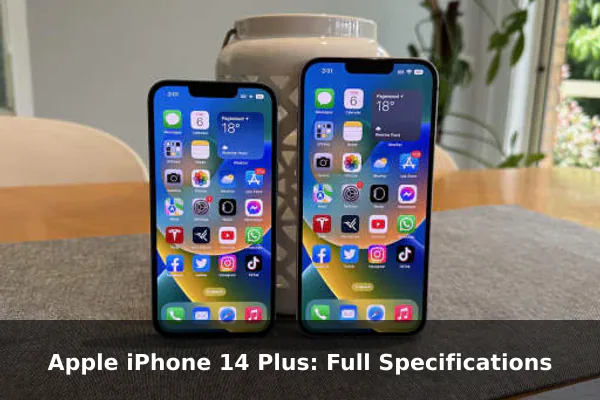
- Apple Support – iPhone 14 Plus Tech Specs – Primary Apple specification page for iPhone 14 Plus dimensions, display, chip, cameras, battery, wireless bands, SIM, sensors, software, and in-box contents.
- Apple Support – Identify your iPhone model – Official Apple reference for iPhone 14 Plus model numbers, year introduced, colors, capacity options, display description, and regional SIM tray differences.
- Apple Newsroom – Apple introduces iPhone 14 and iPhone 14 Plus – Official launch announcement with release context, feature highlights, display and battery claims, chipset details, 5G/eSIM information, and availability notes.
- Apple – iPhone 14 and iPhone 14 Plus Product Environmental Report – Official Apple PDF for environmental details, materials, packaging, energy efficiency, and product introduction date that can support specs-related notes.
