
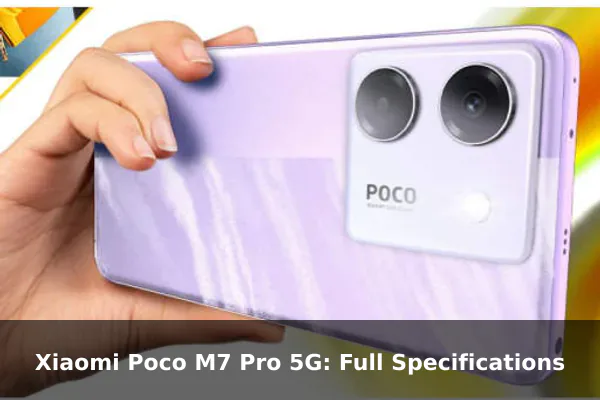
The Xiaomi Poco M7 Pro 5G is a budget-focused 5G phone that leans heavily on display quality, practical battery life, and everyday usability rather than headline-chasing extras. Its key appeal is the mix of a 120Hz AMOLED panel, Dimensity 7025 Ultra chipset, optical image stabilization on the main camera, stereo speakers, and a large 5110 mAh battery.
For shoppers comparing affordable Android phones, this model is most interesting because it does not treat the screen, charging, or storage as afterthoughts. It still has clear limits, especially video recording and the simple secondary camera, but the core package is unusually balanced for its price class.
Full Specifications
Network
| Technology: | GSM / HSPA / LTE / 5G |
| 2G bands: | GSM 850 / 900 / 1800 / 1900 |
| 3G bands: | HSDPA 800 / 850 / 900 / 1700(AWS) / 1900 / 2100 – International |
| HSDPA 850 / 900 / 2100 – India | |
| 4G bands: | 1, 2, 3, 4, 5, 7, 8, 12, 13, 17, 18, 19, 20, 26, 28, 32, 38, 40, 41, 42, 48, 66 – International |
| 1, 3, 5, 8, 28, 40, 41 – India | |
| 5G bands: | 1, 2, 3, 5, 7, 8, 12, 20, 26, 28, 38, 40, 41, 48, 66, 77, 78 SA/NSA – International |
| 1, 3, 5, 8, 28, 40, 78 SA/NSA – India | |
| Speed: | HSPA, LTE, 5G |
Launch
| Announced: | 2024, December 17 |
| Status: | Available. Released 2024, December 20 |
Body
| Dimensions: | 162.4 x 75.7 x 8 mm (6.39 x 2.98 x 0.31 in) |
| Weight: | 190 g (6.70 oz) |
| Build: | Glass front (Gorilla Glass 5), plastic back, plastic frame |
| SIM: | Nano-SIM + Nano-SIM |
| IP64 dust tight and water resistant (water splashes) |
Display
| Type: | AMOLED, 120Hz, 960Hz PWM, HDR10+, 2100 nits (peak), Dolby Vision (India only) |
| Size: | 6.67 inches, 107.4 cm2 (~87.4% screen-to-body ratio) |
| Resolution: | 1080 x 2400 pixels, 20:9 ratio (~395 ppi density) |
| Protection: | Corning Gorilla Glass 5, Mohs level 5 |
Platform
| OS: | Android 14, up to 2 (INT) / 4 (EU) major Android upgrades, HyperOS |
| Chipset: | Mediatek Dimensity 7025 Ultra (6 nm) |
| CPU: | Octa-core (2×2.5 GHz Cortex-A78 & 6×2.0 GHz Cortex-A55) |
| GPU: | IMG BXM-8-256 |
Memory
| Card slot: | microSDXC (uses shared SIM slot) |
| Internal: | 128GB 6GB RAM, 256GB 8GB RAM, 256GB 12GB RAM, 512GB 12GB RAM |
| UFS 2.2 |
Main Camera
| Dual: | 50 MP, f/1.5, 26mm (wide), 1/1.95″, 0.8µm, PDAF, OIS 2 MP, f/2.4, (depth) |
| Features: | LED flash, HDR, panorama |
| Video: | 1080p@30fps |
Selfie camera
| Single: | 20 MP, f/2.2, 21mm (wide), 1/4.0″, 0.7µm |
| Features: | Panorama, HDR |
| Video: | 1080p@30fps |
Sound
| Loudspeaker: | Yes, with stereo speakers (with Dolby Atmos) |
| 3.5mm jack: | Yes |
| 24-bit/192kHz Hi-Res audio |
Comms
| WLAN: | Wi-Fi 802.11 a/b/g/n/ac, dual-band |
| Bluetooth: | 5.0, A2DP, LE |
| Positioning: | GPS, GLONASS, GALILEO, BDS |
| NFC: | Yes (market/region dependent) |
| Infrared port: | Yes |
| Radio: | FM radio (market/region dependent) |
| USB: | USB Type-C |
Features
| Sensors: | Fingerprint (under display, optical), accelerometer, gyro, compass |
| Virtual proximity sensing |
Battery
| Type: | Li-Po 5110 mAh |
| Charging: | 45W wired |
Misc
| Colors: | Lavender Frost, Lunar Dust, Olive Twilight, Classic Black |
| Models: | 2409FPCC4G, 2409FPCC4I |
| SAR: | 0.86 W/kg (head) 0.79 W/kg (body) |
| Price: | € 165.00 / $ 240.03 / £ 148.00 / ₹ 12,888 |
Our Tests
| Loudspeaker: | -23.3 LUFS (Very good) |
| Battery: | Active use score 11:21h |
EU LABEL
| Energy: | Class D |
| Battery: | 37:46h endurance, 1000 cycles |
| Free fall: | Class D (45 falls) |
| Repairability: | Class C |
Price and Availability
The Xiaomi Poco M7 Pro 5G offers a compelling combination of features and performance. While the base price is around €165, the actual cost may vary depending on your location and retailer. Below, you’ll find the approximate price of the Xiaomi Poco M7 Pro 5G converted into various currencies. Please note that these are estimates based on recent exchange rates as of July 21, 2026 and may not reflect the exact price you’ll find at a retailer.
- United States: $188
- Japan: ¥30,610
- United Kingdom: £140
- Australia: A$269
- Canada: C$265
- Taiwan: NT$6,086
- Denmark: kr1.232
- Saudi Arabia: ﷼707
- South Korea: ₩278,973
- Germany: €165
- Brazil: R$961
- Vietnam: ₫4.943.458
- Kenya: KSh 24,386
- India: ₹18,175
- Indonesia: Rp 3.385.154
- Nigeria: ₦258,196
- Pakistan: ₨52,360
- Philippines: ₱11,623
- Bangladesh: ৳২৩,২৪৫
Value Positioning
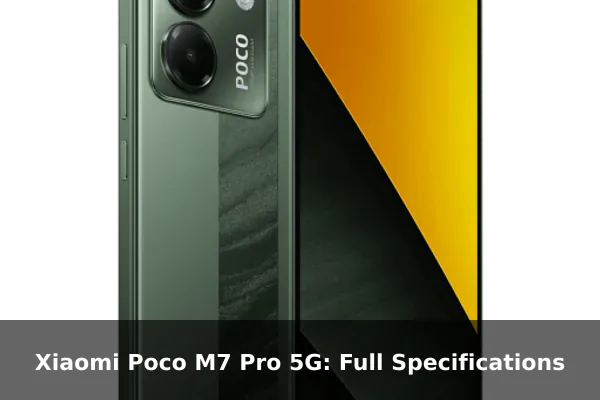
The Poco M7 Pro 5G sits in the part of the market where small specification choices matter. Instead of presenting itself as a gaming phone or a camera-first model, it focuses on features that most buyers will notice every day: a bright AMOLED display, 5G support, a 5110 mAh battery, 45W wired charging, expandable storage, and a 3.5mm headphone jack. That combination gives it a practical identity in the lower mid-range segment.
The raw price data places it in a competitive bracket, but prices can shift by region, storage version, retailer, and launch promotion. The more important buying point is configuration. The base 128GB and 6GB RAM version is the budget pick, while the 256GB and 8GB RAM model looks like the better long-term balance for users who install many apps, keep local media, or plan to use the phone for several years.
Design and Durability
The phone measures 162.4 x 75.7 x 8 mm and weighs 190 g, which makes it fairly standard for a modern 6.67-inch Android handset. It is not especially compact, but the 8 mm thickness keeps it from feeling bulky on paper. Xiaomi uses Gorilla Glass 5 on the front, with a plastic frame and plastic back, a familiar cost-conscious build choice in this category.
The IP64 rating is a useful advantage. It means the phone is dust tight and resistant to water splashes, but it should not be treated as a waterproof device. For daily use, that level of protection is still welcome because it adds confidence against light rain, dusty bags, and accidental splashes. The color options, including Lavender Frost, Lunar Dust, Olive Twilight, and Classic Black, also give the phone more variety than the usual single dark finish.
Display Quality
The display is the strongest part of the Poco M7 Pro 5G story. A 6.67-inch AMOLED panel with 1080 x 2400 resolution, 120Hz refresh rate, HDR10+, and a stated 2100 nits peak brightness gives it a much richer specification profile than many low-cost 5G phones. The roughly 395 ppi density is sharp enough for reading, streaming, social feeds, and everyday browsing.
The 960Hz PWM figure will also matter to some users who are sensitive to flicker, although comfort can still vary from person to person. Gorilla Glass 5 protection and the listed Mohs level 5 scratch resistance add another practical note. Dolby Vision is listed for India only, so buyers outside India should not assume that feature applies to their local unit.
Performance and Storage
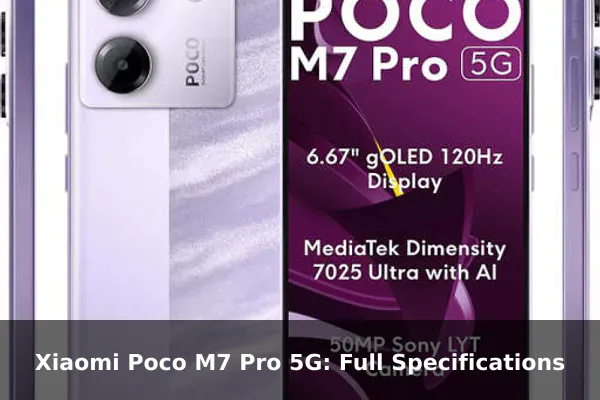
The MediaTek Dimensity 7025 Ultra is built on a 6 nm process and uses two Cortex-A78 performance cores at up to 2.5 GHz with six Cortex-A55 efficiency cores at up to 2.0 GHz. This is a sensible chipset for daily Android use, 5G connectivity, streaming, navigation, messaging, and casual games. It is not positioned as a flagship-class processor, but the CPU layout gives it enough headroom for the kind of multitasking expected from this price range.
Storage is another area where the phone avoids feeling too basic. The listed variants include 128GB with 6GB RAM, 256GB with 8GB RAM, 256GB with 12GB RAM, and 512GB with 12GB RAM, all using UFS 2.2 storage. The microSDXC slot is useful, but it uses the shared SIM slot, so buyers must choose between dual SIM use and storage expansion.
Camera Setup
The rear camera system is simple: a 50 MP wide camera with f/1.5 aperture, PDAF, and OIS, plus a 2 MP depth sensor. The main camera is the real feature here. Optical image stabilization is valuable in this class because it can help with steadier handheld shots and improve the chance of usable photos in less ideal lighting.
The limitation is flexibility. There is no ultrawide camera and no dedicated telephoto lens, so the Poco M7 Pro 5G is better viewed as a single-main-camera phone with a supporting depth sensor. Video is capped at 1080p at 30fps on both the rear and front cameras. The 20 MP selfie camera, with HDR and panorama support, should be enough for video calls and social photos, but video creators should note the lack of 4K capture.
Battery, Charging, and Audio
The 5110 mAh battery is well matched to the phone’s display and processor class. The listed active use score of 11:21h points to dependable mixed-use endurance, while the EU label lists 37:46h endurance and 1000 cycles. Those figures suggest a phone built for long daily sessions rather than quick top-up anxiety.
Charging is rated at 45W wired, which is a meaningful step above basic budget charging speeds. Audio is also unusually complete for the segment: stereo speakers, Dolby Atmos support, a 3.5mm headphone jack, and 24-bit/192kHz Hi-Res audio are all listed. The loudspeaker result of -23.3 LUFS is marked very good, making this a strong option for users who watch videos or listen without external speakers.
Software and Regional Differences
The Poco M7 Pro 5G ships with Android 14 and HyperOS. The update policy differs by region, with up to two major Android upgrades listed for the international model and up to four major Android upgrades listed for the EU model. That distinction is important because long-term software value may not be identical across markets.
Regional variation also appears in connectivity and multimedia features. Network bands are listed separately for international and India versions, NFC and FM radio are market dependent, and Dolby Vision is India only. Before buying an imported unit, users should check the exact model number and local carrier support rather than relying only on the global product name.
Connectivity and Everyday Features
Connectivity is broad for an affordable 5G phone. The Poco M7 Pro 5G supports GSM, HSPA, LTE, and 5G, with SA and NSA 5G bands listed for both international and India variants. Wi-Fi 802.11 a/b/g/n/ac dual-band, Bluetooth 5.0, GPS, GLONASS, GALILEO, BDS, USB Type-C, and an infrared port are included.
The under-display optical fingerprint sensor helps the phone feel more modern than models with side-mounted readers, while the accelerometer, gyro, compass, and virtual proximity sensing cover the expected basics. The lack of Wi-Fi 6 is not surprising at this level, but users with newer routers should know that it is limited to Wi-Fi 5-class connectivity.
Who Should Buy It?
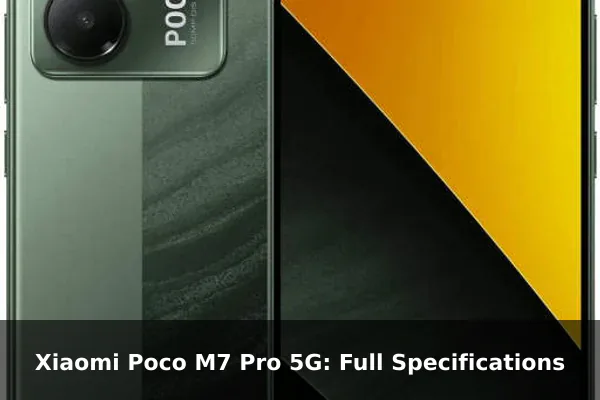
The Poco M7 Pro 5G makes the most sense for buyers who care more about display quality, battery life, charging speed, stereo audio, and storage flexibility than about having multiple high-quality rear cameras. It is a good fit for students, commuters, streaming-heavy users, and anyone moving from an older 4G phone to an affordable 5G model.
It is less ideal for users who need compact dimensions, 4K video recording, an ultrawide camera, premium materials, or guaranteed identical features across every region. If those points matter, a more expensive Redmi Note, Poco X, or competing mid-range phone may be the better comparison target.
Conclusion
The Xiaomi Poco M7 Pro 5G is a value-first 5G phone with a standout AMOLED display, solid battery hardware, useful audio features, and a capable stabilized main camera. Its secondary camera, 1080p video limit, and region-specific feature differences keep it from being a complete all-rounder. For buyers who want a bright screen, dependable endurance, and practical everyday performance at a lower price, it is an easy phone to shortlist.
References
- POCO M7 Pro 5G Specs – Xiaomi Global – Official manufacturer specifications for processor, memory, dimensions, display, cameras, battery, charging, network bands, sensors, OS, and package contents.
- POCO M7 Pro 5G FAQ – Xiaomi Global Support – Official support FAQ with detailed connectivity, SIM, network band, VoLTE/VoNR/VoWi-Fi, and eSIM information.
- MediaTek Dimensity 7025 – Official Product Page – Official chipset reference to verify CPU cores, GPU, 5G modem capabilities, display support, Wi-Fi, Bluetooth, and GNSS features.
- Notebookcheck POCO M7 Pro 5G Review – Independent technical review with tested display, performance, connectivity, battery, camera, and software observations for cross-checking official claims.
- GSMArena (gsmarena.com) – Well-known smartphone specification database useful for cross-checking launch status, model variants, market differences, and full phone specifications against official sources.
