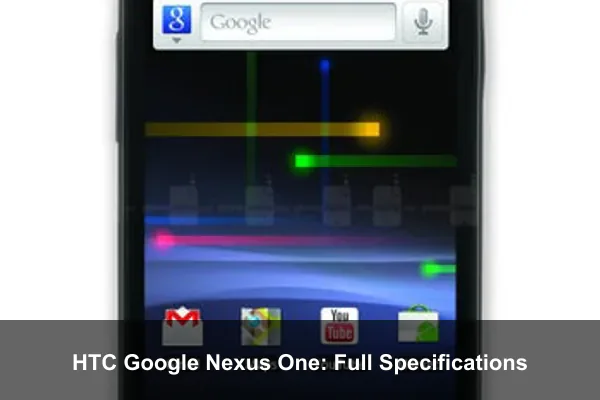
The HTC Google Nexus One is a landmark early Android smartphone that sits in a very different class from today’s large-screen 4G and 5G devices. Its appeal is strongest for readers comparing Android history, compact hardware, and classic Nexus-era design.
This overview focuses on what the specs mean in practical terms, while the full specifications table can handle the line-by-line details. The key context is simple: this is a discontinued 2010 phone with legacy connectivity, modest hardware, and a clean reference-device identity.
Full Specifications
Network
| Technology |
GSM / HSPA |
| 2G bands |
GSM 850 / 900 / 1800 / 1900 |
| 3G bands |
HSDPA 900 / 1700 / 2100 |
|
HSDPA 850 / 1900 / 2100 – for AT&T, Rogers Wireless |
| Speed |
HSPA 7.2/2 Mbps |
Launch
| Announced |
2010, January. Released 2010, January |
| Status |
Discontinued |
Body
| Dimensions |
119 x 59.8 x 11.5 mm (4.69 x 2.35 x 0.45 in) |
| Weight |
130 g (4.59 oz) |
| SIM |
Mini-SIM |
|
Trackball |
Display
| Type |
AMOLED |
| Size |
3.7 inches, 39.0 cm2 (~54.8% screen-to-body ratio) |
| Resolution |
480 x 800 pixels, 5:3 ratio (~252 ppi density) |
Platform
| OS |
Android 2.1 (Eclair), upgradable to 2.3.6 (Gingerbread) |
| Chipset |
Qualcomm QSD8250 Snapdragon S1 |
| CPU |
1.0 GHz Scorpion |
| GPU |
Adreno 200 |
Memory
| Card slot |
microSDHC (dedicated slot), 4 GB included |
| Internal |
512MB RAM, 512MB |
Main Camera
| Single |
5 MP, AF |
| Features |
LED flash |
| Video |
480p@24fps |
Selfie camera
Sound
| Loudspeaker |
Yes |
| 3.5mm jack |
Yes |
Comms
| WLAN |
Wi-Fi 802.11 a/b/g |
| Bluetooth |
2.1, A2DP |
| Positioning |
GPS, A-GPS |
| Radio |
Factory locked by default, can be enabled |
| USB |
microUSB 2.0 |
Features
| Sensors |
Accelerometer, proximity, compass |
| Browser |
HTML |
|
Dedicated search key MP3/eAAC+/WAV player MP4/H.264 player Voice memo Predictive text input |
Battery
| Type |
Removable Li-Ion 1400 mAh battery |
| Stand-by |
Up to 290 h (2G) / Up to 250 h (3G) |
| Talk time |
Up to 10 hours (2G) / Up to 7 hours (3G) |
| Music play |
Up to 20 hours |
Misc
| Colors |
Brown (teflon coating) |
| SAR |
0.37 W/kg (head) 0.74 W/kg (body) |
| Price |
About 120 EUR |
Our Tests
| Camera |
Photo |
| Loudspeaker |
Voice 69dB / Noise 66dB / Ring 79dB |
| Audio quality |
Noise -86.1dB / Crosstalk -85.2dB |
Price and Availability
The HTC Google Nexus One offers a compelling combination of features and performance. While the base price is around €120, the actual cost may vary depending on your location and retailer. Below, you’ll find the approximate price of the HTC Google Nexus One converted into various currencies. Please note that these are estimates based on recent exchange rates as of May 15, 2026 and may not reflect the exact price you’ll find at a retailer.
- United States: $140
- Japan: ¥22,170
- United Kingdom: £104
- Australia: A$194
- Canada: C$192
- Taiwan: NT$4,421
- Denmark: kr895
- Saudi Arabia: ﷼526
- South Korea: ₩209,330
- Germany: €120
- Brazil: R$701
- Vietnam: ₫3.659.169
- Kenya: KSh 18,161
- India: ₹13,432
- Indonesia: Rp 2.444.299
- Nigeria: ₦191,581
- Pakistan: ₨39,093
- Philippines: ₱8,642
- Bangladesh: ৳১৭,২০৫
Value and Market Position
The HTC Google Nexus One is not a value pick in the modern mainstream sense. Its worth comes from its status as an early Google-branded Android reference phone, making it more interesting for collectors, repair hobbyists, and users studying older smartphone hardware than for everyday buyers.
Design and Handling
With a 130 g body, Mini-SIM support, and a physical trackball, the Nexus One reflects the compact, tactile design language of early Android devices. The brown finish with Teflon coating gives it a distinct look compared with today’s glass-heavy phones, while the dedicated search key reinforces its Google-first identity.
Display Experience
The 3.7-inch AMOLED display is small by current standards, but the 480 x 800 resolution and roughly 252 ppi density were meaningful for its generation. It is best suited to basic reading, menus, and classic Android use rather than modern video, gaming, or split-screen workflows.
Performance and Storage
The Snapdragon S1 chipset, 1.0 GHz Scorpion CPU, Adreno 200 GPU, and 512MB RAM place the Nexus One firmly in legacy territory. The dedicated microSDHC slot helps with media storage, but the limited internal capacity means expectations should stay focused on period-correct apps and light tasks.
Camera Expectations
The rear camera is a simple 5 MP autofocus unit with LED flash and 480p video recording at 24fps. There is no selfie camera, so this phone is better understood as a basic photo device from the early Android era rather than a social-media or video-call handset.
Battery and Daily Practicality
The removable 1400 mAh battery is one of the more practical hardware traits for a legacy phone, especially for users who value replaceability. The quoted standby, talk time, and music playback figures are useful reference points, but real-world performance today depends heavily on battery age and network conditions.
Software Context
The Nexus One launched with Android 2.1 Eclair and is listed as upgradable to Android 2.3.6 Gingerbread. That makes it historically important, but also limits compatibility with current apps, security expectations, and modern Android services.
Connectivity and Audio
Connectivity is centered on GSM and HSPA, with Wi-Fi 802.11 a/b/g, Bluetooth 2.1, GPS with A-GPS, microUSB 2.0, and a 3.5mm headphone jack. The lack of LTE or 5G is a major limitation today, while the factory-locked radio note is relevant for users interested in deeper device tinkering.
Who Should Buy the HTC Google Nexus One?
This phone makes sense for collectors, Android historians, retro tech enthusiasts, and anyone who specifically wants a Nexus-era device with a trackball and removable battery. It is not a sensible choice for users who need current app support, fast mobile data, a selfie camera, or modern multimedia performance.
Conclusion
The HTC Google Nexus One is best treated as a classic Android reference phone, not a modern daily driver. Buy it for nostalgia, collection value, or legacy testing; skip it if you need current smartphone convenience.