
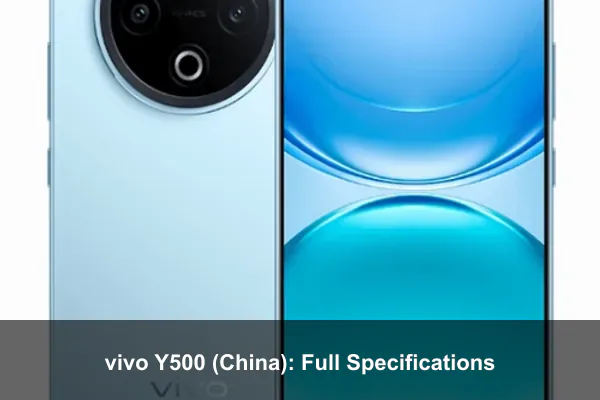
The vivo Y500 (China) is a durability-focused 5G smartphone built around a huge battery, a bright AMOLED display, and modern mid-range hardware.
Its biggest appeal is not flashy camera count, but everyday endurance: an 8200 mAh Si/C battery, 90W wired charging, IP68/IP69+ protection, and a 120Hz screen make it a practical China-market option.
Full Specifications
Network
| Technology | GSM / CDMA / HSPA / LTE / 5G |
| 2G bands | GSM 850 / 900 / 1800 / 1900 |
| CDMA 800 | |
| 3G bands | HSDPA 850 / 900 / 2100 |
| 4G bands | 1, 3, 5, 8, 28, 34, 38, 39, 40, 41 |
| 5G bands | 1, 3, 5, 8, 28, 38, 40, 41, 77, 78 SA/NSA |
| Speed | HSPA, LTE, 5G |
Launch
| Announced | 2025, September 01 |
| Status | Available. Released 2025, September 05 |
Body
| Dimensions | 163.1 x 75.9 x 8.2 mm (6.42 x 2.99 x 0.32 in) |
| Weight | 213 g (7.51 oz) |
| SIM | Nano-SIM + Nano-SIM |
| IP68/IP69+ dust tight and water resistant (high pressure water jets; immersible up to 1.5m for 24 hours) Drop resistant up to 1.7m |
Display
| Type | AMOLED, 1B colors, 120Hz, 3840Hz PWM, 5000 nits (peak) |
| Size | 6.77 inches, 110.9 cm2 (~89.6% screen-to-body ratio) |
| Resolution | 1080 x 2392 pixels (~388 ppi density) |
| Protection | Diamond Shield Glass |
Platform
| OS | Android 15, OriginOS 5 |
| Chipset | Mediatek Dimensity 7300 (4 nm) |
| CPU | Octa-core (4×2.5 GHz Cortex-A78 & 4×2.0 GHz Cortex-A55) |
| GPU | Mali-G615 MC2 |
Memory
| Card slot | No |
| Internal | 128GB 8GB RAM, 256GB 8GB RAM, 256GB 12GB RAM, 512GB 12GB RAM |
| UFS 3.1 |
Main Camera
| Dual | 50 MP, f/1.8, (wide), PDAF Auxiliary lens |
| Features | Ring-LED flash, panorama, HDR |
| Video | 4K@30fps, 1080p@30fps, gyro-EIS |
Selfie camera
| Single | 8 MP, f/2.1, (wide) |
| Features | Panorama |
| Video | 1080p@30fps |
Sound
| Loudspeaker | Yes, with stereo speakers |
| 3.5mm jack | No |
| 24-bit/192kHz Hi-Res & Hi-Res Wireless audio 3D Panoramic Audio speaker |
Comms
| WLAN | Wi-Fi 802.11 a/b/g/n/ac/6, dual-band |
| Bluetooth | 5.4, A2DP, LE, aptX HD |
| Positioning | GPS, GALILEO, GLONASS, QZSS, BDS |
| NFC | Yes |
| Radio | No |
| USB | USB Type-C 2.0, OTG |
Features
| Sensors | Fingerprint (under display, optical), accelerometer, gyro, proximity, compass |
Battery
| Type | Si/C Li-Ion 8200 mAh |
| Charging | 90W wired Reverse wired |
Misc
| Colors | Black, Blue, Purple |
| Models | V2506A |
| Price | About 170 EUR |
Price and Availability
The vivo Y500 (China) offers a compelling combination of features and performance. While the base price is around €170, the actual cost may vary depending on your location and retailer. Below, you’ll find the approximate price of the vivo Y500 (China) converted into various currencies. Please note that these are estimates based on recent exchange rates as of May 4, 2026 and may not reflect the exact price you’ll find at a retailer.
- United States: $200
- Japan: ¥31,282
- United Kingdom: £147
- Australia: A$277
- Canada: C$271
- Taiwan: NT$6,307
- Denmark: kr1.268
- Saudi Arabia: ﷼748
- South Korea: ₩294,122
- Germany: €170
- Brazil: R$989
- Vietnam: ₫5.206.732
- Kenya: KSh 25,751
- India: ₹18,924
- Indonesia: Rp 3.453.400
- Nigeria: ₦274,086
- Pakistan: ₨55,621
- Philippines: ₱12,241
- Bangladesh: ৳২৪,৪৭২
Why Should You Buy the vivo Y500 (China)?
The vivo Y500 (China) stands out for buyers who care about battery life, rugged protection, and a smooth display more than having a complex camera system. It combines a large-capacity silicon-carbon battery with 5G, UFS 3.1 storage, and a bright AMOLED panel, making it a strong value pick in its segment.
Design and Durability
The phone is relatively substantial at 213 g, but that weight is easier to understand once the 8200 mAh battery and reinforced build are considered. IP68/IP69+ protection, high-pressure water resistance, long-duration immersion support, and drop resistance up to 1.7 m give it a tougher profile than many typical budget and mid-range phones.
Display Quality
The 6.77-inch AMOLED display is one of the device’s strongest areas. A 120Hz refresh rate, 1B color support, 3840Hz PWM dimming, Diamond Shield Glass, and a very high peak brightness rating make it well suited for scrolling, video, and outdoor use.
Performance and Storage
The MediaTek Dimensity 7300 gives the vivo Y500 (China) a balanced 5G platform for daily apps, multitasking, navigation, social media, and light to moderate gaming. UFS 3.1 storage is a welcome inclusion, though the lack of a microSD card slot means buyers should choose the storage variant carefully.
Camera Setup
The rear camera system is simple: a 50 MP main camera with PDAF plus an auxiliary lens. It supports HDR, panorama, Ring-LED flash, 4K video at 30fps, and gyro-EIS, while the 8 MP selfie camera is more basic and best viewed as serviceable for calls and casual photos.
Battery and Charging
Battery life is the headline feature. The 8200 mAh Si/C Li-Ion cell is much larger than what most mainstream phones offer, and 90W wired charging helps reduce downtime. Reverse wired charging also adds utility for topping up smaller accessories or another device in a pinch.
Software Experience
The phone ships with Android 15 and OriginOS 5, matching its China-market positioning. Buyers outside China should remember that regional software builds can differ in app services, language behavior, and preloaded ecosystem features.
Connectivity and Audio
Connectivity is broad, with 5G SA/NSA, Wi-Fi 6, Bluetooth 5.4, NFC, multi-system satellite positioning, and USB-C with OTG. Stereo speakers, Hi-Res wired and wireless audio support, and 3D Panoramic Audio are useful additions, though there is no 3.5mm headphone jack or FM radio.
Who Should Buy It?
The vivo Y500 (China) is best for users who want maximum endurance, a bright AMOLED display, tough water and dust protection, and reliable 5G performance. It is less ideal for users who need expandable storage, a headphone jack, or a more advanced multi-camera setup.
Conclusion
The vivo Y500 (China) is an endurance-first 5G phone with a huge battery, strong protection ratings, a smooth AMOLED screen, and practical mid-range performance. Buy it if battery life and durability matter more than camera versatility.
