
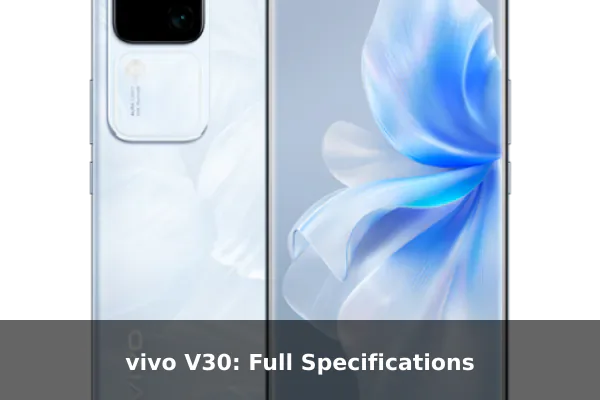
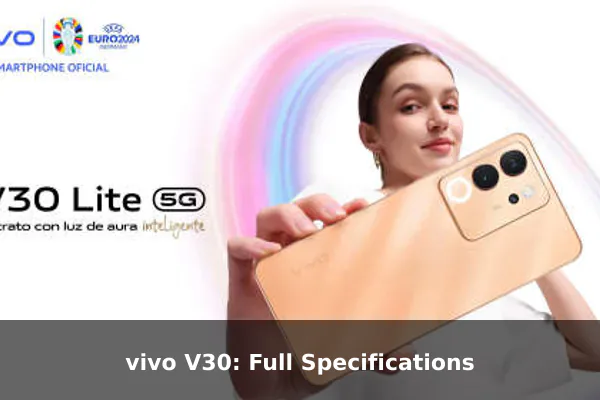
The vivo V30 is a slim 5G Android phone built around a large AMOLED display, a Snapdragon 7 Gen 3 chipset, and a camera setup that gives unusual attention to both rear and selfie photography. It sits in the upper mid-range space, where design, charging speed, and camera flexibility matter as much as raw benchmark numbers.
This article focuses on the vivo V30 from a specs-first perspective, highlighting what the hardware means in daily use without repeating the full specification table that follows separately. The angle here is value for buyers who want a polished, lightweight-feeling phone with strong portrait tools, fast charging, and broad network support.
Full Specifications
Network
| Technology: | GSM / HSPA / LTE / 5G |
| 2G bands: | GSM 850 / 900 / 1800 / 1900 |
| 3G bands: | HSDPA 850 / 900 / 1700(AWS) / 1900 / 2100 |
| 4G bands: | 1, 2, 3, 4, 5, 7, 8, 12, 13, 17, 18, 19, 20, 26, 28, 38, 40, 41, 66 |
| 5G bands: | 1, 2, 3, 5, 7, 8, 20, 26, 28, 38, 40, 41, 66, 77, 78 SA/NSA |
| Speed: | HSPA, LTE, 5G |
Launch
| Announced: | 2024, February 04 |
| Status: | Available. Released 2024, March 04 |
Body
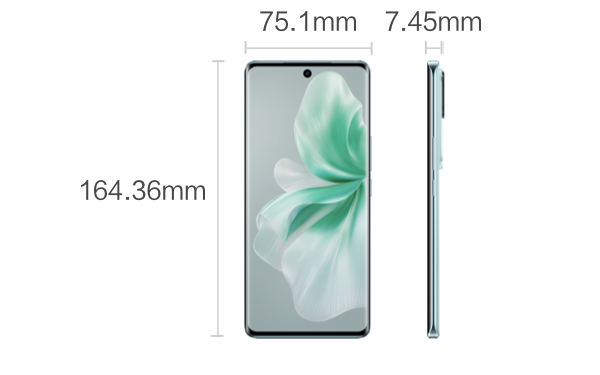
| Dimensions: | 164.4 x 75.1 x 7.5 mm (6.47 x 2.96 x 0.30 in) |
| Weight: | 186 g (6.56 oz) |
| Build: | Glass front, plastic frame, glass back |
| SIM: | Nano-SIMNano-SIM + Nano-SIM |
| IP54 dust protected and water resistant (water splashes) |
Display
| Type: | AMOLED, 1B colors, HDR10+, 120Hz, 1200 nits (HBM), 2800 nits (peak) |
| Size: | 6.78 inches, 111.0 cm2 (~89.9% screen-to-body ratio) |
| Resolution: | 1260 x 2800 pixels, 20:9 ratio (~453 ppi density) |
| Protection: | Schott Alpha |
Platform
| OS: | Android 14, up to 2 major Android upgrades, Funtouch 14 |
| Chipset: | Qualcomm SM7550-AB Snapdragon 7 Gen 3 (4 nm) |
| CPU: | Octa-core (1×2.63 GHz Cortex-A715 & 3×2.4 GHz Cortex-A715 & 4×1.8 GHz Cortex-A510) |
| GPU: | Adreno 720 |
Memory
| Card slot: | No |
| Internal: | 128GB 8GB RAM, 256GB 8GB RAM, 256GB 12GB RAM, 512GB 12GB RAM |
| UFS 2.2 |
Main Camera
| Triple: | 50 MP, f/1.9, 23mm (wide), 1/1.55″, 1.0µm, PDAF, OIS 50 MP, f/2.0, 15mm, 119˚ (ultrawide), 1/2.76″, 0.64µm, AF 2 MP, f/2.4 (market/region dependent) |
| Features: | Ring-LED flash, panorama, HDR |
| Video: | 4K@30fps, 1080p@30fps, gyro-EIS |
Selfie camera
| Single: | 50 MP, f/2.0, 21mm (wide), 1/2.76″, 0.64µm, AF |
| Features: | Dual-LED flash, HDR |
| Video: | 4K@30fps, 1080p@30fps |
Sound
| Loudspeaker: | Yes |
| 3.5mm jack: | No |
| 24-bit/192kHz Hi-Res audio (market/region dependent) Snapdragon Sound (market/region dependent) |
Comms
| WLAN: | Wi-Fi 802.11 a/b/g/n/ac/6, dual-band, Wi-Fi Direct |
| Bluetooth: | 5.4, A2DP, LE, aptX HD, aptX Adaptive, aptX Lossless |
| Positioning: | GPS, GALILEO, GLONASS, QZSS, BDS |
| NFC: | Yes (market/region dependent) |
| Radio: | No |
| USB: | USB Type-C 2.0, OTG |
Features
| Sensors: | Fingerprint (under display, optical), accelerometer, gyro, proximity, compass |
Battery
| Type: | Li-Ion 5000 mAh |
| Charging: | 80W wired, PD, 100% in 48 min Reverse wired |
Misc
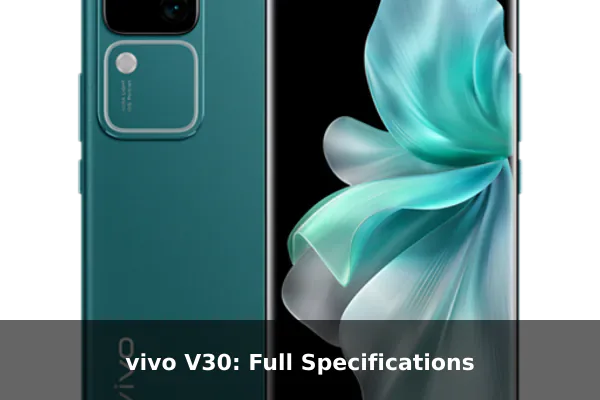
| Colors: | Bloom White, Waving Aqua, Lush Green, Noble Black |
| Models: | V2318 |
| Price: | ₹ 29,900 |
Our Tests
| Performance: | AnTuTu: 655526 (v9), 831644 (v10)
GeekBench: 2848 (v5), 3181 (v6) |
| Display: | 1253 nits max brightness (measured) |
| Loudspeaker: | -26.9 LUFS (Good) |
| Battery: | Active use score 15:01h |
Price and Availability
The vivo V30 offers a compelling combination of features and performance. While the base price is around ₹29,900, the actual cost may vary depending on your location and retailer. Below, you’ll find the approximate price of the vivo V30 converted into various currencies. Please note that these are estimates based on recent exchange rates as of September 1, 2026 and may not reflect the exact price you’ll find at a retailer.
- United States: $314
- Japan: ¥50,197
- United Kingdom: £232
- Australia: A$438
- Canada: C$436
- Taiwan: NT$9,953
- Denmark: kr2.024
- Saudi Arabia: ﷼1,178
- South Korea: ₩429,559
- Germany: €271
- Brazil: R$1.627
- Vietnam: ₫8.180.719
- Kenya: KSh 40,605
- India: ₹29,900
- Indonesia: Rp 5.566.426
- Nigeria: ₦423,589
- Pakistan: ₨87,236
- Philippines: ₱19,603
- Bangladesh: ৳৩৮,৬৮০
Why Should You Buy the vivo V30?
The vivo V30 makes the most sense for buyers who want a modern Android phone that feels premium without moving into flagship pricing. Its biggest strengths are easy to spot: a bright 120Hz AMOLED display, a 5000 mAh battery, 80W wired charging, 5G support, and 50MP cameras on both the front and back. That combination gives it a practical advantage over many mid-range phones that usually compromise on either selfie quality, charging speed, or screen brightness.
The phone is not trying to be a gaming flagship or a compact device. Instead, it targets users who stream, browse, shoot portraits, make video calls, and want a thin phone that still has all-day battery capacity. The inclusion of optical image stabilization on the main rear camera and autofocus on the 50MP selfie camera gives the V30 a clearer identity than a basic spec-sheet upgrade.

Design and Build
The vivo V30 is notably thin for a phone with a 5000 mAh battery. At about 7.5 mm and 186 g, it should feel easier to handle than many large-screen phones that cross 200 g. The body uses a glass front, plastic frame, and glass back, which is a common upper mid-range mix: it keeps the look premium while controlling weight and cost.
Its IP54 rating is useful for dust protection and water splashes, but it should not be treated like full submersion resistance. The color options, including Bloom White, Waving Aqua, Lush Green, and Noble Black, also show that vivo is leaning into design as a selling point rather than offering only plain finishes. Dual nano-SIM support is another practical advantage for travel or separating work and personal numbers.
Display Quality
The 6.78-inch AMOLED panel is one of the phone’s headline features. It supports 1 billion colors, HDR10+, a 120Hz refresh rate, and a high listed peak brightness of 2800 nits. In practical terms, this should make the V30 feel smooth while scrolling and better suited for outdoor visibility than many older mid-range AMOLED phones.
The 1260 x 2800 resolution is sharper than standard Full HD+ panels, producing a dense image at roughly 453 ppi. That helps with small text, high-resolution photos, and streaming detail. Schott Alpha protection is listed for the display, but buyers who are rough on phones should still use a case and screen protector because no front glass makes a phone drop-proof.
Performance and Storage
The Snapdragon 7 Gen 3 is a strong fit for this device class. Built on a 4 nm process, it pairs one higher-clocked Cortex-A715 core with three additional Cortex-A715 performance cores and four Cortex-A510 efficiency cores. The Adreno 720 GPU is not positioned as a flagship graphics part, but it is capable enough for mainstream gaming, high-refresh UI use, and heavy multitasking.
The listed benchmark results place the vivo V30 comfortably in upper mid-range territory, with AnTuTu results reported for both v9 and v10 and GeekBench scores for newer and older benchmark versions. Storage choices range from 128GB with 8GB RAM to 512GB with 12GB RAM, using UFS 2.2 storage. Since there is no microSD card slot, buyers who keep many videos, offline playlists, or large games should consider the 256GB or 512GB version.
Camera System
The rear camera setup is led by a 50MP wide camera with PDAF and OIS, backed by a 50MP ultrawide camera with autofocus. That is more balanced than phones that pair a high-resolution main sensor with a very low-resolution ultrawide. The ultrawide’s autofocus also improves usefulness for closer subjects and sharper group shots, while the ring-style LED flash supports vivo’s portrait-focused approach.
The third 2MP camera is market or region dependent, so it should not be treated as a core reason to buy the device. The important story is the pair of 50MP rear cameras and the 50MP front camera with autofocus. Selfie autofocus is still not universal in this segment, and it can make a visible difference for video calls, group selfies, and handheld vlogging. Both front and rear cameras support up to 4K video at 30fps, which keeps the camera setup consistent for creators who switch between perspectives.
Battery and Charging
The 5000 mAh battery is a strong match for the thin body. The reported active use score of 15:01h suggests the V30 is tuned for dependable daily endurance rather than just looking good on paper. Actual battery life will still depend on 5G coverage, display brightness, camera use, and gaming, but the capacity and chipset efficiency give it a solid foundation.
Charging is another major advantage. The 80W wired charging support is listed with a full charge claim of 100% in 48 minutes, and USB Power Delivery support improves compatibility with modern chargers. Reverse wired charging is also included, which can help in a pinch for accessories or another phone, though it is best viewed as an emergency feature rather than a daily power-sharing solution.
Software Experience
The vivo V30 ships with Android 14 and Funtouch 14, with support listed for up to two major Android upgrades. That gives it a defined upgrade path, though it is not as long as the best update promises from some competitors. Buyers who keep phones for four or five years should weigh that carefully.
Funtouch OS is feature-rich, with plenty of customization options, camera modes, and battery controls. The under-display optical fingerprint sensor keeps the front clean and fits the phone’s premium presentation. Core sensors such as accelerometer, gyro, proximity sensor, and compass are present, so everyday navigation, motion controls, and camera stabilization features are covered.
Connectivity and Audio
Network support is broad, with GSM, HSPA, LTE, and 5G across SA and NSA bands. The band list includes many commonly used 4G and 5G bands, though buyers should still check local carrier compatibility before importing a regional variant. Wi-Fi 6, Bluetooth 5.4, dual-band Wi-Fi, Wi-Fi Direct, and multi-system positioning support round out the connectivity package.
The USB-C port is USB 2.0, which is normal for this price tier but slower for wired file transfers than USB 3.x phones. There is no 3.5mm headphone jack and no FM radio. Hi-Res audio and Snapdragon Sound features are market dependent, so they should be treated as variant-specific extras rather than guaranteed global features.
Who Should Buy the vivo V30?
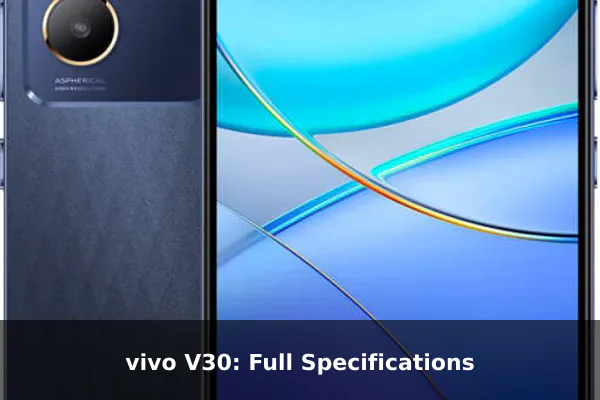
The vivo V30 is best for users who care about a slim design, a bright curved AMOLED display, strong selfie hardware, and fast charging. It is also a good fit for social media-heavy users because the front camera is not an afterthought and the rear ultrawide is stronger than the token sensors often found in mid-range phones.
It is less ideal for buyers who need expandable storage, a headphone jack, rugged water resistance, or the longest possible software support window. Performance is strong for the class, but dedicated mobile gamers may still prefer a thicker performance-focused phone with more aggressive cooling and gaming-specific software tools.
Conclusion
The vivo V30 is a well-rounded upper mid-range smartphone with a clear focus on display quality, portrait photography, slim design, and fast charging. Its main trade-offs are the lack of expandable storage, no 3.5mm jack, USB 2.0 data speeds, and only IP54 protection. For buyers who want a stylish Android phone with a sharp AMOLED screen, dependable battery life, and unusually strong front-camera hardware, the vivo V30 is easy to recommend.
References
- vivo Global – V30 Specifications – Primary manufacturer specification page for vivo V30 covering dimensions, display, chipset, storage, battery, cameras, network bands, connectivity, sensors, and in-box contents.
- vivo Indonesia – V30 Specifications – Official regional specification page useful for Indonesia-specific colors, RAM/storage variants, pricing, NFC/Bluetooth details, and local product wording.
- Qualcomm Snapdragon 7 Gen 3 Mobile Platform – Official chipset source to verify Snapdragon 7 Gen 3 CPU clock, process node, modem, wireless capabilities, and platform-level features used by the vivo V30.
- FCC Equipment Authorization System (apps.fcc.gov) – Official U.S. regulator database for confirming device model filings, FCC ID 2AUCY-V2318, radio certifications, frequency ranges, and SAR-related compliance data.
- GSMArena (gsmarena.com) – Established smartphone specification reference for cross-checking launch timing, model variants, dimensions, display, cameras, and connectivity against official vivo pages.
