
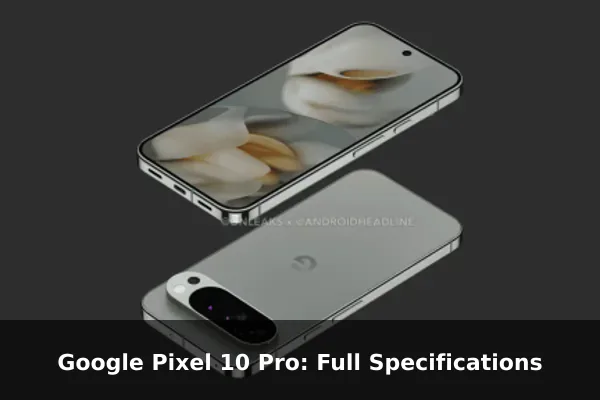
The Google Pixel 10 Pro is positioned as a compact flagship for buyers who want Google’s Pro camera system, high-end display hardware, and long software support without moving to a larger phone. Its 6.3-inch LTPO OLED panel, 16GB RAM options, Tensor G5 platform, and triple rear camera setup make it a specification-heavy model in a relatively manageable body.
Based on the supplied catalog data and cross-checks against official Google Pixel specification resources, the Pixel 10 Pro is best understood as a premium Android phone built around imaging, AI features, display brightness, and long-term usability. The source price data does not provide an exact launch price, so pricing is intentionally left for the separate price block.
Full Specifications
Network
| Technology: | GSM / HSPA / LTE / 5G |
| 2G bands: | GSM 850 / 900 / 1800 / 1900 |
| 3G bands: | HSDPA 800 / 850 / 900 / 1700(AWS) / 1900 / 2100 |
| 4G bands: | LTE |
| 5G bands: | SA/NSA/Sub6/mmWave – USA |
| SA/NSA/Sub6 – ROW | |
| Speed: | HSPA, LTE (CA), 5G |
Launch
| Announced: | Not announced yet |
| Status: | Rumored |
Body
| Dimensions: | 152.8 x 72 x 8.5 mm (6.02 x 2.83 x 0.33 in) |
| Weight: | 199 g (7.02 oz) |
| Build: | Glass front (Gorilla Glass Victus 2), glass back (Gorilla Glass Victus 2), aluminum frame |
| SIM: | Nano-SIM + eSIM |
| IP68 dust tight and water resistant (immersible up to 1.5m for 30 min) |
Display
| Type: | LTPO OLED, 120Hz, HDR10+, 2000 nits (HBM), 3000 nits (peak) |
| Size: | 6.3 inches, 95.6 cm2 (~86.9% screen-to-body ratio) |
| Resolution: | 1280 x 2856 pixels, 20:9 ratio (~497 ppi density) |
| Protection: | Corning Gorilla Glass Victus 2 |
Platform
| OS: | Android 15, up to 7 major Android upgrades |
| Chipset: | Google Tensor G5 (4 nm) |
| CPU: | Octa-core (1×3.1 GHz Cortex-X4 & 3×2.6 GHz Cortex-A720 & 4×1.92 GHz Cortex-A520) |
| GPU: | Mali-G715 MC7 |
Memory
| Card slot: | No |
| Internal: | 128GB 16GB RAM, 256GB 16GB RAM, 512GB 16GB RAM, 1TB 16GB RAM |
| UFS 4.0 |
Main Camera
| Triple: | 50 MP, f/1.7, 25mm (wide), 1/1.31″, 1.2µm, dual pixel PDAF, OIS 48 MP, f/2.8, 113mm (periscope telephoto), 1/2.55″, dual pixel PDAF, OIS, 5x optical zoom 48 MP, f/1.7, 123˚ (ultrawide), 1/2.55″, dual pixel PDAF |
| Features: | Multi-zone Laser AF, LED flash, Pixel Shift, Ultra-HDR, panorama, Best Take, Zoom Enhance |
| Video: | 8K@30fps (via cloud-based upscaling), 4K@24/30/60fps, 1080p@24/30/60/120/240fps; gyro-EIS, OIS, 10-bit HDR |
Selfie camera
| Single: | 42 MP, f/2.2, 17mm (ultrawide), PDAF |
| Features: | HDR, panorama |
| Video: | 4K@30/60fps, 1080p@30/60fps |
Sound
| Loudspeaker: | Yes, with stereo speakers |
| 3.5mm jack: | No |
Comms
| WLAN: | Wi-Fi 802.11 a/b/g/n/ac/6e/7, tri-band |
| Bluetooth: | 5.3, A2DP, LE, aptX HD |
| Positioning: | GPS (L1+L5), GLONASS, GALILEO, BDS, QZSS, NavIC |
| NFC: | Yes |
| Radio: | No |
| USB: | USB Type-C 3.2 |
Features
| Sensors: | Fingerprint (under display, ultrasonic), accelerometer, gyro, proximity, compass, barometer, thermometer (skin temperature) |
| Ultra Wideband (UWB) support Satellite SOS service Circle to Search |
Battery
| Type: | Li-Ion 4870 mAh |
| Charging: | 29W wired, PD3.0, PPS, 55% in 30 min 21W wireless (w/ Pixel Stand) 15W wireless (w/ Qi compatible charger) Reverse wireless Bypass charging |
Misc
| Colors: | Gray; other colors |
Why Should You Buy the Google Pixel 10 Pro?
The strongest reason to consider the Google Pixel 10 Pro is its balance of compact size and flagship hardware. Many Pro-tier phones use larger displays, but this model keeps a 6.3-inch footprint while still offering 16GB of RAM, a high-resolution LTPO OLED screen, a periscope telephoto camera, and Google’s Tensor G5 chipset. That makes it attractive for users who want the full Pixel feature set without carrying the largest model in the family.
It is also a phone for buyers who care about the total experience more than isolated benchmark numbers. The specification sheet leans into Google’s usual strengths: computational photography, clean Android software, AI-assisted tools, long update support, and strong connectivity. According to the official Google Store Pixel 10 Pro specifications, the phone is part of Google’s current Pro lineup, so readers should treat regional availability, bands, and charging details as items to verify before purchase.
Design and Durability
The Pixel 10 Pro uses a premium glass-and-metal construction with Gorilla Glass Victus 2 on the front and back, plus an aluminum frame. The listed dimensions of 152.8 x 72 x 8.5 mm and 199 g weight place it in a practical flagship range: substantial enough to feel premium, but not oversized compared with many large-screen Android rivals.
Durability is a key part of the value story. The IP68 rating means the phone is dust tight and rated for immersion in fresh water up to 1.5 meters for 30 minutes under controlled conditions. That does not make it waterproof in every real-world situation, but it does give buyers a useful layer of protection against accidents, rain, and dust exposure. The Nano-SIM plus eSIM setup also keeps it flexible for travel or secondary-line use.
Display Experience
The 6.3-inch LTPO OLED display is one of the headline specifications. It combines a 120Hz adaptive refresh rate with HDR10+ support and a sharp 1280 x 2856 resolution. The result should be a crisp, smooth panel for reading, gaming, video streaming, navigation, and camera preview work. At roughly 497 pixels per inch in the supplied data, text and interface elements should appear very sharp.
Brightness is another strength. The source data lists 2000 nits in high-brightness mode and 3000 nits peak, while Google’s official specification pages should be checked for final regional figures and footnotes. Either way, this is clearly designed as a high-visibility panel for outdoor use. The LTPO technology is also important because it allows the refresh rate to scale more efficiently depending on what is being shown, helping balance smoothness with battery life.
Tensor G5 Performance and Storage
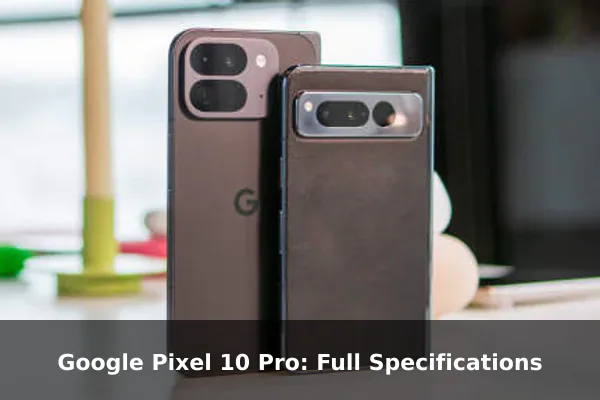
The Google Tensor G5 chipset is listed as a 4 nm platform with an octa-core CPU configuration and Mali-G715 MC7 graphics. For a Pixel phone, the processor story is not only about raw speed. Google’s own Tensor G5 explanation frames the chip around AI, camera processing, and security-related improvements, which fits the Pixel 10 Pro’s software-heavy identity.
The memory configuration is clearly Pro-grade. Every listed storage version comes with 16GB RAM, starting at 128GB and extending through 256GB, 512GB, and 1TB options. UFS 4.0 storage is also listed, which should help with app loading, large file transfers, high-resolution video capture, and general responsiveness. There is no microSD card slot, so buyers should choose storage carefully at purchase.
Camera System
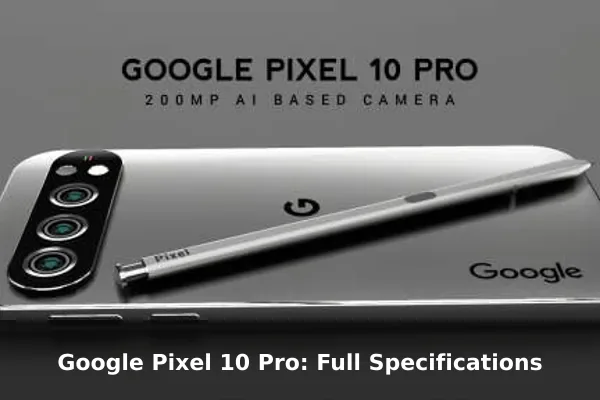
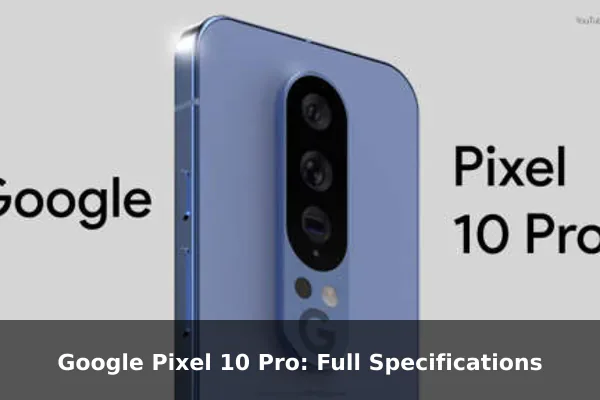
The rear camera setup is the main reason many buyers will look at the Pixel 10 Pro instead of a standard flagship. The supplied data lists a triple camera system with a 50 MP wide camera, a 48 MP periscope telephoto camera with 5x optical zoom, and a 48 MP ultrawide camera. That combination gives the phone a practical focal range for everyday photography: wide scenes, portraits, distant subjects, group shots, and travel images.
The camera feature list is also very Pixel-like. Multi-zone Laser AF, Pixel Shift, Ultra-HDR, panorama, Best Take, and Zoom Enhance all point toward a computational imaging system designed to help users rescue difficult shots. Video support is broad, including 4K at multiple frame rates and 1080p slow-motion options, with gyro-EIS, OIS, and 10-bit HDR. The listed 8K mode relies on cloud-based upscaling, so buyers who need native professional video workflows should read Google’s footnotes carefully.
Selfie Camera and Video Calls
The 42 MP front camera is unusually strong on paper, especially because it includes PDAF and an ultrawide 17 mm field of view in the supplied data. That matters for group selfies, vlogging, video calls, and social content where framing flexibility is more useful than a narrow front camera.
Front video support includes 4K at 30 and 60 fps plus 1080p recording. For users who often shoot directly from the front camera, this is a meaningful advantage over phones that reserve their best recording modes for the rear cameras only. HDR and panorama support round out the selfie feature set without turning it into a separate creator-focused device.
Battery and Charging
The listed 4870 mAh battery is a strong capacity for a compact Pro phone. It is not the largest battery in the flagship market, but it is paired with an LTPO display and Google’s own chipset, so the real test will be efficiency in daily mixed use. The source data lists 29W wired charging with PD3.0 and PPS, reaching 55% in 30 minutes under supported conditions.
Wireless charging support adds useful flexibility. The data lists 21W wireless charging with Pixel Stand, 15W wireless charging with Qi-compatible chargers, reverse wireless charging, and bypass charging. Google’s Pixelsnap accessory documentation is the best place to confirm exact charger compatibility and wattage, because wireless charging speeds often depend on the charger, alignment, and regional accessory support.
Software, Security, and Smart Features
The source data lists Android with up to seven major Android upgrades, which is one of the most important long-term ownership advantages. For a premium phone, extended updates protect resale value and reduce the need to upgrade early. Google’s official Pixel hardware specification documentation should be used to confirm the final software version and support terms for each region.
The feature set includes an ultrasonic under-display fingerprint sensor, accelerometer, gyroscope, proximity sensor, compass, barometer, and skin temperature thermometer. It also lists Ultra Wideband support, Satellite SOS service, and Circle to Search. Those extras make the Pixel 10 Pro feel less like a basic spec upgrade and more like a full ecosystem phone for navigation, safety, device tracking, and AI-assisted search.
Connectivity and Everyday Use
Connectivity is broad, with GSM, HSPA, LTE, and 5G support listed. The source separates USA 5G support with SA/NSA/Sub6/mmWave from rest-of-world SA/NSA/Sub6 support, so buyers should check the exact model variant before importing. This is especially important for mmWave 5G, which is not always available or useful outside specific markets and carriers.
Wi-Fi 7, tri-band Wi-Fi, Bluetooth 5.3 with aptX HD, NFC, USB Type-C 3.2, and multi-constellation positioning support make the Pixel 10 Pro well equipped for modern use. There is no 3.5 mm headphone jack and no FM radio, but stereo speakers are included. For most flagship buyers, the stronger wireless and USB feature set will matter more than legacy ports.
Who Should Buy This Phone?
The Google Pixel 10 Pro is best suited to Android users who want Google’s camera processing, clean software, long updates, and Pro-level hardware in a smaller body. It makes particular sense for photographers, frequent travelers, AI-feature users, and buyers who want a premium display without moving to an oversized phone.
It is less ideal for users who need expandable storage, a headphone jack, or the absolute largest battery possible. It may also be worth comparing with the larger Pro model if screen size, wireless charging speed, or battery endurance is the top priority. For most buyers, though, the Pixel 10 Pro’s appeal is clear: it concentrates Google’s flagship experience into a more practical size.
Conclusion
The Google Pixel 10 Pro stands out as a compact Pro flagship with a sharp LTPO OLED display, Tensor G5 hardware, 16GB RAM, a versatile triple camera system, strong connectivity, and long-term Android support. With no exact source price available here, the final value judgment depends on local pricing, but the specification mix is compelling. Recommended for buyers who want Google’s best phone features in a smaller flagship form.
References
- Google Store Pixel 10 Pro Tech Specs – Primary manufacturer specs for Pixel 10 Pro display, dimensions, battery, cameras, processor, memory, storage, connectivity, network bands, materials, and included features.
- Google Pixel Phone Help: Pixel phone hardware tech specs – Official Google support documentation with detailed Pixel 10 Pro hardware specifications and footnotes, useful for verifying the spec table.
- Google Pixel Safety & Regulatory Guide for Pixel 10, Pixel 10 Pro & Pixel 10 Pro XL – Official regulatory and safety source for Pixel 10 Pro model number, charging requirements, compliance information, and regional regulatory details.
- Google Blog: Tensor G5 for Pixel 10 – Official Google explanation of the Tensor G5 chip, AI capabilities, performance claims, camera processing, and security-related hardware context.
- Google Pixel Phone Help: Learn about Pixelsnap accessories – Official Google source for Pixelsnap and Qi2 wireless charging compatibility and charging wattage details for Pixel 10 Pro.
