
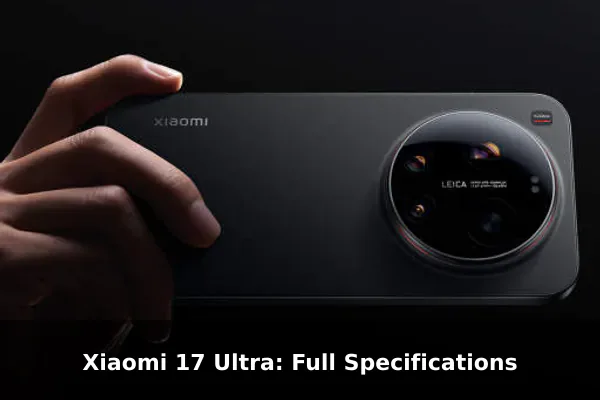
The Xiaomi 17 Ultra is positioned as a camera-first flagship for users who want top-tier imaging hardware, a large premium display, and serious endurance in one Android phone. Its headline features include a Leica-branded triple rear camera system, a 1.0-inch-type main sensor, a 200 MP continuous optical zoom periscope camera, and 8K video recording.
It also brings flagship-grade internals with the Snapdragon 8 Elite Gen 5, UFS 4.1 storage, Android 16 with HyperOS 3, IP68/IP69 protection, Wi-Fi 7, satellite communication, and a 6800 mAh silicon-carbon battery. This article focuses on what those specifications mean for buyers, while the detailed spec table is handled separately.
Full Specifications
Network
| Technology: | GSM / HSPA / LTE / 5G |
| 2G bands: | GSM 850 / 900 / 1800 / 1900 |
| 3G bands: | HSDPA 800 / 850 / 900 / 1700(AWS) / 1800 / 1900 / 2100 |
| 4G bands: | 1, 2, 3, 4, 5, 7, 8, 12, 13, 17, 18, 19, 20, 25, 26, 28, 34, 38, 39, 40, 41, 42, 48, 66 |
| 5G bands: | 1, 2, 3, 5, 7, 8, 12, 13, 18, 20, 25, 26, 28, 38, 40, 41, 48, 66, 70, 77, 78, 79, 80, 81, 83, 84, 89 SA/NSA |
| Speed: | HSPA, LTE, 5G |
Launch
| Announced: | 2025, December 25 |
| Status: | Available. Released 2025, December 27 |
Body
| Dimensions: | 162.9 x 77.6 x 8.5 mm (6.41 x 3.06 x 0.33 in) |
| Weight: | 230 g (8.11 oz) |
| Build: | Glass front, fiber-reinforced plastic back / silicone polymer back (eco leather), aluminum frame |
| SIM: | · Nano-SIM + Nano-SIM· Nano-SIM + Nano-SIM + eSIM + eSIM (max 2 at a time) |
| IP68/IP69 dust tight and water resistant (high pressure water jets; immersible up to 6m for 30 min) Aerospace-grade glass fiber |
Display
| Type: | LTPO AMOLED, 68B colors, 120Hz, 2160Hz PWM, Dolby Vision, HDR Vivid, HDR10+, 3500 nits (peak) |
| Size: | 6.9 inches, 116.6 cm2 (~92.3% screen-to-body ratio) |
| Resolution: | 1200 x 2608 pixels, 19.5:9 ratio (~416 ppi density) |
Platform
| OS: | Android 16, HyperOS 3 |
| Chipset: | Qualcomm SM8850-AC Snapdragon 8 Elite Gen 5 (3 nm) |
| CPU: | Octa-core (2×4.6 GHz Oryon V3 Phoenix L + 6×3.62 GHz Oryon V3 Phoenix M) |
| GPU: | Adreno 840 |
Memory
| Card slot: | No |
| Internal: | 512GB 12GB RAM, 512GB 16GB RAM, 1TB 16GB RAM |
| UFS 4.1 |
Main Camera
| Triple: | 50 MP, f/1.7, 23mm (wide), 1.0″-type, 1.6µm, dual pixel PDAF, OIS 200 MP, f/2.4-3.0, 75-100mm (periscope telephoto), 1/1.4″, 0.56µm, multi-directional PDAF (30cm – ∞), OIS, 3.2-4.3x continuous optical zoom, zoom ring 50 MP, f/2.2, 14mm, 115˚ (ultrawide), 1/2.76″, 0.64µm, dual pixel PDAF TOF 3D, (depth) |
| Features: | Laser AF, color spectrum sensor, Leica lenses, Dual-LED flash, HDR, panorama, 67mm filter ring holder (optional) |
| Video: | 8K@30fps, 4K@30/60/120fps, 1080p@30/60/120/240/480/960/1920fps, gyro-EIS, Dolby Vision HDR 10-bit rec. (4K@60fps, 1080p) |
Selfie camera
| Single: | 50 MP, (wide), 1/2.88″, 0.61µm |
| Features: | HDR, panorama |
| Video: | 4K@30/60fps, 1080p@30/60fps, gyro-EIS |
Sound
| Loudspeaker: | Yes, with stereo speakers |
| 3.5mm jack: | No |
| 24-bit/192kHz Hi-Res & Hi-Res Wireless audio |
Comms
| WLAN: | Wi-Fi 802.11 a/b/g/n/ac/6e/7, dual-band or tri-band, Wi-Fi Direct |
| Bluetooth: | 5.4, A2DP, LE, aptX HD, aptX Adaptive, LHDC 5, MIHC |
| Positioning: | GPS (L1+L5), BDS (B1I+B1c+B2a), GALILEO (E1+E5a), QZSS (L1+L5), NavIC (L5), GLONASS |
| NFC: | Yes |
| Infrared port: | Yes |
| Radio: | No |
| USB: | USB Type-C 3.2 Gen 2, DisplayPort, OTG |
Features
| Sensors: | Fingerprint (under display, ultrasonic), accelerometer, proximity, gyro, compass, barometer |
| Two-way satellite communication |
Battery
| Type: | Si/C Li-Ion 6800 mAh |
| Charging: | 90W wired, 90W PPS, PD3.0, QC3+ 50W wireless 22.5W reverse wired 10W reverse wireless |
Misc
| Colors: | Black, White, Starry Green, Purple |
| Models: | 25128PNA1C |
| Price: | About 850 EUR |
Price and Availability
The Xiaomi 17 Ultra offers a compelling combination of features and performance. While the base price is around €850, the actual cost may vary depending on your location and retailer. Below, you’ll find the approximate price of the Xiaomi 17 Ultra converted into various currencies. Please note that these are estimates based on recent exchange rates as of July 30, 2026 and may not reflect the exact price you’ll find at a retailer.
- United States: $971
- Japan: ¥158,869
- United Kingdom: £729
- Australia: A$1,397
- Canada: C$1,366
- Taiwan: NT$31,377
- Denmark: kr6.344
- Saudi Arabia: ﷼3,641
- South Korea: ₩1,405,555
- Germany: €850
- Brazil: R$4.959
- Vietnam: ₫25.533.446
- Kenya: KSh 125,357
- India: ₹92,648
- Indonesia: Rp 17.491.366
- Nigeria: ₦1,318,946
- Pakistan: ₨270,378
- Philippines: ₱59,488
- Bangladesh: ৳১,১৯,২৪২
Why Should You Buy the Xiaomi 17 Ultra?
The Xiaomi 17 Ultra is built for buyers who care less about owning a standard flagship and more about having a high-end imaging tool in their pocket. Its strongest argument is the combination of a large main camera sensor, a 200 MP periscope telephoto camera, Leica optics, high-end video modes, and a battery that is larger than what many premium rivals offer. That makes it especially interesting for travel photography, event coverage, social video, and anyone who regularly shoots across wide, standard, and zoom focal lengths.
At about 850 EUR in the raw source data, it lands in premium territory but below some ultra-flagship launch prices. The value depends heavily on regional availability, final retail pricing, warranty support, and whether the listed configuration is the one sold in your market. On paper, however, the Xiaomi 17 Ultra looks like a spec-heavy flagship with a clear focus: camera flexibility backed by strong display, charging, and connectivity hardware.
Design and Durability
The Xiaomi 17 Ultra is not a small or lightweight phone. Its listed 162.9 x 77.6 x 8.5 mm body and 230 g weight make it a large device, better suited to users comfortable with two-handed use. The build combines a glass front, aluminum frame, and either a fiber-reinforced plastic back or silicone polymer eco-leather finish, depending on variant. That material mix suggests Xiaomi is balancing a premium frame with grip, texture, and durability considerations rather than relying only on a conventional glass sandwich.
Durability is one of the more serious parts of the package. IP68/IP69 resistance means the phone is listed as dust tight, resistant to high-pressure water jets, and immersible up to 6 meters for 30 minutes under tested conditions. That does not make it a diving camera, and water resistance can degrade with wear, but it gives the device stronger protection credentials than many everyday flagships. The aerospace-grade glass fiber note also reinforces the rugged-premium direction.
Display Quality
The display specification is exactly what a modern Ultra-class Android phone needs to compete. The Xiaomi 17 Ultra uses a 6.9-inch LTPO AMOLED panel with a 120 Hz refresh rate, 68 billion colors, Dolby Vision, HDR Vivid, HDR10+, and a listed 3500-nit peak brightness. The 1200 x 2608 resolution works out to around 416 ppi, which is sharp enough for dense text, camera previews, maps, streaming, and gaming without pushing resolution to an inefficient extreme.
The LTPO element matters because it allows the phone to vary refresh rate more intelligently, helping balance smooth motion with battery efficiency. The 2160 Hz PWM dimming claim will also interest users sensitive to flicker, although real comfort still depends on brightness level, software behavior, and individual sensitivity. Overall, this is a display aimed at outdoor readability, HDR content, and smooth daily use rather than just spec-sheet size.
Performance and Storage
Performance is anchored by the Qualcomm Snapdragon 8 Elite Gen 5, a 3 nm flagship chipset paired with an octa-core CPU and Adreno 840 graphics. The listed CPU configuration, with two high-performance Oryon V3 Phoenix L cores and six Oryon V3 Phoenix M cores, points to a device designed for demanding workloads such as gaming, high-resolution video recording, image processing, multitasking, and on-device AI features.
Storage options are also firmly premium: 512 GB with 12 GB RAM, 512 GB with 16 GB RAM, and 1 TB with 16 GB RAM. There is no memory card slot, so buyers should choose capacity carefully at purchase. The inclusion of UFS 4.1 storage is important for app loading, burst photography, high-bitrate video capture, and long-term responsiveness. For most users, the 512 GB versions should be enough, but the 1 TB model is the cleaner choice for heavy 4K or 8K video users.
Camera System
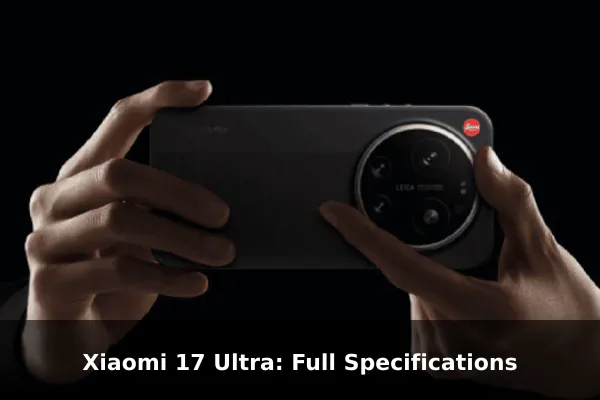
The camera setup is the Xiaomi 17 Ultra’s main identity. The triple rear system starts with a 50 MP wide camera using a 1.0-inch-type sensor, dual pixel PDAF, and OIS. That large sensor format should help with natural depth, stronger low-light capture, and cleaner image data before computational processing is applied. Leica lenses, a color spectrum sensor, Laser AF, Dual-LED flash, HDR, panorama, and an optional 67 mm filter ring holder all point toward a photography-focused device rather than a generic flagship camera array.
The most distinctive camera is the 200 MP periscope telephoto unit. It covers 75-100 mm with 3.2x to 4.3x continuous optical zoom, OIS, multi-directional PDAF, and a zoom ring. This gives the phone more native framing flexibility than fixed 3x or 5x telephoto designs. The 50 MP ultrawide camera adds a 14 mm field of view with autofocus, which is useful for landscapes, architecture, group shots, and close-range creative angles. A TOF 3D depth sensor completes the rear imaging hardware.
Video and Selfie Features
For video, the Xiaomi 17 Ultra is equipped beyond casual recording. The rear camera supports 8K at 30 fps, 4K at up to 120 fps, extensive 1080p slow-motion modes, gyro-EIS, and Dolby Vision HDR 10-bit recording at up to 4K 60 fps and 1080p. Those features make it suitable for users who want more control over motion, color, and post-production flexibility, though storage consumption will rise quickly at the highest settings.
The front camera is also unusually high resolution at 50 MP. It supports HDR, panorama, 4K video at 30 or 60 fps, 1080p recording, and gyro-EIS. That makes the phone more credible for vloggers, video calls, creator clips, and front-facing social content than phones that reserve all serious video features for the rear camera only.
Battery and Charging
Battery capacity is another major reason to pay attention to this model. The listed 6800 mAh silicon-carbon Li-Ion battery is large for a flagship phone with this level of display and camera hardware. Real endurance will still depend on refresh rate, brightness, 5G use, gaming, navigation, and camera recording, but the capacity gives the Xiaomi 17 Ultra a strong foundation for long days.
Charging support is equally broad. The phone lists 90W wired charging, 90W PPS, PD3.0, QC3+, 50W wireless charging, 22.5W reverse wired charging, and 10W reverse wireless charging. That combination is useful for users who switch between Xiaomi chargers, USB-C PD adapters, wireless pads, and accessory top-ups. As always, peak charging speeds usually require compatible chargers and cables.
Software, Connectivity, and Everyday Features
The Xiaomi 17 Ultra runs Android 16 with HyperOS 3, giving it a current software base and Xiaomi’s own interface layer. The sensor list is complete for a flagship: ultrasonic under-display fingerprint reader, accelerometer, proximity sensor, gyroscope, compass, and barometer. Stereo speakers, Hi-Res wired and wireless audio support, and the absence of a 3.5 mm jack match current premium-phone trends.
Connectivity is extensive. The phone supports GSM, HSPA, LTE, and 5G, with a wide band list for both 4G and 5G SA/NSA. It also includes Wi-Fi 7, Bluetooth 5.4 with advanced codecs, NFC, infrared, multi-constellation positioning, USB Type-C 3.2 Gen 2 with DisplayPort, OTG, and two-way satellite communication. The SIM setup is flexible too, with dual nano-SIM support and an option involving nano-SIM plus eSIM combinations, limited to two active lines at a time.
Who Should Buy It?
The Xiaomi 17 Ultra makes the most sense for buyers who want a large Android flagship with real camera ambition, strong zoom hardware, a bright LTPO AMOLED display, fast storage, and a large battery. It is especially compelling for mobile photographers, frequent travelers, content creators, and users who value charging flexibility and broad connectivity.
It is less ideal for people who want a compact phone, a light body, a headphone jack, or expandable storage. Buyers should also check local band support, eSIM availability, charger availability, and warranty terms before importing or purchasing across regions. If those points line up, the Xiaomi 17 Ultra is one of the more complete camera-led flagship options on paper.
Conclusion
The Xiaomi 17 Ultra combines an ambitious Leica camera system, flagship Snapdragon performance, a bright LTPO AMOLED display, robust durability, broad connectivity, and a large fast-charging battery. It is best suited to users who prioritize photography, video, and endurance over compactness. Concise recommendation: buy it if you want a premium Android camera flagship and are comfortable with a large, heavy phone.
References
- Xiaomi Global – Xiaomi 17 Ultra Specifications – Official manufacturer spec sheet for core details including chipset, memory, dimensions, display, cameras, battery, charging, network bands, sensors, OS, and package contents.
- Xiaomi Global Support – Xiaomi 17 Ultra FAQ – Official support FAQ with model-specific clarifications such as launch date, colors, display details, storage variants, SoC, software features, wireless connectivity, and feature availability notes.
- Xiaomi Global Support – Xiaomi 17 Ultra User Guide PDF – Official user guide and safety documentation useful for confirming model identifiers, regulatory notes, charging guidance, RF exposure, and device safety information.
- Global Certification Forum – Xiaomi 17 Ultra Certification – Independent certification listing for Xiaomi 17 Ultra model 2512BPNDAG, useful for verifying supported cellular technologies, bands, eSIM/UICC support, NFC, and codec declarations.
- Qualcomm – Snapdragon 8 Elite Gen 5 Mobile Platform – Official chipset source to verify Snapdragon 8 Elite Gen 5 platform capabilities, CPU/GPU naming, modem, Wi-Fi, Bluetooth, AI, and imaging platform specifications referenced in the phone article.
