
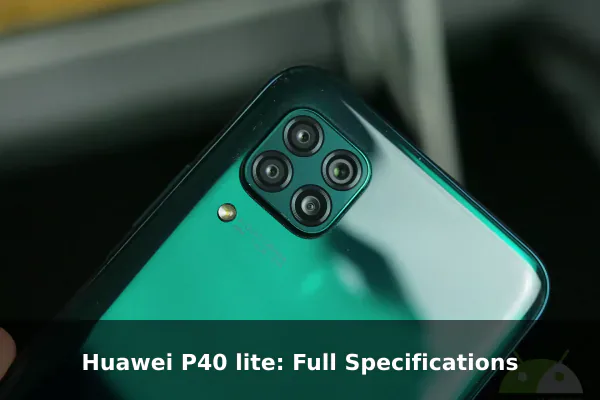
The Huawei P40 lite arrived in early 2020 as a mid-range entry in the P40 family, pairing a familiar Kirin 810 platform with a 6.4-inch IPS display, a 48 MP quad-camera array, and a 4,200 mAh battery with 40W SuperCharge. Announced on February 27, 2020 and released a few days later, it targets shoppers who want flagship-style hardware cues — fast charging, a side-mounted fingerprint reader, and Type-C — without paying flagship money. Pricing started at around 170 EUR, though that figure should be taken as historical because the device is now listed as discontinued.
What makes the P40 lite an interesting reference point in 2026 is the software situation it shipped with: Android 10 under EMUI 10 and, critically, no Google Play Services. That single decision shapes everything from app sideloading to long-term usability, and it is the lens we will use to evaluate whether this handset still makes sense as a budget pickup, a backup phone, or a collector’s snapshot of Huawei’s post-ban era.
Full Specifications
Network
| Technology | GSM / HSPA / LTE |
| 2G bands | GSM 850 / 900 / 1800 / 1900 |
| 3G bands | HSDPA 800 / 850 / 900 / 1700(AWS) / 2100 |
| 4G bands | 1, 2, 3, 4, 5, 7, 8, 18, 19, 20, 28, 34, 38, 39, 40, 41 – JNY-L21A, JNY-L01A, JNY-L21B |
| 1, 2, 3, 4, 5, 7, 8, 18, 19, 28, 34, 38, 39, 40, 41 – JNY-L22A, JNY-L02A, JNY-L22B | |
| Speed | HSPA 42.2/5.76 Mbps, LTE (2CA) Cat13 400/75 Mbps |
Launch
| Announced | 2020, February 27. Released 2020, March 02 |
| Status | Discontinued |
Body
| Dimensions | 159.2 x 76.3 x 8.7 mm (6.27 x 3.00 x 0.34 in) |
| Weight | 183 g (6.46 oz) |
| Build | Glass front, plastic back, plastic frame |
| SIM | Nano-SIM + Nano-SIM |
Display
| Type | IPS LCD |
| Size | 6.4 inches, 101.4 cm2 (~83.5% screen-to-body ratio) |
| Resolution | 1080 x 2310 pixels (~398 ppi density) |
Platform
| OS | Android 10, EMUI 10, no Google Play Services |
| Chipset | Kirin 810 (7 nm) |
| CPU | Octa-core (2×2.27 GHz Cortex-A76 & 6×1.88 GHz Cortex-A55) |
| GPU | Mali-G52 MP6 |
Memory
| Card slot | Nano Memory (uses shared SIM slot) |
| Internal | 128GB 6GB RAM, 128GB 8GB RAM |
| UFS 2.1 |
Main Camera
| Quad | 48 MP, f/1.8, 26mm (wide), 1/2.0", 0.8µm, PDAF 8 MP, f/2.4, (ultrawide) 2 MP (macro) Auxiliary lens |
| Features | LED flash, HDR, panorama |
| Video | 1080p@30fps |
Selfie camera
| Single | 16 MP, f/2.0, (wide), 1/3.06", 1.0µm |
| Features | HDR |
| Video | 1080p@30fps |
Sound
| Loudspeaker | Yes |
| 3.5mm jack | Yes |
Comms
| WLAN | Wi-Fi 802.11 a/b/g/n/ac, dual-band, Wi-Fi Direct |
| Bluetooth | 5.0, A2DP, LE |
| Positioning | GPS, GLONASS, GALILEO, BDS, QZSS |
| NFC | Yes (market/region dependent): JNY-L21A, JNY-L01A, JNY-L21B |
| Radio | FM radio |
| USB | USB Type-C 2.0, OTG |
Features
| Sensors | Fingerprint (side-mounted), accelerometer, proximity, compass |
Battery
| Type | Li-Po 4200 mAh, non-removable |
| Charging | 40W wired, 70% in 30 min |
Misc
| Colors | Black, Emerald Green, Light Pink/Blue, Skyline Gray |
| Models | JNY-L21A, JNY-L01A, JNY-L21B, JNY-L22A, JNY-L02A, JNY-L22B, JNY-LX1 |
| Price | About 170 EUR |
Our Tests
| Performance | AnTuTu: 325777 (v8) GeekBench: 7846 (v4.4), 1862 (v5.1) GFXBench: 18fps (ES 3.1 onscreen) |
| Display | 1085:1 contrast ratio, 515 nits max brightness (measured) |
| Camera | Photo / Video |
| Loudspeaker | -27.0 LUFS (Good) |
| Battery (old) | Endurance rating 121h |
Price and Availability
The Huawei P40 lite offers a compelling combination of features and performance. While the base price is around €170, the actual cost may vary depending on your location and retailer. Below, you’ll find the approximate price of the Huawei P40 lite converted into various currencies. Please note that these are estimates based on recent exchange rates as of June 5, 2026 and may not reflect the exact price you’ll find at a retailer.
- United States: $198
- Japan: ¥31,597
- United Kingdom: £147
- Australia: A$277
- Canada: C$275
- Taiwan: NT$6,221
- Denmark: kr1.269
- Saudi Arabia: ﷼741
- South Korea: ₩302,849
- Germany: €170
- Brazil: R$1.001
- Vietnam: ₫5.180.144
- Kenya: KSh 25,559
- India: ₹18,920
- Indonesia: Rp 3.563.758
- Nigeria: ₦267,928
- Pakistan: ₨55,034
- Philippines: ₱12,170
- Bangladesh: ৳২৪,২৩৯
Where the P40 lite Sits in the Huawei Lineup
The P40 lite is the entry rung of the 2020 P-series ladder, sitting beneath the P40, P40 Pro, and P40 Pro+. Unlike its more expensive siblings, it does not use a Kirin 990 5G chipset; instead it reuses the 7 nm Kirin 810 that debuted on the Honor 9X and nova 5i Pro. That makes it more of a rebadged nova-class device than a true flagship-lite, and it is worth setting that expectation before comparing it against pricier P40 variants.
Design and Build Quality
At 159.2 x 76.3 x 8.7 mm and 183 g, the P40 lite is squarely in the mid-2020 mainstream for footprint and weight. Huawei opted for a glass front with a plastic back and plastic frame, which keeps cost down and helps explain the 170 EUR launch price. Color options include Black, Emerald Green, Light Pink/Blue, and Skyline Gray, with a punch-hole front camera and a square rear camera island that visually echoes the P40 series identity.
Display: A Practical 6.4-inch IPS Panel
The display is a 6.4-inch IPS LCD at 1080 x 2310 pixels, giving roughly 398 ppi and a screen-to-body ratio near 83.5%. Huawei’s own measured testing reportedly puts contrast around 1085:1 and peak brightness at about 515 nits. That is enough for indoor and shaded outdoor reading, but it lacks the deep blacks of the OLED panels found on the standard P40 and P40 Pro. For a sub-200 EUR device launched in 2020, however, the panel is competitive rather than exciting.
Performance and Memory
The Kirin 810 pairs two Cortex-A76 cores at 2.27 GHz with six Cortex-A55 cores at 1.88 GHz, and a Mali-G52 MP6 GPU. Memory is offered in 6 GB or 8 GB configurations alongside 128 GB of UFS 2.1 storage, with a Nano Memory card slot that shares the second SIM tray. Reported benchmarks include an AnTuTu v8 score around 325,777 and a Geekbench v5.1 multi-core score near 1,862. That performance profile is closer to a polished mid-ranger than a gaming phone, which suits the rest of the package.
Camera System
On the back, a quad camera leads with a 48 MP f/1.8 main sensor on a 1/2.0″ chip with PDAF, joined by an 8 MP f/2.4 ultrawide, a 2 MP macro, and an auxiliary depth-style sensor. Video tops out at 1080p at 30 fps on both the rear and the 16 MP f/2.0 front camera, with no 4K capture available. For everyday social-feed photography in good light the main sensor does the heavy lifting, while the macro and depth helpers are best treated as occasional extras rather than headline features.
Battery Life and 40W SuperCharge
A 4,200 mAh Li-Po battery powers the phone, with 40W wired SuperCharge that Huawei rates at roughly 70% in 30 minutes. Independent endurance testing previously published an old-style 121-hour rating, reflecting comfortable all-day use for mixed workloads. The combination of a relatively efficient 7 nm chipset, a 1080p IPS panel, and a sizeable cell is the P40 lite’s strongest selling point in 2026, particularly compared with older budget devices that still ship with 10W or 18W charging.
Software: Android 10, EMUI 10, and No Google Play Services
This is the defining caveat of the P40 lite. It ships with Android 10 under EMUI 10 and does not include Google Play Services, instead relying on Huawei Mobile Services and the AppGallery store. For users who depend on Gmail, Google Maps, YouTube, banking apps that require Play Integrity, or messaging clients that lean on Play Services for notifications, this is a meaningful limitation that workarounds cannot fully solve. For users who can live inside AppGallery, Petal Maps, and sideloaded APKs, EMUI itself remains a polished skin.
Connectivity, Sound, and Sensors
Connectivity covers Wi-Fi 802.11 a/b/g/n/ac dual-band, Bluetooth 5.0 with LE, and a full GNSS stack of GPS, GLONASS, GALILEO, BDS, and QZSS. There is no 5G modem here, which keeps the phone on LTE Cat13 with theoretical 400/75 Mbps speeds. NFC is region dependent and tied to specific JNY-L21A, JNY-L01A, and JNY-L21B model variants, so buyers who plan to use tap-to-pay should verify the exact model number against Huawei’s official certification database. A 3.5 mm headphone jack, FM radio, USB Type-C 2.0 with OTG, and a side-mounted fingerprint sensor round out a practical, well-equipped feature list.
Who Should Buy the Huawei P40 lite
This phone makes the most sense for three groups: shoppers in markets where AppGallery covers their daily apps, secondary-line users who want a capable backup phone with fast charging, and collectors documenting Huawei’s transition away from Google services. For mainstream users in regions that depend on Google apps, a same-era Samsung Galaxy A-series or a refreshed Redmi Note is likely a better daily driver.
Conclusion
The Huawei P40 lite remains an interesting mid-range artifact: solid Kirin 810 performance, a large 1080p IPS panel, a 4,200 mAh battery with 40W charging, and a versatile 48 MP camera, all for around 170 EUR at launch. The hardware still holds up for casual use in 2026, but the lack of Google Play Services is a hard constraint, not a footnote. Buy it if your app needs map cleanly onto AppGallery and Huawei Mobile Services, or if you want a robust backup device; otherwise, look toward an Android handset with full GMS support.
Official references
- Huawei Spain – HUAWEI P40 lite product page – Official Huawei product page for the P40 lite; useful to verify model-specific headline specs such as display, Kirin 810 processor, memory, battery, and SuperCharge details.
- Huawei Support – HUAWEI P40 lite – Official Huawei support hub for the exact product name; useful for manuals, downloads, service information, and confirming product identity.
- Huawei Global Certification – Official Huawei certificate lookup for consumer devices; search model numbers such as JNY-LX1 to verify Declaration of Conformity, SAR/regulatory data, and radio compliance details.
- Wi-Fi Alliance Product Finder (wi-fi.org) – Primary certification database for Wi-Fi capabilities; search Huawei model numbers such as JNY-LX1 to verify certified Wi-Fi standards and interoperability claims.
