
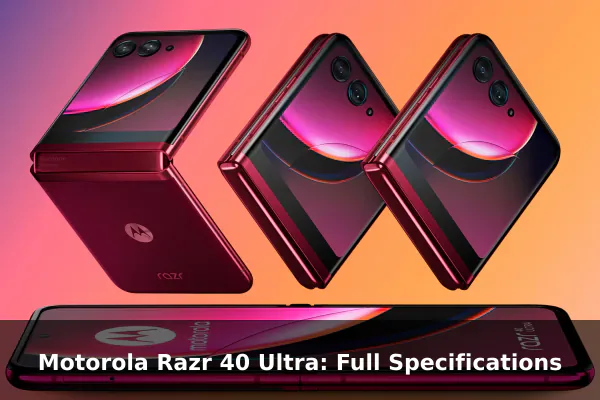
The Motorola Razr 40 Ultra revives the brand’s iconic clamshell silhouette with flagship-grade internals and the largest external cover display on a flip-style foldable at launch. It pairs a 6.9-inch foldable LTPO AMOLED inside with a 3.6-inch external AMOLED that wraps around the dual cameras, turning the closed phone into a fully usable mini smartphone rather than a glorified notification screen.
Powered by the Qualcomm Snapdragon 8+ Gen 1, a stainless-steel hinge and Gorilla Glass Victus on both glass surfaces, the Razr 40 Ultra (also marketed as Razr+ 2023 in North America) targets buyers who want a pocketable foldable that does not compromise on speed, refresh rate, or build quality.
Full Specifications
Network
| Technology | GSM / CDMA / HSPA / EVDO / LTE / 5G |
| 2G bands | GSM 900 / 1800 / 1900 |
| CDMA 800 / 1900 | |
| 3G bands | HSDPA 850 / 900 / 1700(AWS) / 1900 / 2100 |
| CDMA2000 1xEV-DO | |
| 4G bands | 1, 2, 3, 4, 5, 7, 8, 12, 13, 17, 18, 19, 20, 25, 26, 28, 32, 34, 38, 39, 40, 41, 42, 43, 48, 66 – International |
| 1, 2, 3, 4, 5, , 7, 8, 12, 13, 14, 17, 18, 19, 20, 25, 26, 28, 29, 30, 38, 39, 40, 41, 46, 48, 66, 71 – North America | |
| 5G bands | 1, 3, 5, 7, 8, 20, 28, 38, 41, 66, 77, 78, 79 SA/NSA/Sub6 – International |
| 2, 5, 7, 12, 13, 14, 25, 26, 29, 30, 38, 41, 48, 66, 70, 71, 77, 78 SA/NSA/Sub6 – North America | |
| Speed | HSPA, LTE, 5G |
Launch
| Announced | 2023, June 01 |
| Status | Available. Released 2023, June 05 |
Body
| Dimensions | Unfolded: 170.8 x 74 x 7 mmFolded: 88.4 x 74 x 15.1 mm |
| Weight | 184.5 g or 188.5 g (6.53 oz) |
| Build | Plastic front (unfolded), glass front (folded, Gorilla Glass Victus), glass back (Gorilla Glass Victus), aluminum frame (7000 series), hinge (stainless steel) |
| SIM | · Nano-SIM + eSIM· Nano-SIM + Nano-SIM |
| Water-repellent coating |
Display
| Type | Foldable LTPO AMOLED, 1B colors, 165Hz, HDR10+, 1400 nits (peak) |
| Size | 6.9 inches, 107.6 cm2 (~85.1% screen-to-body ratio) |
| Resolution | 1080 x 2640 pixels (~413 ppi density) |
| Second external AMOLED, 1B colors, 144Hz, HDR10+, 1100 nits (peak) 3.6 inches, 1056 x 1066 pixels, 413 ppi, Gorilla Glass Victus |
Platform
| OS | Android 13, up to 3 major Android upgrades |
| Chipset | Qualcomm SM8475 Snapdragon 8+ Gen 1 (4 nm) |
| CPU | Octa-core (1×3.19 GHz Cortex-X2 & 3×2.75 GHz Cortex-A710 & 4×1.80 GHz Cortex-A510) |
| GPU | Adreno 730 |
Memory
| Card slot | No |
| Internal | 256GB 4GB RAM, 256GB 8GB RAM, 256GB 12GB RAM, 512GB 12GB RAM |
| UFS 3.1 |
Main Camera
| Dual | 12 MP, f/1.5, (wide), 1/2.55", 1.4µm, PDAF, OIS 13 MP, f/2.2, 108˚ (ultrawide), 1/3.0", 1.12µm, AF |
| Features | LED flash, panorama, HDR |
| Video | 4K@30/60fps, 1080p@30/60/120fps, HDR10+, gyro-EIS |
Selfie camera
| Single | 32 MP, f/2.4, (wide), 0.7µm |
| Features | HDR |
| Video | 4K@30/60fps, 1080p@30/60fps |
Sound
| Loudspeaker | Yes, with stereo speakers |
| 3.5mm jack | No |
| Snapdragon Sound |
Comms
| WLAN | Wi-Fi 802.11 a/b/g/n/ac/6e, dual-band or tri-band (region dependent) |
| Bluetooth | 5.3, A2DP, LE, aptX HD, aptX Adaptive, aptX Lossless |
| Positioning | GPS (L1+L5), GLONASS (L1), BDS (B1I+B1c+B2a), GALILEO (E1+E5a), QZSS (L1+L5) |
| NFC | Yes |
| Radio | No |
| USB | USB Type-C 2.0 |
Features
| Sensors | Fingerprint (side-mounted), accelerometer, gyro, proximity, compass, barometer (USA only) |
Battery
| Type | Li-Po 3800 mAh |
| Charging | 30W wired 5W wireless |
Misc
| Colors | Infinite Black, Glacier Blue, Viva Magenta, Peach Fuzz |
| Models | XT2321-3, XT2321-1, XT2321-2 |
| Price | $ 229.99 / £ 885.00 / € 489.90 |
Our Tests
| Performance | AnTuTu: 975461 (v9) GeekBench: 3645 (v5.1), 4045 (v6) GFXBench: 65fps (ES 3.1 onscreen) |
| Display | 1050 nits max brightness (measured) |
| Camera | Photo / Video |
| Loudspeaker | -25.4 LUFS (Very good) |
| Battery (old) | Endurance rating 83h |
Price and Availability
The Motorola Razr 40 Ultra offers a compelling combination of features and performance. While the base price is around €490, the actual cost may vary depending on your location and retailer. Below, you’ll find the approximate price of the Motorola Razr 40 Ultra converted into various currencies. Please note that these are estimates based on recent exchange rates as of June 1, 2026 and may not reflect the exact price you’ll find at a retailer.
- United States: $571
- Japan: ¥90,965
- United Kingdom: £424
- Australia: A$795
- Canada: C$788
- Taiwan: NT$17,920
- Denmark: kr3.655
- Saudi Arabia: ﷼2,141
- South Korea: ₩860,228
- Germany: €490
- Brazil: R$2.877
- Vietnam: ₫14.929.132
- Kenya: KSh 73,879
- India: ₹54,202
- Indonesia: Rp 10.189.698
- Nigeria: ₦780,045
- Pakistan: ₨158,923
- Philippines: ₱35,110
- Bangladesh: ৳৭০,০৩৯
Where the Razr 40 Ultra Fits in the Foldable Market
Foldables typically force a choice between book-style productivity and clamshell pocketability. The Razr 40 Ultra leans firmly into the clamshell category but tries to remove the usual compromise by giving the outer panel almost the same role as the inner one. Motorola’s official product page positions it as a flip phone designed to be used while folded, which is reflected in the 3.6-inch external screen running at 144Hz with HDR10+ support. Compared with rival flip foldables that ship with smaller cover screens, this device essentially offers two usable displays rather than a primary and a secondary.
Design, Hinge and Build Quality
Unfolded, the phone measures 170.8 x 74 x 7 mm and weighs around 184.5 to 188.5 grams depending on the configuration. Folded, it shrinks to 88.4 x 74 x 15.1 mm, making it noticeably easier to pocket than any conventional 6.9-inch slab. The frame uses 7000-series aluminum, while the hinge relies on stainless steel for rigidity. Both glass surfaces are protected by Gorilla Glass Victus, and Motorola applies a water-repellent coating, although there is no formal IP rating for full water resistance. Color options include Infinite Black, Glacier Blue, Viva Magenta and Peach Fuzz, with the latter two leaning into Motorola’s vegan leather finishes.
Inner and Outer Displays
The main 6.9-inch foldable LTPO AMOLED runs at up to 165Hz with a 1080 x 2640 resolution, roughly 413 ppi, HDR10+ support and a peak brightness rated at 1400 nits, though independent measurements landed closer to 1050 nits in typical conditions. The crease is present but tuned to be shallow. Outside, the 3.6-inch panel at 1056 x 1066 pixels offers a 144Hz refresh rate and 1100 nits peak brightness, which is more than enough to run full Android apps, reply to messages, navigate maps or use it as a high-quality selfie viewfinder for the rear cameras.
Performance and Thermals
Inside sits the Qualcomm SM8475 Snapdragon 8+ Gen 1, built on a 4 nm process with one Cortex-X2 prime core at 3.19 GHz, three Cortex-A710 performance cores and four Cortex-A510 efficiency cores, paired with the Adreno 730 GPU. In Motorola’s own tests, the device returned AnTuTu scores around 975,461 and GeekBench 6 results near 4045, which keeps it competitive with non-foldable flagships from the same era. Storage options span 256GB and 512GB with 4GB, 8GB or 12GB of LPDDR5 RAM over UFS 3.1, and there is no microSD slot.
Camera System
Motorola opts for a dual rear setup rather than chasing telephoto reach. A 12 MP f/1.5 main sensor with OIS and PDAF handles general shooting, while a 13 MP f/2.2 ultrawide with a 108-degree field of view doubles as a macro shooter thanks to autofocus. Both can record 4K video at 30 or 60 fps with HDR10+ and gyro-EIS. The 32 MP f/2.4 front camera sits in a hole-punch on the inner display, but the more interesting setup is using the rear cameras for selfies with the outer screen as a live preview, which generally yields better results.
Battery Life and Charging
The clamshell form factor limits the battery to a 3800 mAh Li-Po cell split across both halves. In long-term use the device manages an endurance rating around 83 hours in mixed scenarios, which is solid for a flip foldable but unsurprisingly behind candy-bar flagships with 4500-5000 mAh batteries. Charging tops out at 30W wired and 5W wireless, so a full top-up takes longer than on rivals offering 45W or more. There is no charger guaranteed in the box in every region, so check the local listing.
Software Experience
The Razr 40 Ultra ships with Android 13 and a near-stock Motorola skin enhanced with Moto-specific gestures, Ready For desktop mode and a dedicated panel manager for the outer display. Motorola committed to up to three major Android version upgrades, which would carry the device through Android 16. The official user guide details how widgets, full apps, games and Google Assistant can run on the external panel, making the cover display a first-class citizen rather than a stripped-down companion.
Connectivity, Audio and Sensors
Wireless connectivity is comprehensive with 5G Sub-6 SA and NSA across International and North American band sets, Wi-Fi 6E with dual or tri-band depending on region, Bluetooth 5.3 with aptX HD, Adaptive and Lossless, plus Snapdragon Sound. Positioning covers GPS L1+L5, GLONASS, BDS, GALILEO and QZSS. NFC is on board for contactless payments. There is no 3.5 mm headphone jack and no FM radio, while USB-C tops out at the slower USB 2.0 standard. Stereo speakers handle media playback, and a side-mounted fingerprint sensor integrated into the power button takes care of biometrics.
Who Should Buy the Razr 40 Ultra
This phone is ideal for buyers who prioritize a pocketable, fashion-forward design and want a flip foldable that can do most tasks without ever being opened. Power users who care about peak gaming performance, the longest battery life, optical zoom or formal IP68 ratings may be better served by a traditional slab flagship or the larger book-style foldables.
Conclusion
The Motorola Razr 40 Ultra is the most coherent clamshell foldable Motorola has shipped, balancing a class-leading external display, flagship Snapdragon 8+ Gen 1 performance and a refined hinge in a body that genuinely fits in small pockets. Compromises on battery capacity, charging speed and USB 2.0 are real, but for buyers who value design, dual-screen flexibility and a unique form factor over raw endurance, it remains a strong recommendation in the flip foldable category.
Official references
- Motorola official product page for motorola razr 40 ultra – Official manufacturer product page for model positioning, key features, display, battery, processor, camera, and design claims.
- Motorola Support specifications for motorola razr 40 ultra – Official Motorola support specification page covering chipset, RAM/storage, display, dimensions, cameras, connectivity bands, SIM, and battery details.
- Motorola global English user guide for motorola razr 40 ultra – Official English PDF user guide for device features, Android software behavior, settings, connectivity, and support details.
- Motorola Support SAR information for motorola razr 40 ultra – Official Motorola SAR and radio-frequency exposure reference for safety and regulatory accuracy.
- Motorola UK PSTI Statement of Compliance for XT2321-1 – Official compliance statement confirming model number XT2321-1, market name motorola razr 40 ultra, product type, and security update support period.
