
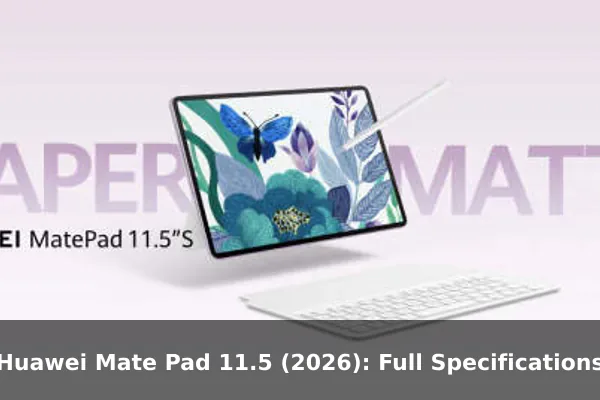
The Huawei Mate Pad 11.5 (2026) is a large-screen HarmonyOS tablet built around an 11.5-inch 120Hz display, a slim aluminum body, stylus support, and a 10100 mAh battery. It is positioned as an affordable productivity and study-focused device rather than a cellular tablet or phone replacement.
This article takes a specs-first look at what makes the 2026 Mate Pad 11.5 different from earlier MatePad entries already covered on the site: its Wi-Fi-only setup, updated Kirin platform, optional PaperMatte-style display experience, and value-oriented configuration choices.
Full Specifications
Network
| Technology: | No cellular connectivity |
| 2G bands: | N/A |
| 3G bands: | N/A |
| 4G bands: | N/A |
| GPRS: | No |
| EDGE: | No |
Launch
| Announced: | 2025, December 22 |
| Status: | Available. Released 2025, December 25 |
Body
| Dimensions: | 262.6 x 177.5 x 6.1 mm (10.34 x 6.99 x 0.24 in) |
| Weight: | 515 g (1.14 lb) |
| Build: | Glass front, aluminum frame, aluminum back |
| SIM: | No |
| Stylus support (magnetic) |
Display
| Type: | TFT LCD, 120Hz, 600 nits (peak) |
| Size: | 11.5 inches, 390.2 cm2 (~83.7% screen-to-body ratio) |
| Resolution: | 1600 x 2456 pixels, 3:2 ratio (~255 ppi density) |
| Optional PaperMatte Edition display |
Platform
| OS: | Harmony OS 5.1 |
| Chipset: | Kirin T82B |
| CPU: | 12-core (2×2.29 GHz & 6×2.05 GHz & 4×1.31 GHz) |
| GPU: | Maleoon 920c |
Memory
| Card slot: | No |
| Internal: | 128GB 8GB RAM, 256GB 8GB RAM, 256GB 12GB RAM |
Main Camera
| Single: | 13 MP, f/1.8, (wide), AF |
| Features: | Panorama |
| Video: | 1080p@30fps |
Selfie camera
| Single: | 8 MP, f/2.2, 105˚ (ultrawide) |
| Video: | 1080p@30fps |
Sound
| Loudspeaker: | Yes, with stereo speakers (4 speakers) |
| 3.5mm jack: | No |
Comms
| WLAN: | Wi-Fi 802.11 a/b/g/n/ac/6, dual-band |
| Bluetooth: | 5.2, A2DP, LE, L2HC |
| Positioning: | No |
| NFC: | No |
| Radio: | No |
| USB: | USB Type-C 2.0, OTG, magnetic accessory connector |
Features
| Sensors: | Accelerometer, proximity (accessories only) |
Battery
| Type: | 10100 mAh |
| Charging: | 40W wired 5W reverse wired |
Misc
| Colors: | Violet, Gray, Silver, Blue |
| Models: | TXZ-W10 |
| Price: | About 220 EUR |
Price and Availability
The Huawei Mate Pad 11.5 (2026) offers a compelling combination of features and performance. While the base price is around €220, the actual cost may vary depending on your location and retailer. Below, you’ll find the approximate price of the Huawei Mate Pad 11.5 (2026) converted into various currencies. Please note that these are estimates based on recent exchange rates as of August 24, 2026 and may not reflect the exact price you’ll find at a retailer.
- United States: $257
- Japan: ¥40,833
- United Kingdom: £188
- Australia: A$359
- Canada: C$354
- Taiwan: NT$8,182
- Denmark: kr1.645
- Saudi Arabia: ﷼964
- South Korea: ₩356,211
- Germany: €220
- Brazil: R$1.330
- Vietnam: ₫6.701.373
- Kenya: KSh 33,283
- India: ₹24,603
- Indonesia: Rp 4.546.588
- Nigeria: ₦347,094
- Pakistan: ₨71,380
- Philippines: ₱15,847
- Bangladesh: ৳৩১,৪৬৮
Value Positioning
The Huawei Mate Pad 11.5 (2026) stands out most clearly as a budget-conscious large tablet. With the source price listed at about 220 EUR, it targets buyers who want a proper 11.5-inch screen, stylus support, and a large battery without moving into premium tablet pricing. That value angle is important because the device is not trying to compete through cellular connectivity, flagship OLED display technology, or advanced camera hardware. Instead, it focuses on the core tablet basics: screen size, battery life, storage options, speakers, and accessory support.
Compared with many entry-level tablets, the memory options are relatively practical. The listed configurations include 128GB with 8GB RAM, 256GB with 8GB RAM, and 256GB with 12GB RAM. Since there is no memory card slot, choosing the right storage version matters from the start. The 256GB models make more sense for users who plan to keep offline videos, large documents, school materials, or creative files on the tablet.
Design and Build
The tablet measures 262.6 x 177.5 x 6.1 mm and weighs 515 g, giving it a thin profile for an 11.5-inch device. The glass front, aluminum frame, and aluminum back help it feel more durable and refined than plastic-bodied budget tablets. At 6.1 mm thick, it should also be comfortable to carry in a bag or hold during note-taking sessions, although the 515 g weight means it is still better suited to two-handed use or desk use during longer sessions.
Stylus support is one of the most important design features here. The magnetic stylus attachment makes the tablet more useful for handwritten notes, document markup, sketching, and classroom or meeting workflows. The color options, listed as Violet, Gray, Silver, and Blue, also give Huawei a wider lifestyle angle than tablets that ship only in neutral finishes.
Display Experience
The display is the center of the Mate Pad 11.5 (2026). The source data lists an 11.5-inch TFT LCD panel with a 120Hz refresh rate, 600 nits peak brightness, and a 1600 x 2456 pixel resolution in a 3:2 aspect ratio. That shape is especially useful for reading, note-taking, split-screen work, web browsing, and document editing because it provides more vertical room than a wider entertainment-first panel.
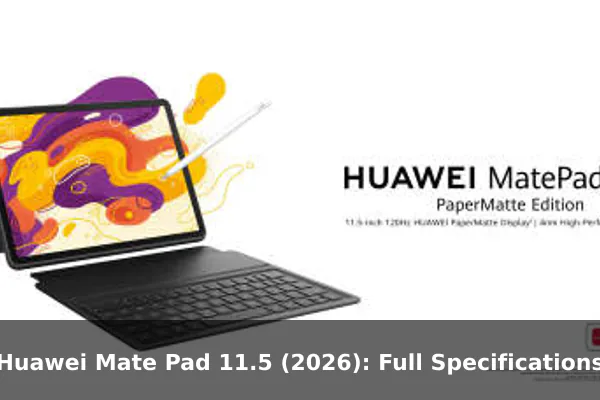
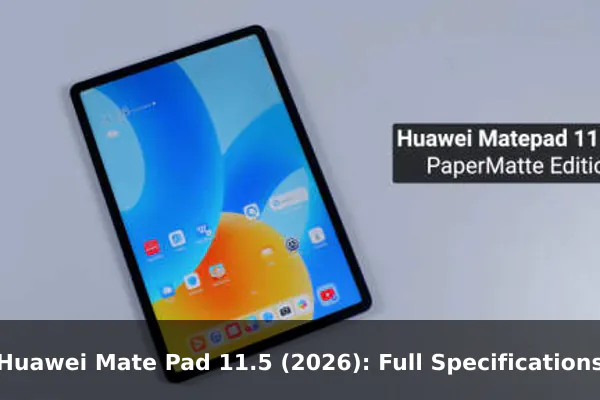
The 255 ppi density is sharp enough for text-heavy use, and the 120Hz refresh rate should make scrolling, stylus input, and general navigation feel smoother than a standard 60Hz panel. Huawei also lists an optional PaperMatte Edition display, which is likely the more interesting version for readers, students, and writers who prefer a reduced-glare surface. Huawei’s official product page emphasizes eye-comfort and study use for this generation, while the official specifications page confirms the 11.5-inch class display, 2456 x 1600 resolution, and HarmonyOS 5.1 software scope.
Performance and Hardware
The tablet runs on the Kirin T82B chipset with a 12-core CPU arrangement listed as 2×2.29 GHz, 6×2.05 GHz, and 4×1.31 GHz, paired with a Maleoon 920c GPU. That specification suggests a platform designed for efficient multitasking, media playback, learning apps, web work, and casual gaming rather than high-end graphics workloads.
For everyday tablet use, the most meaningful spec is the RAM. The 8GB RAM versions should be enough for browsing, streaming, reading, notes, and light productivity. The 12GB RAM version is the better fit for users who often keep multiple apps open, work with large documents, or use split-screen features heavily. Because the storage is fixed and there is no card slot, the 256GB versions are the safer long-term choice.
Camera Setup
The Mate Pad 11.5 (2026) keeps the camera system simple. The rear camera is a single 13 MP wide camera with autofocus, f/1.8 aperture, panorama support, and 1080p video recording at 30 fps. That is enough for scanning documents, quick reference photos, classroom boards, and basic video capture, but it is not a camera-focused device.
The front camera is more relevant for most tablet buyers. The listed 8 MP ultrawide selfie camera with a 105-degree field of view is useful for video calls, online classes, and meetings because it can fit more of the user or surrounding scene into frame. Both front and rear cameras are limited to 1080p at 30 fps, which is acceptable for communication and documentation but not aimed at creators who need high-resolution video capture.
Battery and Charging
Battery capacity is a major strength. The 10100 mAh battery gives the Mate Pad 11.5 (2026) the kind of capacity expected from a full-size tablet, not a compact media slate. Huawei’s official page also highlights the large battery and 40W charging as key selling points, which fits the tablet’s role as a study, work, and entertainment device.
The charging setup includes 40W wired charging and 5W reverse wired charging. The 40W speed is useful because large tablet batteries can feel slow to refill when paired with basic charging. Reverse wired charging is not a headline feature, but it can be practical in emergencies for topping up small accessories or another device through USB Type-C.
Software and Productivity
HarmonyOS 5.1 is the listed operating system, and that matters for buyers already using Huawei phones, laptops, or accessories. The software experience is likely to be strongest inside Huawei’s own ecosystem, where device sharing, accessory pairing, notes, learning tools, and multi-screen workflows can feel more integrated.
For users outside that ecosystem, the key consideration is app availability. The Mate Pad 11.5 (2026) should be judged less like a generic Android tablet and more like a Huawei productivity tablet. It can still be a strong fit for note-taking, reading, video playback, browser-based work, and education apps, but buyers should check that their required apps and services are supported in their region before choosing it.
Connectivity and Audio
This is a Wi-Fi-only tablet with no cellular connectivity, no SIM slot, no NFC, no radio, and no dedicated positioning hardware in the source data. That limitation is important: the Mate Pad 11.5 (2026) is best used at home, school, the office, or anywhere reliable Wi-Fi is available. It is not designed for users who need always-on mobile data.
The wireless feature set includes Wi-Fi 802.11 a/b/g/n/ac/6 dual-band and Bluetooth 5.2 with A2DP, LE, and L2HC support. Wired connectivity is handled by USB Type-C 2.0 with OTG, plus a magnetic accessory connector. Audio is handled by four stereo speakers, which should make the tablet more enjoyable for video, calls, and study content. There is no 3.5mm headphone jack, so wired audio users will need USB-C audio or wireless headphones.
Who Should Buy It?
The Huawei Mate Pad 11.5 (2026) is best suited to students, readers, note-takers, families, and budget-conscious buyers who want a large display and long battery life more than cellular data or premium cameras. The 3:2 screen ratio, stylus support, large battery, and quad speakers make it a good everyday tablet for study, documents, media, and light productivity.
It is less suitable for buyers who need mobile network access, expandable storage, GPS-style navigation, Google-centric workflows, or advanced camera performance. If your priority is a low-cost tablet with a spacious screen and practical hardware, this model makes sense. If you need a travel tablet that works independently from Wi-Fi, a cellular model from another lineup will be the better match.
Conclusion
The Huawei Mate Pad 11.5 (2026) is a focused, affordable HarmonyOS tablet with a sharp 120Hz 11.5-inch display, slim aluminum design, stylus support, strong battery capacity, and useful storage options. Its biggest compromises are the lack of cellular connectivity, no microSD slot, no headphone jack, and a basic camera system. Recommended for buyers who want a value-focused Wi-Fi tablet for study, reading, notes, and entertainment.
References
- Huawei China – HUAWEI MatePad 11.5 2026 Specifications – Primary official specifications page for dimensions, display, chipset variants, memory, cameras, battery, charging, connectivity, sensors, audio, and in-box contents.
- Huawei China – HUAWEI MatePad 11.5 2026 Product Page – Official product overview with feature claims, display details, battery and charging claims, color options, certifications, and footnotes from Huawei.
- Huawei China Support – HUAWEI MatePad 11.5 2026 User Guide – Official support documentation confirming supported 2026 model variants and HarmonyOS 5.1 product scope, useful for cross-checking model numbers and software references.
- Huawei Vmall / Huawei Mall (vmall.com) – Official Huawei sales channel for China, useful for verifying available RAM/storage configurations, launch availability, pricing, colors, and retail bundle details if the product listing is accessible.
- Notebookcheck – Huawei MatePad 11.5 (2026) Launch Coverage – Reputable technology publication summarizing launch timing, China availability, pricing, and key specifications; useful as a secondary source after Huawei's official pages.
